

Box 5.1 (continued)
gentle shaking. The resin was then transferred into a column and washed four times with buffer
containing 50 mM Tris/HCl, pH 8, 5 mM MgCl 2 , 10 mgÁL
À1 PMSF, 1 mM DTT, and 10% glycerol,
containing either 0.01% DDM (DDM sample) or no surfactant (A8-35 one). Elution was performed
with the same buffers supplemented with 10 mM of glutathione. The elution fractions were
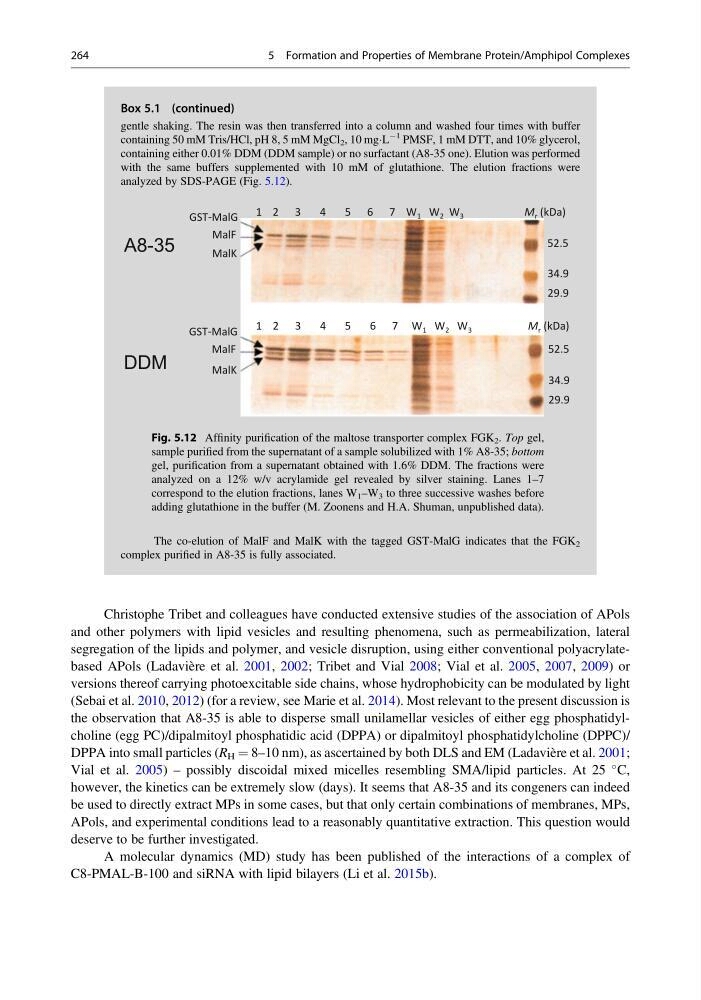
analyzed by SDS-PAGE (Fig. 5.12).
The co-elution of MalF and MalK with the tagged GST-MalG indicates that the FGK 2
complex purified in A8-35 is fully associated.
Christophe Tribet and colleagues have conducted extensive studies of the association of APols
and other polymers with lipid vesicles and resulting phenomena, such as permeabilization, lateral
segregation of the lipids and polymer, and vesicle disruption, using either conventional polyacrylatebased APols (Ladavière et al. 2001, 2002; Tribet and Vial 2008; Vial et al. 2005, 2007, 2009) or
versions thereof carrying photoexcitable side chains, whose hydrophobicity can be modulated by light
(Sebai et al. 2010, 2012) (for a review, see Marie et al. 2014). Most relevant to the present discussion is
the observation that A8-35 is able to disperse small unilamellar vesicles of either egg phosphatidylcholine (egg PC)/dipalmitoyl phosphatidic acid (DPPA) or dipalmitoyl phosphatidylcholine (DPPC)/
DPPA into small particles (R H ¼ 8–10 nm), as ascertained by both DLS and EM (Ladavière et al. 2001;
Vial et al. 2005) – possibly discoidal mixed micelles resembling SMA/lipid particles. At 25
C,
however, the kinetics can be extremely slow (days). It seems that A8-35 and its congeners can indeed
be used to directly extract MPs in some cases, but that only certain combinations of membranes, MPs,
APols, and experimental conditions lead to a reasonably quantitative extraction. This question would
deserve to be further investigated.
A molecular dynamics (MD) study has been published of the interactions of a complex of
C8-PMAL-B-100 and siRNA with lipid bilayers (Li et al. 2015b).
29.9
34.9
52.5
29.9
34.9
52.5
1 2 3
4
5
6 7 W 1 W 2 W 3
M r (kDa)
1 2 3
4
5 6 7 W 1 W 2 W 3
M r (kDa)
GST‐MalG
MalF
MalK
GST‐MalG
MalF
MalK
A8-35
DDM
Fig. 5.12 Affinity purification of the maltose transporter complex FGK 2 . Top gel,
sample purified from the supernatant of a sample solubilized with 1% A8-35; bottom
gel, purification from a supernatant obtained with 1.6% DDM. The fractions were
analyzed on a 12% w/v acrylamide gel revealed by silver staining. Lanes 1–7
correspond to the elution fractions, lanes W 1 –W 3 to three successive washes before
adding glutathione in the buffer (M. Zoonens and H.A. Shuman, unpublished data).
264
5 Formation and Properties of Membrane Protein/Amphipol Complexes
gentle shaking. The resin was then transferred into a column and washed four times with buffer
containing 50 mM Tris/HCl, pH 8, 5 mM MgCl 2 , 10 mgÁL
À1 PMSF, 1 mM DTT, and 10% glycerol,
containing either 0.01% DDM (DDM sample) or no surfactant (A8-35 one). Elution was performed
with the same buffers supplemented with 10 mM of glutathione. The elution fractions were
analyzed by SDS-PAGE (Fig. 5.12).
The co-elution of MalF and MalK with the tagged GST-MalG indicates that the FGK 2
complex purified in A8-35 is fully associated.
Christophe Tribet and colleagues have conducted extensive studies of the association of APols
and other polymers with lipid vesicles and resulting phenomena, such as permeabilization, lateral
segregation of the lipids and polymer, and vesicle disruption, using either conventional polyacrylatebased APols (Ladavière et al. 2001, 2002; Tribet and Vial 2008; Vial et al. 2005, 2007, 2009) or
versions thereof carrying photoexcitable side chains, whose hydrophobicity can be modulated by light
(Sebai et al. 2010, 2012) (for a review, see Marie et al. 2014). Most relevant to the present discussion is
the observation that A8-35 is able to disperse small unilamellar vesicles of either egg phosphatidylcholine (egg PC)/dipalmitoyl phosphatidic acid (DPPA) or dipalmitoyl phosphatidylcholine (DPPC)/
DPPA into small particles (R H ¼ 8–10 nm), as ascertained by both DLS and EM (Ladavière et al. 2001;
Vial et al. 2005) – possibly discoidal mixed micelles resembling SMA/lipid particles. At 25
C,
however, the kinetics can be extremely slow (days). It seems that A8-35 and its congeners can indeed
be used to directly extract MPs in some cases, but that only certain combinations of membranes, MPs,
APols, and experimental conditions lead to a reasonably quantitative extraction. This question would
deserve to be further investigated.
A molecular dynamics (MD) study has been published of the interactions of a complex of
C8-PMAL-B-100 and siRNA with lipid bilayers (Li et al. 2015b).
29.9
34.9
52.5
29.9
34.9
52.5
1 2 3
4
5
6 7 W 1 W 2 W 3
M r (kDa)
1 2 3
4
5 6 7 W 1 W 2 W 3
M r (kDa)
GST‐MalG
MalF
MalK
GST‐MalG
MalF
MalK
A8-35
DDM
Fig. 5.12 Affinity purification of the maltose transporter complex FGK 2 . Top gel,
sample purified from the supernatant of a sample solubilized with 1% A8-35; bottom
gel, purification from a supernatant obtained with 1.6% DDM. The fractions were
analyzed on a 12% w/v acrylamide gel revealed by silver staining. Lanes 1–7
correspond to the elution fractions, lanes W 1 –W 3 to three successive washes before
adding glutathione in the buffer (M. Zoonens and H.A. Shuman, unpublished data).
264
5 Formation and Properties of Membrane Protein/Amphipol Complexes