

physically eliminated by dialysis, adsorption onto Bio-Beads, ultrafiltration, gel filtration, sucrose
gradient centrifugation, etc. Note that the quick exchange afforded by dilution can be preferable to the
slow one that takes place when using Bio-Beads to remove the detergent, without first diluting it. Such
is the case when BR is transferred from OTG to A8-75: its integrity is preserved after dilution followed
by Bio-Beads, whereas it denatures when using Bio-Beads without dilution (M. Zoonens, personal
communication). This is likely due to a destabilizing effect of A8-75/OTG mixtures, to which BR is
exposed for an extended period of time in the second case, but not in the first one.
For low-CMC detergents, however, the total concentration of detergent (bound + free) is
generally too much above the CMC for dilution to be very practical, the resulting samples being too
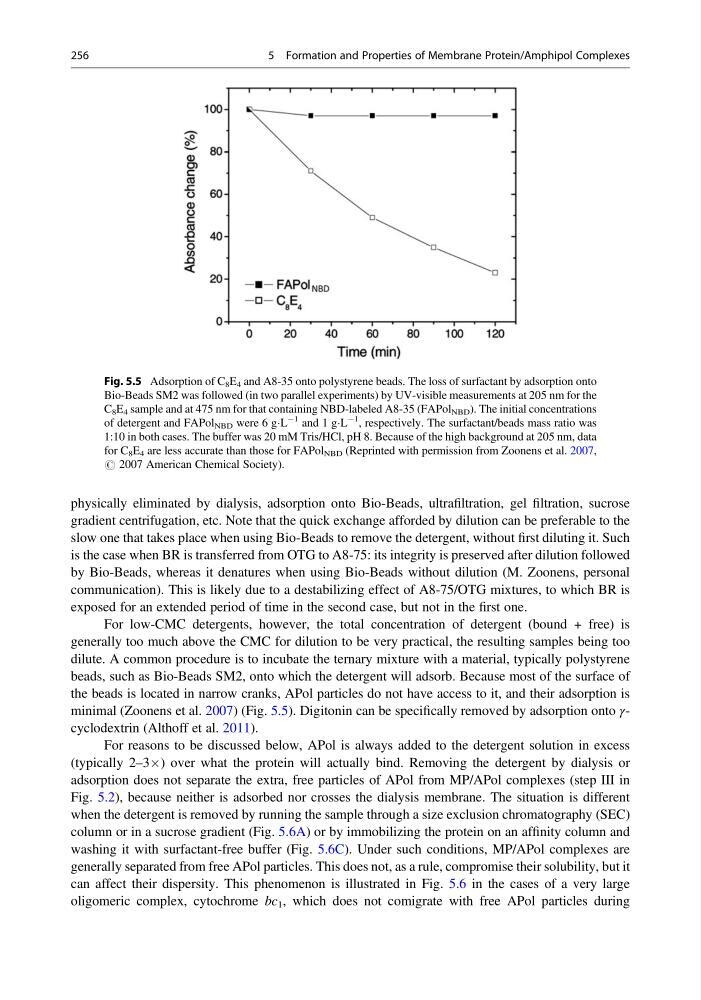
dilute. A common procedure is to incubate the ternary mixture with a material, typically polystyrene
beads, such as Bio-Beads SM2, onto which the detergent will adsorb. Because most of the surface of
the beads is located in narrow cranks, APol particles do not have access to it, and their adsorption is
minimal (Zoonens et al. 2007) (Fig. 5.5). Digitonin can be specifically removed by adsorption onto γcyclodextrin (Althoff et al. 2011).
For reasons to be discussed below, APol is always added to the detergent solution in excess
(typically 2–3Â) over what the protein will actually bind. Removing the detergent by dialysis or
adsorption does not separate the extra, free particles of APol from MP/APol complexes (step III in
Fig. 5.2), because neither is adsorbed nor crosses the dialysis membrane. The situation is different
when the detergent is removed by running the sample through a size exclusion chromatography (SEC)
column or in a sucrose gradient (Fig. 5.6A) or by immobilizing the protein on an affinity column and
washing it with surfactant-free buffer (Fig. 5.6C). Under such conditions, MP/APol complexes are
generally separated from free APol particles. This does not, as a rule, compromise their solubility, but it
can affect their dispersity. This phenomenon is illustrated in Fig. 5.6 in the cases of a very large
oligomeric complex, cytochrome bc 1 , which does not comigrate with free APol particles during
Fig. 5.5 Adsorption of C 8 E 4 and A8-35 onto polystyrene beads. The loss of surfactant by adsorption onto
Bio-Beads SM2 was followed (in two parallel experiments) by UV-visible measurements at 205 nm for the
C 8 E 4 sample and at 475 nm for that containing NBD-labeled A8-35 (FAPol NBD ). The initial concentrations
of detergent and FAPol NBD were 6 gÁL
À1 and 1 gÁL
À1
, respectively. The surfactant/beads mass ratio was
1:10 in both cases. The buffer was 20 mM Tris/HCl, pH 8. Because of the high background at 205 nm, data
for C 8 E 4 are less accurate than those for FAPol NBD (Reprinted with permission from Zoonens et al. 2007,
# 2007 American Chemical Society).
256
5 Formation and Properties of Membrane Protein/Amphipol Complexes
gradient centrifugation, etc. Note that the quick exchange afforded by dilution can be preferable to the
slow one that takes place when using Bio-Beads to remove the detergent, without first diluting it. Such
is the case when BR is transferred from OTG to A8-75: its integrity is preserved after dilution followed
by Bio-Beads, whereas it denatures when using Bio-Beads without dilution (M. Zoonens, personal
communication). This is likely due to a destabilizing effect of A8-75/OTG mixtures, to which BR is
exposed for an extended period of time in the second case, but not in the first one.
For low-CMC detergents, however, the total concentration of detergent (bound + free) is
generally too much above the CMC for dilution to be very practical, the resulting samples being too
dilute. A common procedure is to incubate the ternary mixture with a material, typically polystyrene
beads, such as Bio-Beads SM2, onto which the detergent will adsorb. Because most of the surface of
the beads is located in narrow cranks, APol particles do not have access to it, and their adsorption is
minimal (Zoonens et al. 2007) (Fig. 5.5). Digitonin can be specifically removed by adsorption onto γcyclodextrin (Althoff et al. 2011).
For reasons to be discussed below, APol is always added to the detergent solution in excess
(typically 2–3Â) over what the protein will actually bind. Removing the detergent by dialysis or
adsorption does not separate the extra, free particles of APol from MP/APol complexes (step III in
Fig. 5.2), because neither is adsorbed nor crosses the dialysis membrane. The situation is different
when the detergent is removed by running the sample through a size exclusion chromatography (SEC)
column or in a sucrose gradient (Fig. 5.6A) or by immobilizing the protein on an affinity column and
washing it with surfactant-free buffer (Fig. 5.6C). Under such conditions, MP/APol complexes are
generally separated from free APol particles. This does not, as a rule, compromise their solubility, but it
can affect their dispersity. This phenomenon is illustrated in Fig. 5.6 in the cases of a very large
oligomeric complex, cytochrome bc 1 , which does not comigrate with free APol particles during
Fig. 5.5 Adsorption of C 8 E 4 and A8-35 onto polystyrene beads. The loss of surfactant by adsorption onto
Bio-Beads SM2 was followed (in two parallel experiments) by UV-visible measurements at 205 nm for the
C 8 E 4 sample and at 475 nm for that containing NBD-labeled A8-35 (FAPol NBD ). The initial concentrations
of detergent and FAPol NBD were 6 gÁL
À1 and 1 gÁL
À1
, respectively. The surfactant/beads mass ratio was
1:10 in both cases. The buffer was 20 mM Tris/HCl, pH 8. Because of the high background at 205 nm, data
for C 8 E 4 are less accurate than those for FAPol NBD (Reprinted with permission from Zoonens et al. 2007,
# 2007 American Chemical Society).
256
5 Formation and Properties of Membrane Protein/Amphipol Complexes