

may improve as compared to that in pure detergent (see e.g. in § 5.6, Fig. 5.33, the case of the
sarcoplasmic calcium ATPase examined in Champeil et al. 2000).
In the second step (II ! III in Fig. 5.2), the detergent is removed from the mixture. It does not
seem that the chemical structure nor physical-chemical properties of the detergent pose any obstacle to
its removal: Table 5.1 lists 23 detergents and a few detergent mixtures from which MPs have been
successfully transferred to APols. Some of these detergents have high CMCs (OG, CHAPS, etc.), some
very low ones (digitonin, LMNG, etc.). Detergents that have been used more than once are listed in
Table 5.3, along with the methods used for their removal. Whereas it seems that any detergent can be
used, not any method of removal will work with any detergent. Detergents with a high CMC, for
instance, can be dialyzed away, whereas this process is very slow with low-CMC ones, since only the
monomers, which often represent a very small fraction of the detergent present in the preparation, can
cross the dialysis membrane. In practice, dialysis is mostly used in a second step, after the concentration of the detergent has been lowered under its CMC, under which circumstances its monomers
distribute between the aqueous phase and the APol belts and particles as a function of their partition
coefficient and the volume of each phase (for an early analysis of this phenomenon, using membrane
fragments, see Brotherus et al. 1979).
When starting from a MP in a solution of detergent sufficiently close to its CMC, a useful
technique is to dilute the MP/APol/detergent mixture with surfactant-free buffer well under the CMC
of the detergent. This does not physically remove the detergent from the sample, but it displaces it from
the protein-bound surfactant belt: if the final concentration of free detergent is 1/20 the CMC, for
instance, the concentration of detergent in the belt will be in a volume ratio of ~1:19 to that of the APol
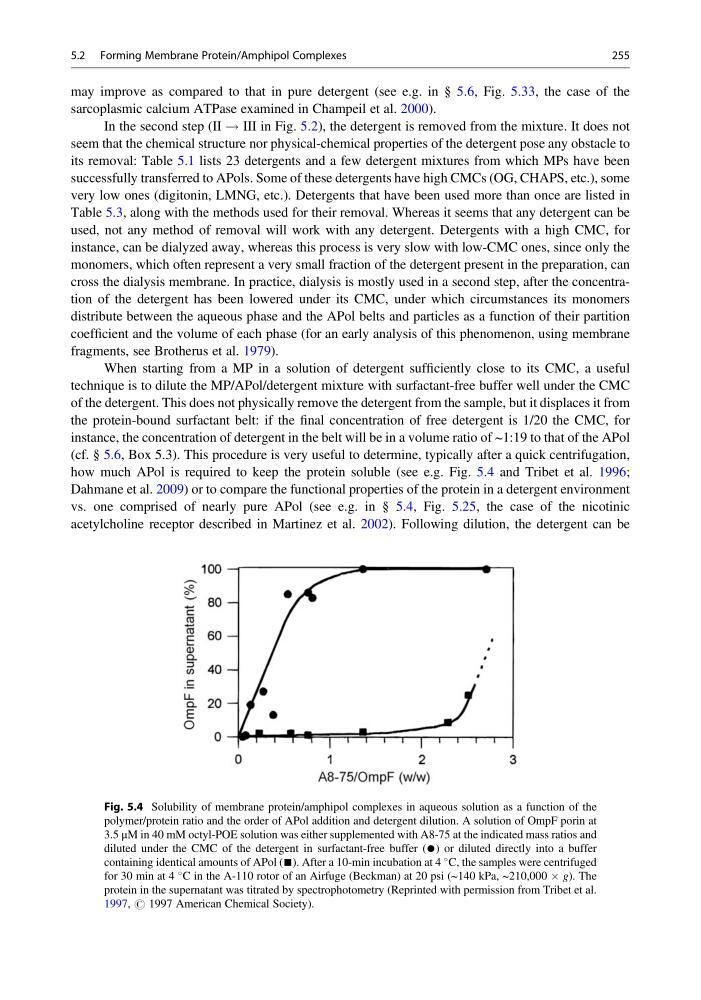
(cf. § 5.6, Box 5.3). This procedure is very useful to determine, typically after a quick centrifugation,
how much APol is required to keep the protein soluble (see e.g. Fig. 5.4 and Tribet et al. 1996;
Dahmane et al. 2009) or to compare the functional properties of the protein in a detergent environment
vs. one comprised of nearly pure APol (see e.g. in § 5.4, Fig. 5.25, the case of the nicotinic
acetylcholine receptor described in Martinez et al. 2002). Following dilution, the detergent can be
Fig. 5.4 Solubility of membrane protein/amphipol complexes in aqueous solution as a function of the
polymer/protein ratio and the order of APol addition and detergent dilution. A solution of OmpF porin at
3.5 μM in 40 mM octyl-POE solution was either supplemented with A8-75 at the indicated mass ratios and
diluted under the CMC of the detergent in surfactant-free buffer (●) or diluted directly into a buffer
containing identical amounts of APol (■). After a 10-min incubation at 4
C, the samples were centrifuged
for 30 min at 4
C in the A-110 rotor of an Airfuge (Beckman) at 20 psi (~140 kPa, ~210,000 Â g). The
protein in the supernatant was titrated by spectrophotometry (Reprinted with permission from Tribet et al.
1997, # 1997 American Chemical Society).
5.2 Forming Membrane Protein/Amphipol Complexes
255
sarcoplasmic calcium ATPase examined in Champeil et al. 2000).
In the second step (II ! III in Fig. 5.2), the detergent is removed from the mixture. It does not
seem that the chemical structure nor physical-chemical properties of the detergent pose any obstacle to
its removal: Table 5.1 lists 23 detergents and a few detergent mixtures from which MPs have been
successfully transferred to APols. Some of these detergents have high CMCs (OG, CHAPS, etc.), some
very low ones (digitonin, LMNG, etc.). Detergents that have been used more than once are listed in
Table 5.3, along with the methods used for their removal. Whereas it seems that any detergent can be
used, not any method of removal will work with any detergent. Detergents with a high CMC, for
instance, can be dialyzed away, whereas this process is very slow with low-CMC ones, since only the
monomers, which often represent a very small fraction of the detergent present in the preparation, can
cross the dialysis membrane. In practice, dialysis is mostly used in a second step, after the concentration of the detergent has been lowered under its CMC, under which circumstances its monomers
distribute between the aqueous phase and the APol belts and particles as a function of their partition
coefficient and the volume of each phase (for an early analysis of this phenomenon, using membrane
fragments, see Brotherus et al. 1979).
When starting from a MP in a solution of detergent sufficiently close to its CMC, a useful
technique is to dilute the MP/APol/detergent mixture with surfactant-free buffer well under the CMC
of the detergent. This does not physically remove the detergent from the sample, but it displaces it from
the protein-bound surfactant belt: if the final concentration of free detergent is 1/20 the CMC, for
instance, the concentration of detergent in the belt will be in a volume ratio of ~1:19 to that of the APol
(cf. § 5.6, Box 5.3). This procedure is very useful to determine, typically after a quick centrifugation,
how much APol is required to keep the protein soluble (see e.g. Fig. 5.4 and Tribet et al. 1996;
Dahmane et al. 2009) or to compare the functional properties of the protein in a detergent environment
vs. one comprised of nearly pure APol (see e.g. in § 5.4, Fig. 5.25, the case of the nicotinic
acetylcholine receptor described in Martinez et al. 2002). Following dilution, the detergent can be
Fig. 5.4 Solubility of membrane protein/amphipol complexes in aqueous solution as a function of the
polymer/protein ratio and the order of APol addition and detergent dilution. A solution of OmpF porin at
3.5 μM in 40 mM octyl-POE solution was either supplemented with A8-75 at the indicated mass ratios and
diluted under the CMC of the detergent in surfactant-free buffer (●) or diluted directly into a buffer
containing identical amounts of APol (■). After a 10-min incubation at 4
C, the samples were centrifuged
for 30 min at 4
C in the A-110 rotor of an Airfuge (Beckman) at 20 psi (~140 kPa, ~210,000 Â g). The
protein in the supernatant was titrated by spectrophotometry (Reprinted with permission from Tribet et al.
1997, # 1997 American Chemical Society).
5.2 Forming Membrane Protein/Amphipol Complexes
255