

In the ternary mixture (stage II in Fig. 5.2), detergent and APol mix about ideally, both in the free
particles and at the surface of the protein (Zoonens et al. 2007; Tribet et al. 2009). The critical
aggregation concentration (CAC) of APols is so low (~0.002 gÁL
À1 for A8-35 (Giusti et al. 2012),
possibly lower for non-ionic APols; see Chap. 4, § 4.3.1.1) that the concentration of free APol
molecules is negligible. Because the monomeric detergent in the aqueous phase is in equilibrium
with that in the mixed particles, where it is diluted by the APol, its chemical potential is lower than in a
pure detergent solution, and its concentration is expected to drop. One can estimate, for instance, that it
will be about half the CMC if the particles comprise about equal volumes of APol and detergent, as
represented in Fig. 5.2 (see § 5.6, Box 5.3). This actually depends on detergent/detergent vs. detergent/
APol interactions in the particles and may be more complex, for instance, for a charged detergent
mixed with a non-ionic APol. As will be discussed in § 5.6, the function of the protein may be affected
by being transferred from a pure detergent to a mixed detergent/APol environment, and its stability
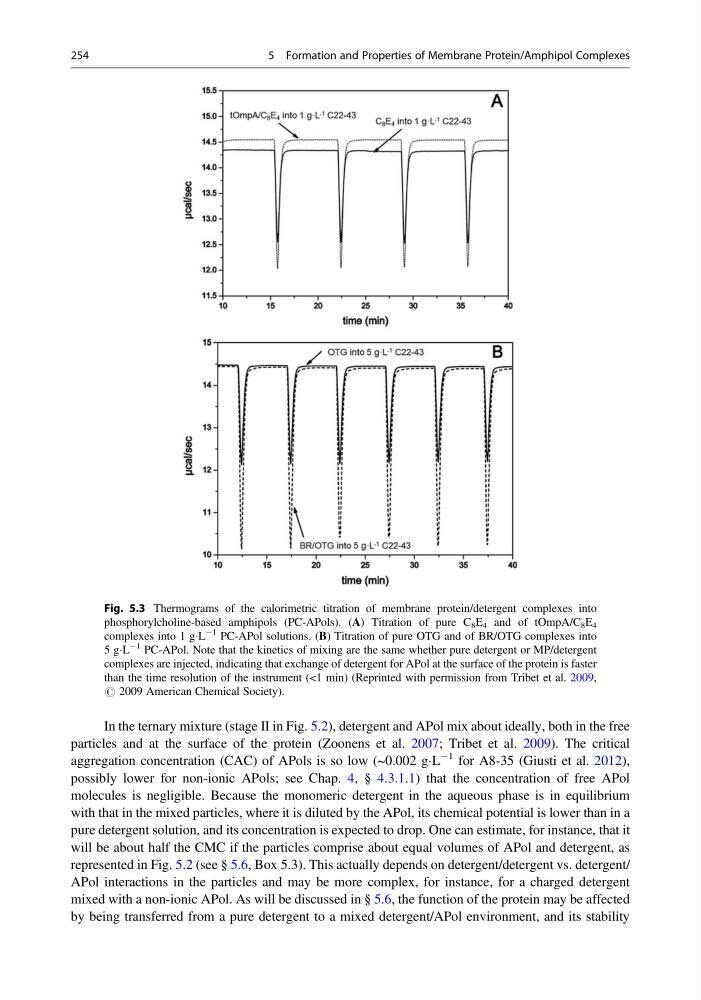
Fig. 5.3 Thermograms of the calorimetric titration of membrane protein/detergent complexes into
phosphorylcholine-based amphipols (PC-APols). (A) Titration of pure C 8 E 4 and of tOmpA/C 8 E 4
complexes into 1 gÁL
À1 PC-APol solutions. (B) Titration of pure OTG and of BR/OTG complexes into
5 gÁL
À1 PC-APol. Note that the kinetics of mixing are the same whether pure detergent or MP/detergent
complexes are injected, indicating that exchange of detergent for APol at the surface of the protein is faster
than the time resolution of the instrument (<1 min) (Reprinted with permission from Tribet et al. 2009,
# 2009 American Chemical Society).
254
5 Formation and Properties of Membrane Protein/Amphipol Complexes
particles and at the surface of the protein (Zoonens et al. 2007; Tribet et al. 2009). The critical
aggregation concentration (CAC) of APols is so low (~0.002 gÁL
À1 for A8-35 (Giusti et al. 2012),
possibly lower for non-ionic APols; see Chap. 4, § 4.3.1.1) that the concentration of free APol
molecules is negligible. Because the monomeric detergent in the aqueous phase is in equilibrium
with that in the mixed particles, where it is diluted by the APol, its chemical potential is lower than in a
pure detergent solution, and its concentration is expected to drop. One can estimate, for instance, that it
will be about half the CMC if the particles comprise about equal volumes of APol and detergent, as
represented in Fig. 5.2 (see § 5.6, Box 5.3). This actually depends on detergent/detergent vs. detergent/
APol interactions in the particles and may be more complex, for instance, for a charged detergent
mixed with a non-ionic APol. As will be discussed in § 5.6, the function of the protein may be affected
by being transferred from a pure detergent to a mixed detergent/APol environment, and its stability
Fig. 5.3 Thermograms of the calorimetric titration of membrane protein/detergent complexes into
phosphorylcholine-based amphipols (PC-APols). (A) Titration of pure C 8 E 4 and of tOmpA/C 8 E 4
complexes into 1 gÁL
À1 PC-APol solutions. (B) Titration of pure OTG and of BR/OTG complexes into
5 gÁL
À1 PC-APol. Note that the kinetics of mixing are the same whether pure detergent or MP/detergent
complexes are injected, indicating that exchange of detergent for APol at the surface of the protein is faster
than the time resolution of the instrument (<1 min) (Reprinted with permission from Tribet et al. 2009,
# 2009 American Chemical Society).
254
5 Formation and Properties of Membrane Protein/Amphipol Complexes