

The duration of the incubation seems to have only limited effects on the outcome of the transfer
procedure (Tribet et al. 1997). Two points, however, may be worth keeping in mind. First, in many
cases, the mixture also contains lipids, whose rebinding to the protein upon diluting the detergent with
APol (§ 5.3.1.2; see e.g. Martinez et al. 2002; Dahmane et al. 2013) may be slower than the mixing of
detergent and APol. Second, it is essential that APol be added before the detergent is removed: direct
dilution of a MP in detergent solution into an APol solution leads to the formation of aggregates
(Fig. 5.4), indicating that, upon dilution of the detergent under its CMC in the presence of APol,
protein/protein contacts form more rapidly than protein/APol ones and that the APol is inefficient
(or slow) at dissociating the resulting aggregates (Tribet et al. 1997).
Extracting a membrane protein with a detergent and transferring it to an amphipol
(# 2018 by Francis Haraux)
Detergent monomers
Detergent
belt
Detergent
micelle
Mixed
belt
Mixed
particle
Amphipol
belt
Amphipol
particle
+ amphipol
- detergent
I
I I
III
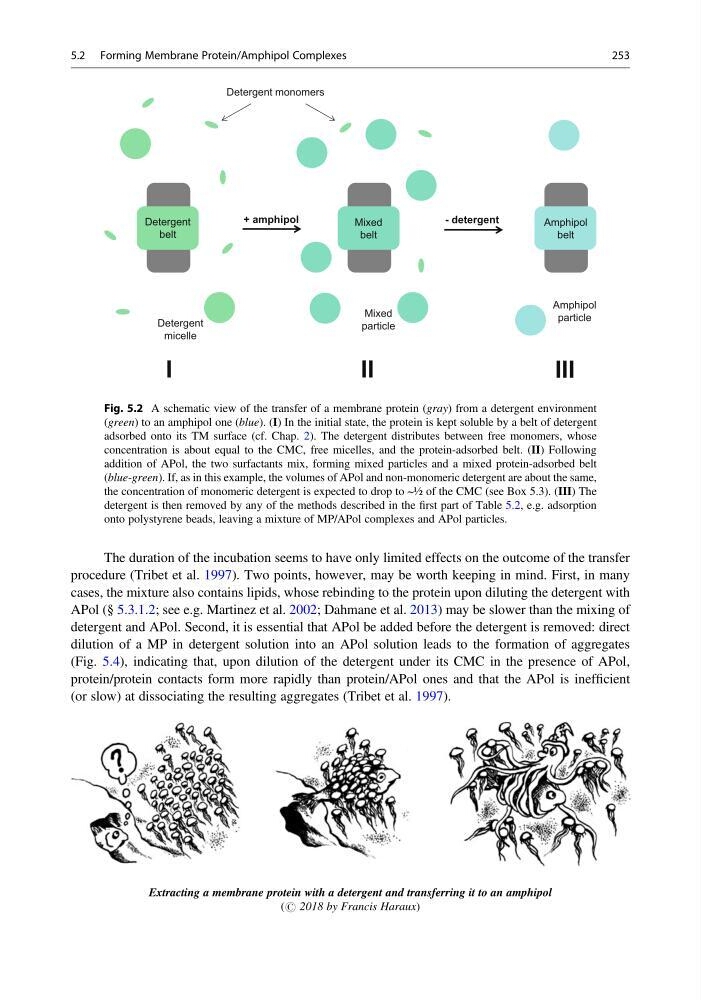
Fig. 5.2 A schematic view of the transfer of a membrane protein (gray) from a detergent environment
(green) to an amphipol one (blue). (I) In the initial state, the protein is kept soluble by a belt of detergent
adsorbed onto its TM surface (cf. Chap. 2). The detergent distributes between free monomers, whose
concentration is about equal to the CMC, free micelles, and the protein-adsorbed belt. (II) Following
addition of APol, the two surfactants mix, forming mixed particles and a mixed protein-adsorbed belt
(blue-green). If, as in this example, the volumes of APol and non-monomeric detergent are about the same,
the concentration of monomeric detergent is expected to drop to ~½ of the CMC (see Box 5.3). (III) The
detergent is then removed by any of the methods described in the first part of Table 5.2, e.g. adsorption
onto polystyrene beads, leaving a mixture of MP/APol complexes and APol particles.
5.2 Forming Membrane Protein/Amphipol Complexes
253
procedure (Tribet et al. 1997). Two points, however, may be worth keeping in mind. First, in many
cases, the mixture also contains lipids, whose rebinding to the protein upon diluting the detergent with
APol (§ 5.3.1.2; see e.g. Martinez et al. 2002; Dahmane et al. 2013) may be slower than the mixing of
detergent and APol. Second, it is essential that APol be added before the detergent is removed: direct
dilution of a MP in detergent solution into an APol solution leads to the formation of aggregates
(Fig. 5.4), indicating that, upon dilution of the detergent under its CMC in the presence of APol,
protein/protein contacts form more rapidly than protein/APol ones and that the APol is inefficient
(or slow) at dissociating the resulting aggregates (Tribet et al. 1997).
Extracting a membrane protein with a detergent and transferring it to an amphipol
(# 2018 by Francis Haraux)
Detergent monomers
Detergent
belt
Detergent
micelle
Mixed
belt
Mixed
particle
Amphipol
belt
Amphipol
particle
+ amphipol
- detergent
I
I I
III
Fig. 5.2 A schematic view of the transfer of a membrane protein (gray) from a detergent environment
(green) to an amphipol one (blue). (I) In the initial state, the protein is kept soluble by a belt of detergent
adsorbed onto its TM surface (cf. Chap. 2). The detergent distributes between free monomers, whose
concentration is about equal to the CMC, free micelles, and the protein-adsorbed belt. (II) Following
addition of APol, the two surfactants mix, forming mixed particles and a mixed protein-adsorbed belt
(blue-green). If, as in this example, the volumes of APol and non-monomeric detergent are about the same,
the concentration of monomeric detergent is expected to drop to ~½ of the CMC (see Box 5.3). (III) The
detergent is then removed by any of the methods described in the first part of Table 5.2, e.g. adsorption
onto polystyrene beads, leaving a mixture of MP/APol complexes and APol particles.
5.2 Forming Membrane Protein/Amphipol Complexes
253