

The most widely used route to date has been to start from a detergent solution of the target MP –
either in a purified form or not – and replace the detergent belt that keeps it soluble (Chap. 2) with an
APol one. A standard procedure is described in § 5.9, Protocol 5.1. As in the preceding chapter, we will
start with reviewing what has been established using A8-35, by far the most extensively studied APol,
and then point out what is known of the similarities and differences with other types of APols.
5.2.1
Transferring Native Membrane Proteins from Detergent Solution
to Amphipols
Starting from a native or refolded MP in non-denaturing detergent solution, the most usual procedure
for transfer to APols starts with forming ternary MP/detergent/APol complexes, which happens
spontaneously upon supplementing the MP/detergent solution with APols (Fig. 5.2, step I ! II).
Mixing of the surfactants, both at the surface of the protein and in protein-free mixed particles, takes
place very rapidly: within the time of injection in isothermal titration calorimetry (ITC) (Tribet et al.
2009; Fig. 5.3), in less than a second as measured in stopped-flow experiments (Zoonens et al. 2007;
see § 5.6, Fig. 5.40). It is usual, however, to let the mixture stand for 15–30 min before proceeding to
the removal of the detergent.
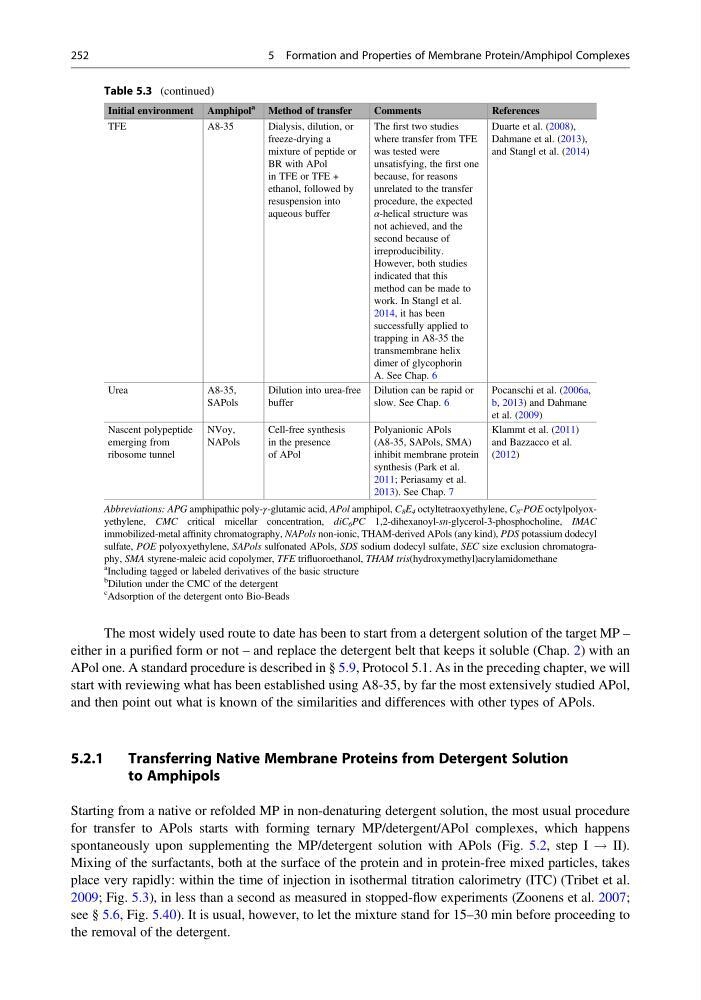
Table 5.3 (continued)
Initial environment Amphipol
a
Method of transfer
Comments
References
TFE
A8-35
Dialysis, dilution, or
freeze-drying a
mixture of peptide or
BR with APol
in TFE or TFE +
ethanol, followed by
resuspension into
aqueous buffer
The first two studies
where transfer from TFE
was tested were
unsatisfying, the first one
because, for reasons
unrelated to the transfer
procedure, the expected
α-helical structure was
not achieved, and the
second because of
irreproducibility.
However, both studies
indicated that this
method can be made to
work. In Stangl et al.
2014, it has been
successfully applied to
trapping in A8-35 the
transmembrane helix
dimer of glycophorin
A. See Chap. 6
Duarte et al. (2008),
Dahmane et al. (2013),
and Stangl et al. (2014)
Urea
A8-35,
SAPols
Dilution into urea-free
buffer
Dilution can be rapid or
slow. See Chap. 6
Pocanschi et al. (2006a,
b, 2013) and Dahmane
et al. (2009)
Nascent polypeptide
emerging from
ribosome tunnel
NVoy,
NAPols
Cell-free synthesis
in the presence
of APol
Polyanionic APols
(A8-35, SAPols, SMA)
inhibit membrane protein
synthesis (Park et al.
2011; Periasamy et al.
2013). See Chap. 7
Klammt et al. (2011)
and Bazzacco et al.
(2012)
Abbreviations: APG amphipathic poly-γ-glutamic acid, APol amphipol, C 8 E 4 octyltetraoxyethylene, C 8 -POE octylpolyoxyethylene, CMC critical micellar concentration, diC 6 PC 1,2-dihexanoyl-sn-glycerol-3-phosphocholine, IMAC
immobilized-metal affinity chromatography, NAPols non-ionic, THAM-derived APols (any kind), PDS potassium dodecyl
sulfate, POE polyoxyethylene, SAPols sulfonated APols, SDS sodium dodecyl sulfate, SEC size exclusion chromatography, SMA styrene-maleic acid copolymer, TFE trifluoroethanol, THAM tris(hydroxymethyl)acrylamidomethane
a
Including tagged or labeled derivatives of the basic structure
b
Dilution under the CMC of the detergent
c
Adsorption of the detergent onto Bio-Beads
252
5 Formation and Properties of Membrane Protein/Amphipol Complexes
either in a purified form or not – and replace the detergent belt that keeps it soluble (Chap. 2) with an
APol one. A standard procedure is described in § 5.9, Protocol 5.1. As in the preceding chapter, we will
start with reviewing what has been established using A8-35, by far the most extensively studied APol,
and then point out what is known of the similarities and differences with other types of APols.
5.2.1
Transferring Native Membrane Proteins from Detergent Solution
to Amphipols
Starting from a native or refolded MP in non-denaturing detergent solution, the most usual procedure
for transfer to APols starts with forming ternary MP/detergent/APol complexes, which happens
spontaneously upon supplementing the MP/detergent solution with APols (Fig. 5.2, step I ! II).
Mixing of the surfactants, both at the surface of the protein and in protein-free mixed particles, takes
place very rapidly: within the time of injection in isothermal titration calorimetry (ITC) (Tribet et al.
2009; Fig. 5.3), in less than a second as measured in stopped-flow experiments (Zoonens et al. 2007;
see § 5.6, Fig. 5.40). It is usual, however, to let the mixture stand for 15–30 min before proceeding to
the removal of the detergent.
Table 5.3 (continued)
Initial environment Amphipol
a
Method of transfer
Comments
References
TFE
A8-35
Dialysis, dilution, or
freeze-drying a
mixture of peptide or
BR with APol
in TFE or TFE +
ethanol, followed by
resuspension into
aqueous buffer
The first two studies
where transfer from TFE
was tested were
unsatisfying, the first one
because, for reasons
unrelated to the transfer
procedure, the expected
α-helical structure was
not achieved, and the
second because of
irreproducibility.
However, both studies
indicated that this
method can be made to
work. In Stangl et al.
2014, it has been
successfully applied to
trapping in A8-35 the
transmembrane helix
dimer of glycophorin
A. See Chap. 6
Duarte et al. (2008),
Dahmane et al. (2013),
and Stangl et al. (2014)
Urea
A8-35,
SAPols
Dilution into urea-free
buffer
Dilution can be rapid or
slow. See Chap. 6
Pocanschi et al. (2006a,
b, 2013) and Dahmane
et al. (2009)
Nascent polypeptide
emerging from
ribosome tunnel
NVoy,
NAPols
Cell-free synthesis
in the presence
of APol
Polyanionic APols
(A8-35, SAPols, SMA)
inhibit membrane protein
synthesis (Park et al.
2011; Periasamy et al.
2013). See Chap. 7
Klammt et al. (2011)
and Bazzacco et al.
(2012)
Abbreviations: APG amphipathic poly-γ-glutamic acid, APol amphipol, C 8 E 4 octyltetraoxyethylene, C 8 -POE octylpolyoxyethylene, CMC critical micellar concentration, diC 6 PC 1,2-dihexanoyl-sn-glycerol-3-phosphocholine, IMAC
immobilized-metal affinity chromatography, NAPols non-ionic, THAM-derived APols (any kind), PDS potassium dodecyl
sulfate, POE polyoxyethylene, SAPols sulfonated APols, SDS sodium dodecyl sulfate, SEC size exclusion chromatography, SMA styrene-maleic acid copolymer, TFE trifluoroethanol, THAM tris(hydroxymethyl)acrylamidomethane
a
Including tagged or labeled derivatives of the basic structure
b
Dilution under the CMC of the detergent
c
Adsorption of the detergent onto Bio-Beads
252
5 Formation and Properties of Membrane Protein/Amphipol Complexes