

As mentioned above, there are many ways to form MP/APol complexes. They fall into the
following categories:
(i) Transferring a native MP to APols from a detergent solution;
(ii) Folding a denatured MP or a peptide by transfer to APols;
(iii) Directly extracting native MPs from synthetic or natural membranes;
(iv) Expressing MPs in vitro and folding them in the presence of an APol and the absence of any
membrane.
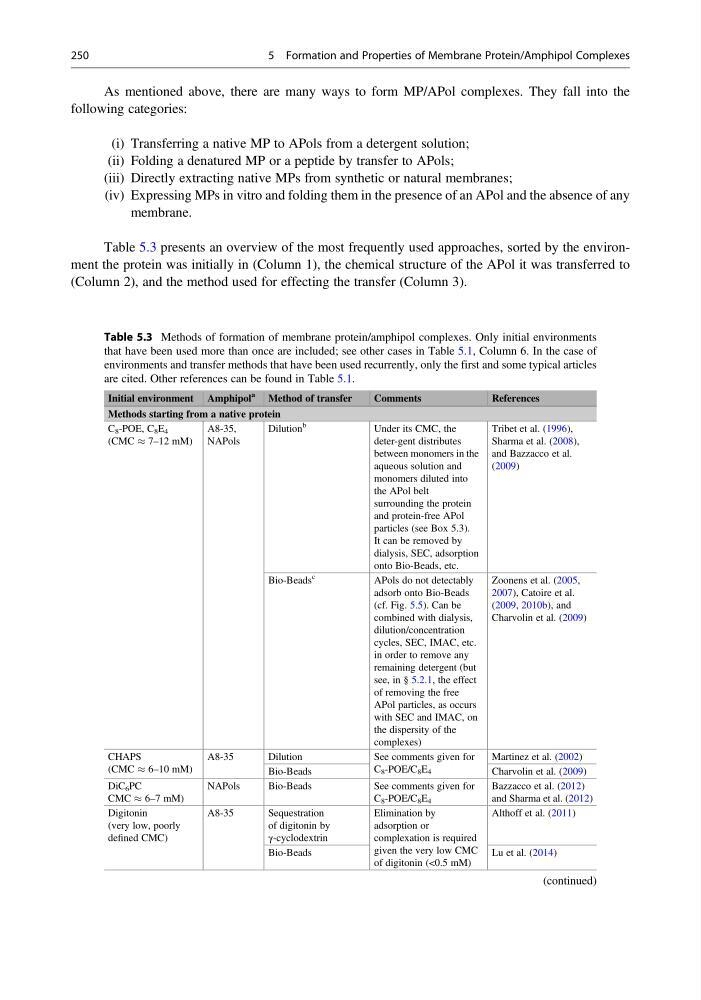
Table 5.3 presents an overview of the most frequently used approaches, sorted by the environment the protein was initially in (Column 1), the chemical structure of the APol it was transferred to
(Column 2), and the method used for effecting the transfer (Column 3).
Table 5.3 Methods of formation of membrane protein/amphipol complexes. Only initial environments
that have been used more than once are included; see other cases in Table 5.1, Column 6. In the case of
environments and transfer methods that have been used recurrently, only the first and some typical articles
are cited. Other references can be found in Table 5.1.
Initial environment Amphipol
a
Method of transfer
Comments
References
Methods starting from a native protein
C 8 -POE, C 8 E 4
(CMC % 7–12 mM)
A8-35,
NAPols
Dilution
b
Under its CMC, the
deter-gent distributes
between monomers in the
aqueous solution and
monomers diluted into
the APol belt
surrounding the protein
and protein-free APol
particles (see Box 5.3).
It can be removed by
dialysis, SEC, adsorption
onto Bio-Beads, etc.
Tribet et al. (1996),
Sharma et al. (2008),
and Bazzacco et al.
(2009)
Bio-Beads
c
APols do not detectably
adsorb onto Bio-Beads
(cf. Fig. 5.5). Can be
combined with dialysis,
dilution/concentration
cycles, SEC, IMAC, etc.
in order to remove any
remaining detergent (but
see, in § 5.2.1, the effect
of removing the free
APol particles, as occurs
with SEC and IMAC, on
the dispersity of the
complexes)
Zoonens et al. (2005,
2007), Catoire et al.
(2009, 2010b), and
Charvolin et al. (2009)
CHAPS
(CMC % 6–10 mM)
A8-35
Dilution
See comments given for
C 8 -POE/C 8 E 4
Martinez et al. (2002)
Bio-Beads
Charvolin et al. (2009)
DiC 6 PC
CMC % 6–7 mM)
NAPols
Bio-Beads
See comments given for
C 8 -POE/C 8 E 4
Bazzacco et al. (2012)
and Sharma et al. (2012)
Digitonin
(very low, poorly
defined CMC)
A8-35
Sequestration
of digitonin by
γ-cyclodextrin
Elimination by
adsorption or
complexation is required
given the very low CMC
of digitonin (<0.5 mM)
Althoff et al. (2011)
Bio-Beads
Lu et al. (2014)
(continued)
250
5 Formation and Properties of Membrane Protein/Amphipol Complexes
following categories:
(i) Transferring a native MP to APols from a detergent solution;
(ii) Folding a denatured MP or a peptide by transfer to APols;
(iii) Directly extracting native MPs from synthetic or natural membranes;
(iv) Expressing MPs in vitro and folding them in the presence of an APol and the absence of any
membrane.
Table 5.3 presents an overview of the most frequently used approaches, sorted by the environment the protein was initially in (Column 1), the chemical structure of the APol it was transferred to
(Column 2), and the method used for effecting the transfer (Column 3).
Table 5.3 Methods of formation of membrane protein/amphipol complexes. Only initial environments
that have been used more than once are included; see other cases in Table 5.1, Column 6. In the case of
environments and transfer methods that have been used recurrently, only the first and some typical articles
are cited. Other references can be found in Table 5.1.
Initial environment Amphipol
a
Method of transfer
Comments
References
Methods starting from a native protein
C 8 -POE, C 8 E 4
(CMC % 7–12 mM)
A8-35,
NAPols
Dilution
b
Under its CMC, the
deter-gent distributes
between monomers in the
aqueous solution and
monomers diluted into
the APol belt
surrounding the protein
and protein-free APol
particles (see Box 5.3).
It can be removed by
dialysis, SEC, adsorption
onto Bio-Beads, etc.
Tribet et al. (1996),
Sharma et al. (2008),
and Bazzacco et al.
(2009)
Bio-Beads
c
APols do not detectably
adsorb onto Bio-Beads
(cf. Fig. 5.5). Can be
combined with dialysis,
dilution/concentration
cycles, SEC, IMAC, etc.
in order to remove any
remaining detergent (but
see, in § 5.2.1, the effect
of removing the free
APol particles, as occurs
with SEC and IMAC, on
the dispersity of the
complexes)
Zoonens et al. (2005,
2007), Catoire et al.
(2009, 2010b), and
Charvolin et al. (2009)
CHAPS
(CMC % 6–10 mM)
A8-35
Dilution
See comments given for
C 8 -POE/C 8 E 4
Martinez et al. (2002)
Bio-Beads
Charvolin et al. (2009)
DiC 6 PC
CMC % 6–7 mM)
NAPols
Bio-Beads
See comments given for
C 8 -POE/C 8 E 4
Bazzacco et al. (2012)
and Sharma et al. (2012)
Digitonin
(very low, poorly
defined CMC)
A8-35
Sequestration
of digitonin by
γ-cyclodextrin
Elimination by
adsorption or
complexation is required
given the very low CMC
of digitonin (<0.5 mM)
Althoff et al. (2011)
Bio-Beads
Lu et al. (2014)
(continued)
250
5 Formation and Properties of Membrane Protein/Amphipol Complexes