

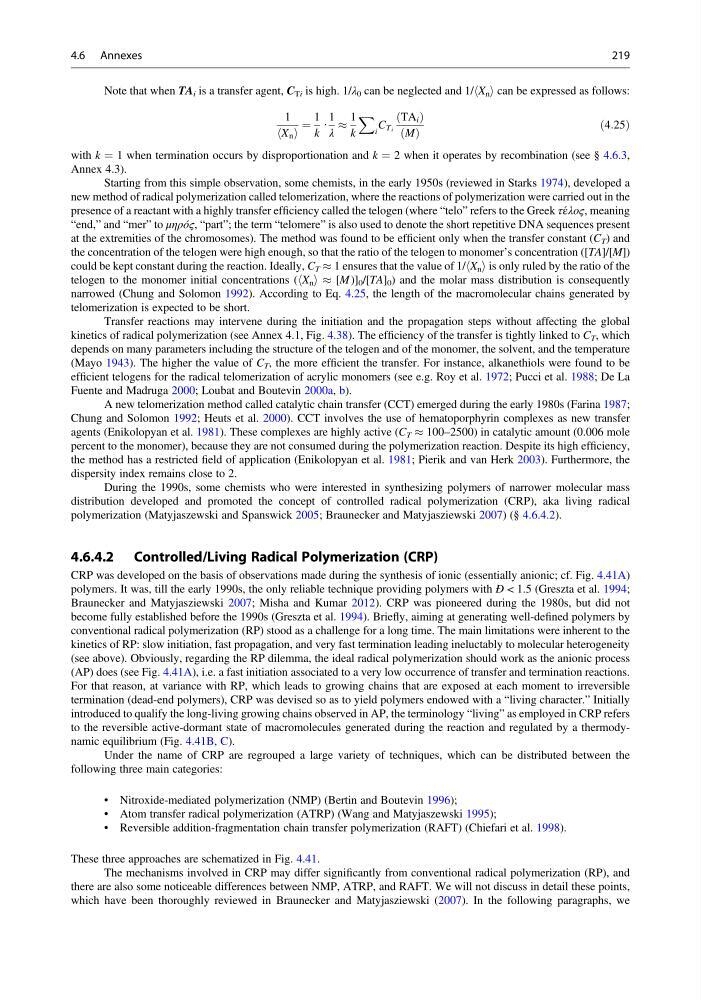
Note that when TA i is a transfer agent, C Ti is high. 1/λ 0 can be neglected and 1/hX n i can be expressed as follows:
1
X n
h i
¼
1
k
∙
1
λ
%
1
k
X
i
C Ti
TA i
ð
Þ
M
ð Þ
ð4:25Þ
with k ¼ 1 when termination occurs by disproportionation and k ¼ 2 when it operates by recombination (see § 4.6.3,
Annex 4.3).
Starting from this simple observation, some chemists, in the early 1950s (reviewed in Starks 1974), developed a
new method of radical polymerization called telomerization, where the reactions of polymerization were carried out in the
presence of a reactant with a highly transfer efficiency called the telogen (where “telo” refers to the Greek τε λoς, meaning
“end,” and “mer” to μηρóς, “part”; the term “telomere” is also used to denote the short repetitive DNA sequences present
at the extremities of the chromosomes). The method was found to be efficient only when the transfer constant (C T ) and
the concentration of the telogen were high enough, so that the ratio of the telogen to monomer’s concentration ([TA]/[M])
could be kept constant during the reaction. Ideally, C T % 1 ensures that the value of 1/hX n i is only ruled by the ratio of the
telogen to the monomer initial concentrations (hX n i % [M )] 0 /[TA] 0 ) and the molar mass distribution is consequently
narrowed (Chung and Solomon 1992). According to Eq. 4.25, the length of the macromolecular chains generated by
telomerization is expected to be short.
Transfer reactions may intervene during the initiation and the propagation steps without affecting the global
kinetics of radical polymerization (see Annex 4.1, Fig. 4.38). The efficiency of the transfer is tightly linked to C T , which
depends on many parameters including the structure of the telogen and of the monomer, the solvent, and the temperature
(Mayo 1943). The higher the value of C T , the more efficient the transfer. For instance, alkanethiols were found to be
efficient telogens for the radical telomerization of acrylic monomers (see e.g. Roy et al. 1972; Pucci et al. 1988; De La
Fuente and Madruga 2000; Loubat and Boutevin 2000a, b).
A new telomerization method called catalytic chain transfer (CCT) emerged during the early 1980s (Farina 1987;
Chung and Solomon 1992; Heuts et al. 2000). CCT involves the use of hematoporphyrin complexes as new transfer
agents (Enikolopyan et al. 1981). These complexes are highly active (C T % 100–2500) in catalytic amount (0.006 mole
percent to the monomer), because they are not consumed during the polymerization reaction. Despite its high efficiency,
the method has a restricted field of application (Enikolopyan et al. 1981; Pierik and van Herk 2003). Furthermore, the
dispersity index remains close to 2.
During the 1990s, some chemists who were interested in synthesizing polymers of narrower molecular mass
distribution developed and promoted the concept of controlled radical polymerization (CRP), aka living radical
polymerization (Matyjaszewski and Spanswick 2005; Braunecker and Matyjasziewski 2007) (§ 4.6.4.2).
4.6.4.2 Controlled/Living Radical Polymerization (CRP)
CRP was developed on the basis of observations made during the synthesis of ionic (essentially anionic; cf. Fig. 4.41A)
polymers. It was, till the early 1990s, the only reliable technique providing polymers with Đ < 1.5 (Greszta et al. 1994;
Braunecker and Matyjasziewski 2007; Misha and Kumar 2012). CRP was pioneered during the 1980s, but did not
become fully established before the 1990s (Greszta et al. 1994). Briefly, aiming at generating well-defined polymers by
conventional radical polymerization (RP) stood as a challenge for a long time. The main limitations were inherent to the
kinetics of RP: slow initiation, fast propagation, and very fast termination leading ineluctably to molecular heterogeneity
(see above). Obviously, regarding the RP dilemma, the ideal radical polymerization should work as the anionic process
(AP) does (see Fig. 4.41A), i.e. a fast initiation associated to a very low occurrence of transfer and termination reactions.
For that reason, at variance with RP, which leads to growing chains that are exposed at each moment to irreversible
termination (dead-end polymers), CRP was devised so as to yield polymers endowed with a “living character.” Initially
introduced to qualify the long-living growing chains observed in AP, the terminology “living” as employed in CRP refers
to the reversible active-dormant state of macromolecules generated during the reaction and regulated by a thermodynamic equilibrium (Fig. 4.41B, C).
Under the name of CRP are regrouped a large variety of techniques, which can be distributed between the
following three main categories:
• Nitroxide-mediated polymerization (NMP) (Bertin and Boutevin 1996);
• Atom transfer radical polymerization (ATRP) (Wang and Matyjaszewski 1995);
• Reversible addition-fragmentation chain transfer polymerization (RAFT) (Chiefari et al. 1998).
These three approaches are schematized in Fig. 4.41.
The mechanisms involved in CRP may differ significantly from conventional radical polymerization (RP), and
there are also some noticeable differences between NMP, ATRP, and RAFT. We will not discuss in detail these points,
which have been thoroughly reviewed in Braunecker and Matyjasziewski (2007). In the following paragraphs, we
4.6 Annexes
219
1
X n
h i
¼
1
k
∙
1
λ
%
1
k
X
i
C Ti
TA i
ð
Þ
M
ð Þ
ð4:25Þ
with k ¼ 1 when termination occurs by disproportionation and k ¼ 2 when it operates by recombination (see § 4.6.3,
Annex 4.3).
Starting from this simple observation, some chemists, in the early 1950s (reviewed in Starks 1974), developed a
new method of radical polymerization called telomerization, where the reactions of polymerization were carried out in the
presence of a reactant with a highly transfer efficiency called the telogen (where “telo” refers to the Greek τε λoς, meaning
“end,” and “mer” to μηρóς, “part”; the term “telomere” is also used to denote the short repetitive DNA sequences present
at the extremities of the chromosomes). The method was found to be efficient only when the transfer constant (C T ) and
the concentration of the telogen were high enough, so that the ratio of the telogen to monomer’s concentration ([TA]/[M])
could be kept constant during the reaction. Ideally, C T % 1 ensures that the value of 1/hX n i is only ruled by the ratio of the
telogen to the monomer initial concentrations (hX n i % [M )] 0 /[TA] 0 ) and the molar mass distribution is consequently
narrowed (Chung and Solomon 1992). According to Eq. 4.25, the length of the macromolecular chains generated by
telomerization is expected to be short.
Transfer reactions may intervene during the initiation and the propagation steps without affecting the global
kinetics of radical polymerization (see Annex 4.1, Fig. 4.38). The efficiency of the transfer is tightly linked to C T , which
depends on many parameters including the structure of the telogen and of the monomer, the solvent, and the temperature
(Mayo 1943). The higher the value of C T , the more efficient the transfer. For instance, alkanethiols were found to be
efficient telogens for the radical telomerization of acrylic monomers (see e.g. Roy et al. 1972; Pucci et al. 1988; De La
Fuente and Madruga 2000; Loubat and Boutevin 2000a, b).
A new telomerization method called catalytic chain transfer (CCT) emerged during the early 1980s (Farina 1987;
Chung and Solomon 1992; Heuts et al. 2000). CCT involves the use of hematoporphyrin complexes as new transfer
agents (Enikolopyan et al. 1981). These complexes are highly active (C T % 100–2500) in catalytic amount (0.006 mole
percent to the monomer), because they are not consumed during the polymerization reaction. Despite its high efficiency,
the method has a restricted field of application (Enikolopyan et al. 1981; Pierik and van Herk 2003). Furthermore, the
dispersity index remains close to 2.
During the 1990s, some chemists who were interested in synthesizing polymers of narrower molecular mass
distribution developed and promoted the concept of controlled radical polymerization (CRP), aka living radical
polymerization (Matyjaszewski and Spanswick 2005; Braunecker and Matyjasziewski 2007) (§ 4.6.4.2).
4.6.4.2 Controlled/Living Radical Polymerization (CRP)
CRP was developed on the basis of observations made during the synthesis of ionic (essentially anionic; cf. Fig. 4.41A)
polymers. It was, till the early 1990s, the only reliable technique providing polymers with Đ < 1.5 (Greszta et al. 1994;
Braunecker and Matyjasziewski 2007; Misha and Kumar 2012). CRP was pioneered during the 1980s, but did not
become fully established before the 1990s (Greszta et al. 1994). Briefly, aiming at generating well-defined polymers by
conventional radical polymerization (RP) stood as a challenge for a long time. The main limitations were inherent to the
kinetics of RP: slow initiation, fast propagation, and very fast termination leading ineluctably to molecular heterogeneity
(see above). Obviously, regarding the RP dilemma, the ideal radical polymerization should work as the anionic process
(AP) does (see Fig. 4.41A), i.e. a fast initiation associated to a very low occurrence of transfer and termination reactions.
For that reason, at variance with RP, which leads to growing chains that are exposed at each moment to irreversible
termination (dead-end polymers), CRP was devised so as to yield polymers endowed with a “living character.” Initially
introduced to qualify the long-living growing chains observed in AP, the terminology “living” as employed in CRP refers
to the reversible active-dormant state of macromolecules generated during the reaction and regulated by a thermodynamic equilibrium (Fig. 4.41B, C).
Under the name of CRP are regrouped a large variety of techniques, which can be distributed between the
following three main categories:
• Nitroxide-mediated polymerization (NMP) (Bertin and Boutevin 1996);
• Atom transfer radical polymerization (ATRP) (Wang and Matyjaszewski 1995);
• Reversible addition-fragmentation chain transfer polymerization (RAFT) (Chiefari et al. 1998).
These three approaches are schematized in Fig. 4.41.
The mechanisms involved in CRP may differ significantly from conventional radical polymerization (RP), and
there are also some noticeable differences between NMP, ATRP, and RAFT. We will not discuss in detail these points,
which have been thoroughly reviewed in Braunecker and Matyjasziewski (2007). In the following paragraphs, we
4.6 Annexes
219