

provide only a few essential elements, which can be easily understood by the lay reader provided he has been through
Annex 4.1. For further details, we refer to publications listed in Table 4.6.
CRP has been developed on the basis of two distinct approaches designated as persistent radical effect (PRE) and
degenerative transfer (DT).
In PRE (which concerns ATRP and NMP), polymerization is initiated quickly (in the presence of a specific
initiator Ini-X), and all monomers react at an early stage of the reaction to form short chains that grow up to full
conversion. Propagating macroradicals IniM n
• are quickly deactivated by species X
• , leading to stable IniM n -X species.
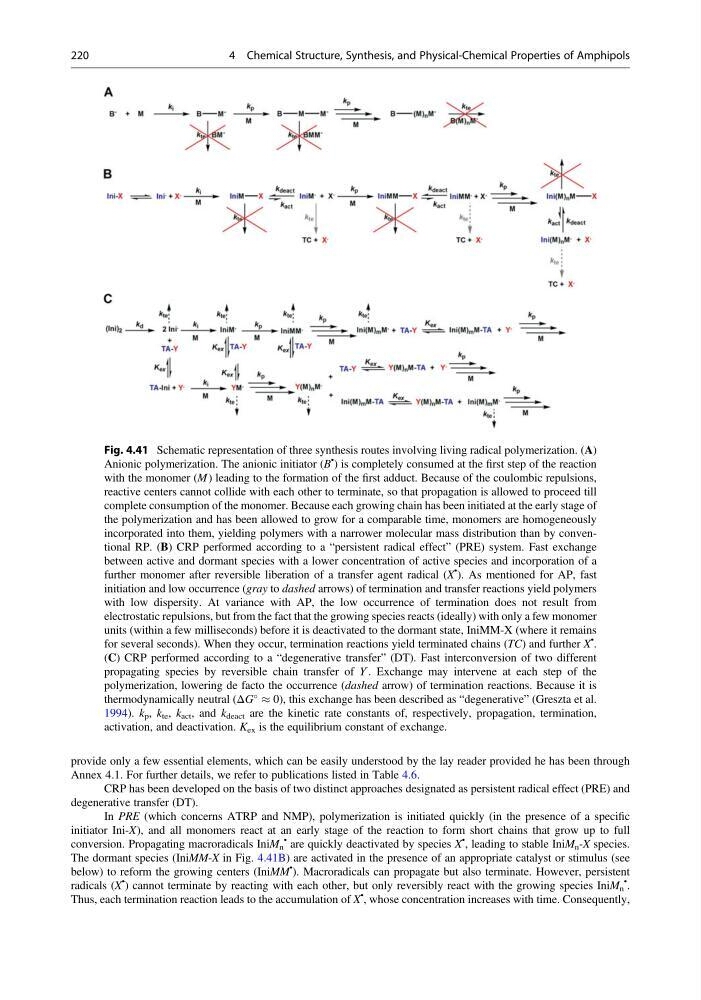
The dormant species (IniMM-X in Fig. 4.41B) are activated in the presence of an appropriate catalyst or stimulus (see
below) to reform the growing centers (IniMM
• ). Macroradicals can propagate but also terminate. However, persistent
radicals (X
• ) cannot terminate by reacting with each other, but only reversibly react with the growing species IniM n
• .
Thus, each termination reaction leads to the accumulation of X
•
, whose concentration increases with time. Consequently,
Fig. 4.41 Schematic representation of three synthesis routes involving living radical polymerization. (A)
Anionic polymerization. The anionic initiator (B
• ) is completely consumed at the first step of the reaction
with the monomer (M ) leading to the formation of the first adduct. Because of the coulombic repulsions,
reactive centers cannot collide with each other to terminate, so that propagation is allowed to proceed till
complete consumption of the monomer. Because each growing chain has been initiated at the early stage of
the polymerization and has been allowed to grow for a comparable time, monomers are homogeneously
incorporated into them, yielding polymers with a narrower molecular mass distribution than by conventional RP. (B) CRP performed according to a “persistent radical effect” (PRE) system. Fast exchange
between active and dormant species with a lower concentration of active species and incorporation of a
further monomer after reversible liberation of a transfer agent radical (X
• ). As mentioned for AP, fast
initiation and low occurrence (gray to dashed arrows) of termination and transfer reactions yield polymers
with low dispersity. At variance with AP, the low occurrence of termination does not result from
electrostatic repulsions, but from the fact that the growing species reacts (ideally) with only a few monomer
units (within a few milliseconds) before it is deactivated to the dormant state, IniMM-X (where it remains
for several seconds). When they occur, termination reactions yield terminated chains (TC) and further X
• .
(C) CRP performed according to a “degenerative transfer” (DT). Fast interconversion of two different
propagating species by reversible chain transfer of Y
∙
. Exchange may intervene at each step of the
polymerization, lowering de facto the occurrence (dashed arrow) of termination reactions. Because it is
thermodynamically neutral (ΔG
% 0), this exchange has been described as “degenerative” (Greszta et al.
1994). k p , k te , k act , and k deact are the kinetic rate constants of, respectively, propagation, termination,
activation, and deactivation. K ex is the equilibrium constant of exchange.
220
4 Chemical Structure, Synthesis, and Physical-Chemical Properties of Amphipols
Annex 4.1. For further details, we refer to publications listed in Table 4.6.
CRP has been developed on the basis of two distinct approaches designated as persistent radical effect (PRE) and
degenerative transfer (DT).
In PRE (which concerns ATRP and NMP), polymerization is initiated quickly (in the presence of a specific
initiator Ini-X), and all monomers react at an early stage of the reaction to form short chains that grow up to full
conversion. Propagating macroradicals IniM n
• are quickly deactivated by species X
• , leading to stable IniM n -X species.
The dormant species (IniMM-X in Fig. 4.41B) are activated in the presence of an appropriate catalyst or stimulus (see
below) to reform the growing centers (IniMM
• ). Macroradicals can propagate but also terminate. However, persistent
radicals (X
• ) cannot terminate by reacting with each other, but only reversibly react with the growing species IniM n
• .
Thus, each termination reaction leads to the accumulation of X
•
, whose concentration increases with time. Consequently,
Fig. 4.41 Schematic representation of three synthesis routes involving living radical polymerization. (A)
Anionic polymerization. The anionic initiator (B
• ) is completely consumed at the first step of the reaction
with the monomer (M ) leading to the formation of the first adduct. Because of the coulombic repulsions,
reactive centers cannot collide with each other to terminate, so that propagation is allowed to proceed till
complete consumption of the monomer. Because each growing chain has been initiated at the early stage of
the polymerization and has been allowed to grow for a comparable time, monomers are homogeneously
incorporated into them, yielding polymers with a narrower molecular mass distribution than by conventional RP. (B) CRP performed according to a “persistent radical effect” (PRE) system. Fast exchange
between active and dormant species with a lower concentration of active species and incorporation of a
further monomer after reversible liberation of a transfer agent radical (X
• ). As mentioned for AP, fast
initiation and low occurrence (gray to dashed arrows) of termination and transfer reactions yield polymers
with low dispersity. At variance with AP, the low occurrence of termination does not result from
electrostatic repulsions, but from the fact that the growing species reacts (ideally) with only a few monomer
units (within a few milliseconds) before it is deactivated to the dormant state, IniMM-X (where it remains
for several seconds). When they occur, termination reactions yield terminated chains (TC) and further X
• .
(C) CRP performed according to a “degenerative transfer” (DT). Fast interconversion of two different
propagating species by reversible chain transfer of Y
∙
. Exchange may intervene at each step of the
polymerization, lowering de facto the occurrence (dashed arrow) of termination reactions. Because it is
thermodynamically neutral (ΔG
% 0), this exchange has been described as “degenerative” (Greszta et al.
1994). k p , k te , k act , and k deact are the kinetic rate constants of, respectively, propagation, termination,
activation, and deactivation. K ex is the equilibrium constant of exchange.
220
4 Chemical Structure, Synthesis, and Physical-Chemical Properties of Amphipols