

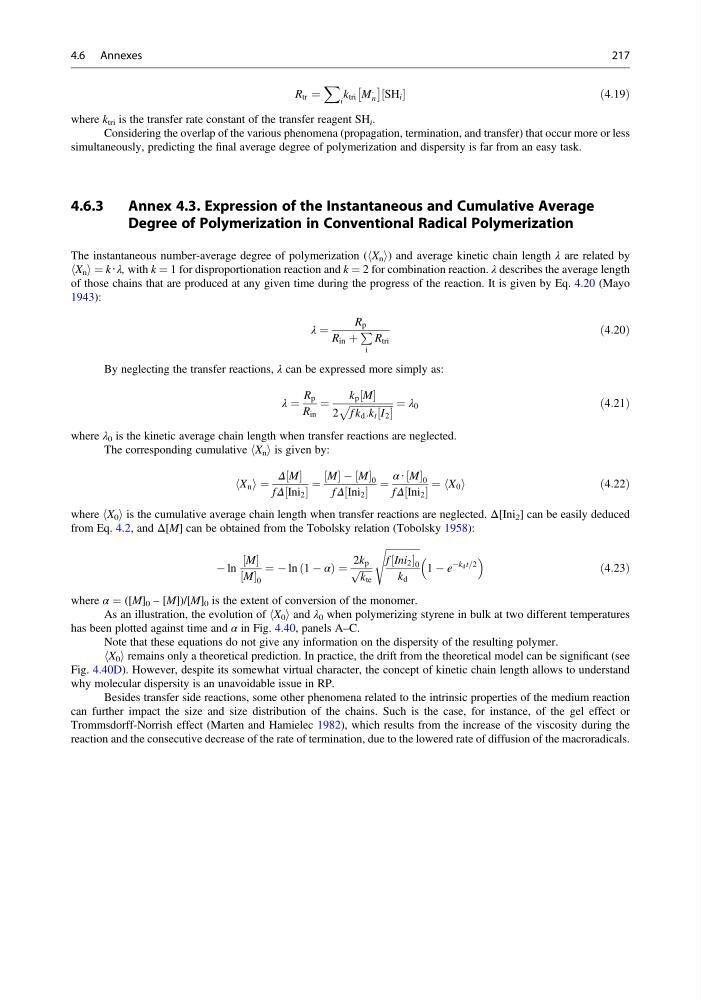
R tr ¼
X
i
k tri M
:
n
 Ã
SH i
½
ð4:19Þ
where k tri is the transfer rate constant of the transfer reagent SH i .
Considering the overlap of the various phenomena (propagation, termination, and transfer) that occur more or less
simultaneously, predicting the final average degree of polymerization and dispersity is far from an easy task.
4.6.3
Annex 4.3. Expression of the Instantaneous and Cumulative Average
Degree of Polymerization in Conventional Radical Polymerization
The instantaneous number-average degree of polymerization (hX n i) and average kinetic chain length λ are related by
hX n i ¼ k‧λ, with k ¼ 1 for disproportionation reaction and k ¼ 2 for combination reaction. λ describes the average length
of those chains that are produced at any given time during the progress of the reaction. It is given by Eq. 4.20 (Mayo
1943):
λ ¼
R p
R in þ
P
i
R tri
ð4:20Þ
By neglecting the transfer reactions, λ can be expressed more simply as:
λ ¼
R p
R in
¼
k p M
½
2
ffiffiffiffiffiffiffiffiffiffiffiffiffiffiffiffiffiffi
f k d :k t I 2
½
p
¼ λ 0
ð4:21Þ
where λ 0 is the kinetic average chain length when transfer reactions are neglected.
The corresponding cumulative hX n i is given by:
X n
h i ¼
Δ M
½
f Δ Ini 2
½
¼
M
½ À M
½ 0
f Δ Ini 2
½
¼
α ∙ M
½ 0
f Δ Ini 2
½
¼ X 0
h i
ð4:22Þ
where hX 0 i is the cumulative average chain length when transfer reactions are neglected. Δ[Ini 2 ] can be easily deduced
from Eq. 4.2, and Δ[M] can be obtained from the Tobolsky relation (Tobolsky 1958):
À ln
M
½
M
½ 0
¼ À ln 1 À α
ð
Þ¼
2k p
ffiffiffiffiffi
k te
p
ffiffiffiffiffiffiffiffiffiffiffiffiffiffi
f Ini 2
½
0
k d
s
1 À e
Àkdt=2
ð4:23Þ
where α ¼ ([M] 0 – [M])/[M] 0 is the extent of conversion of the monomer.
As an illustration, the evolution of hX 0 i and λ 0 when polymerizing styrene in bulk at two different temperatures
has been plotted against time and α in Fig. 4.40, panels A–C.
Note that these equations do not give any information on the dispersity of the resulting polymer.
hX 0 i remains only a theoretical prediction. In practice, the drift from the theoretical model can be significant (see
Fig. 4.40D). However, despite its somewhat virtual character, the concept of kinetic chain length allows to understand
why molecular dispersity is an unavoidable issue in RP.
Besides transfer side reactions, some other phenomena related to the intrinsic properties of the medium reaction
can further impact the size and size distribution of the chains. Such is the case, for instance, of the gel effect or
Trommsdorff-Norrish effect (Marten and Hamielec 1982), which results from the increase of the viscosity during the
reaction and the consecutive decrease of the rate of termination, due to the lowered rate of diffusion of the macroradicals.
4.6 Annexes
217
X
i
k tri M
:
n
 Ã
SH i
½
ð4:19Þ
where k tri is the transfer rate constant of the transfer reagent SH i .
Considering the overlap of the various phenomena (propagation, termination, and transfer) that occur more or less
simultaneously, predicting the final average degree of polymerization and dispersity is far from an easy task.
4.6.3
Annex 4.3. Expression of the Instantaneous and Cumulative Average
Degree of Polymerization in Conventional Radical Polymerization
The instantaneous number-average degree of polymerization (hX n i) and average kinetic chain length λ are related by
hX n i ¼ k‧λ, with k ¼ 1 for disproportionation reaction and k ¼ 2 for combination reaction. λ describes the average length
of those chains that are produced at any given time during the progress of the reaction. It is given by Eq. 4.20 (Mayo
1943):
λ ¼
R p
R in þ
P
i
R tri
ð4:20Þ
By neglecting the transfer reactions, λ can be expressed more simply as:
λ ¼
R p
R in
¼
k p M
½
2
ffiffiffiffiffiffiffiffiffiffiffiffiffiffiffiffiffiffi
f k d :k t I 2
½
p
¼ λ 0
ð4:21Þ
where λ 0 is the kinetic average chain length when transfer reactions are neglected.
The corresponding cumulative hX n i is given by:
X n
h i ¼
Δ M
½
f Δ Ini 2
½
¼
M
½ À M
½ 0
f Δ Ini 2
½
¼
α ∙ M
½ 0
f Δ Ini 2
½
¼ X 0
h i
ð4:22Þ
where hX 0 i is the cumulative average chain length when transfer reactions are neglected. Δ[Ini 2 ] can be easily deduced
from Eq. 4.2, and Δ[M] can be obtained from the Tobolsky relation (Tobolsky 1958):
À ln
M
½
M
½ 0
¼ À ln 1 À α
ð
Þ¼
2k p
ffiffiffiffiffi
k te
p
ffiffiffiffiffiffiffiffiffiffiffiffiffiffi
f Ini 2
½
0
k d
s
1 À e
Àkdt=2
ð4:23Þ
where α ¼ ([M] 0 – [M])/[M] 0 is the extent of conversion of the monomer.
As an illustration, the evolution of hX 0 i and λ 0 when polymerizing styrene in bulk at two different temperatures
has been plotted against time and α in Fig. 4.40, panels A–C.
Note that these equations do not give any information on the dispersity of the resulting polymer.
hX 0 i remains only a theoretical prediction. In practice, the drift from the theoretical model can be significant (see
Fig. 4.40D). However, despite its somewhat virtual character, the concept of kinetic chain length allows to understand
why molecular dispersity is an unavoidable issue in RP.
Besides transfer side reactions, some other phenomena related to the intrinsic properties of the medium reaction
can further impact the size and size distribution of the chains. Such is the case, for instance, of the gel effect or
Trommsdorff-Norrish effect (Marten and Hamielec 1982), which results from the increase of the viscosity during the
reaction and the consecutive decrease of the rate of termination, due to the lowered rate of diffusion of the macroradicals.
4.6 Annexes
217