

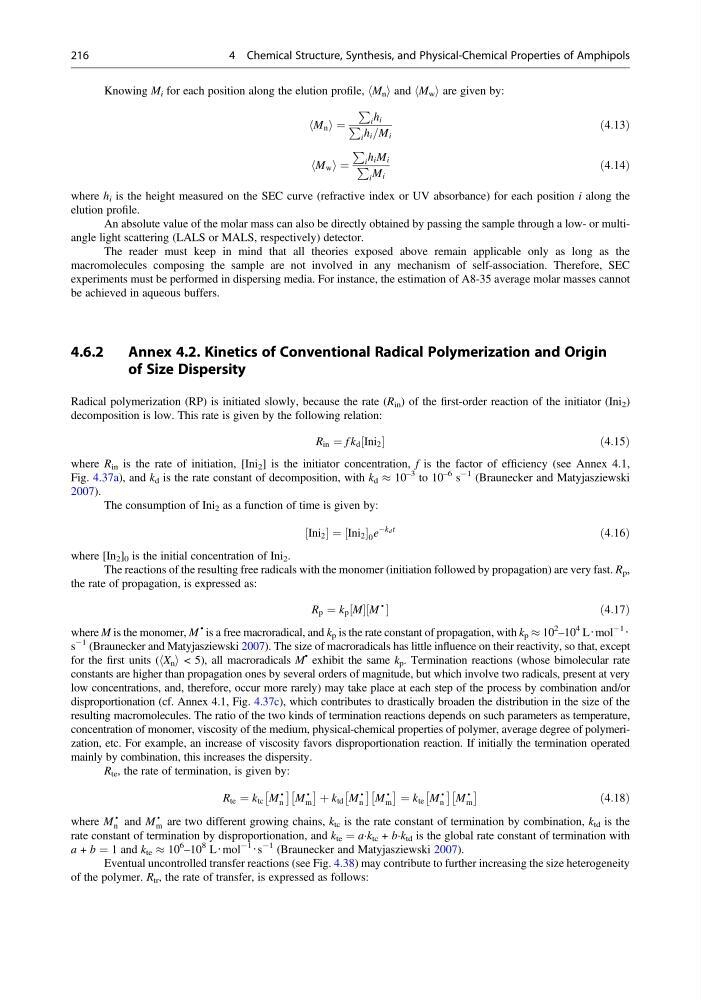
Knowing M i for each position along the elution profile, hM n i and hM w i are given by:
M n
h i ¼
P
i h i
P
i h i =M i
ð4:13Þ
M w
h i ¼
P
i h i M i
P
i M i
ð4:14Þ
where h i is the height measured on the SEC curve (refractive index or UV absorbance) for each position i along the
elution profile.
An absolute value of the molar mass can also be directly obtained by passing the sample through a low- or multiangle light scattering (LALS or MALS, respectively) detector.
The reader must keep in mind that all theories exposed above remain applicable only as long as the
macromolecules composing the sample are not involved in any mechanism of self-association. Therefore, SEC
experiments must be performed in dispersing media. For instance, the estimation of A8-35 average molar masses cannot
be achieved in aqueous buffers.
4.6.2
Annex 4.2. Kinetics of Conventional Radical Polymerization and Origin
of Size Dispersity
Radical polymerization (RP) is initiated slowly, because the rate (R in ) of the first-order reaction of the initiator (Ini 2 )
decomposition is low. This rate is given by the following relation:
R in ¼ f k d Ini 2
½
ð4:15Þ
where R in is the rate of initiation, [Ini 2 ] is the initiator concentration, f is the factor of efficiency (see Annex 4.1,
Fig. 4.37a), and k d is the rate constant of decomposition, with k d % 10
–3 to 10
–6 s
À1 (Braunecker and Matyjasziewski
2007).
The consumption of Ini 2 as a function of time is given by:
Ini 2
½
¼ Ini 2
½
0 e
Àkd t
ð4:16Þ
where [In 2 ] 0 is the initial concentration of Ini 2 .
The reactions of the resulting free radicals with the monomer (initiation followed by propagation) are very fast. R p ,
the rate of propagation, is expressed as:
R p ¼ k p M
½ M
•
½
ð4:17Þ
where M is the monomer, M
• is a free macroradical, and k p is the rate constant of propagation, with k p % 10
2
–10
4 L‧mol
À1
‧
s
À1 (Braunecker and Matyjasziewski 2007). The size of macroradicals has little influence on their reactivity, so that, except
for the first units (hX n i < 5), all macroradicals M
• exhibit the same k p . Termination reactions (whose bimolecular rate
constants are higher than propagation ones by several orders of magnitude, but which involve two radicals, present at very
low concentrations, and, therefore, occur more rarely) may take place at each step of the process by combination and/or
disproportionation (cf. Annex 4.1, Fig. 4.37c), which contributes to drastically broaden the distribution in the size of the
resulting macromolecules. The ratio of the two kinds of termination reactions depends on such parameters as temperature,
concentration of monomer, viscosity of the medium, physical-chemical properties of polymer, average degree of polymerization, etc. For example, an increase of viscosity favors disproportionation reaction. If initially the termination operated
mainly by combination, this increases the dispersity.
R te , the rate of termination, is given by:
R te ¼ k tc M
•
n
 Ã
M
•
m
 à þ k td M
•
n
 Ã
M
•
m
 à ¼ k te M
•
n
 Ã
M
•
m
 Ã
ð4:18Þ
where M
•
n and M
•
m are two different growing chains, k tc is the rate constant of termination by combination, k td is the
rate constant of termination by disproportionation, and k te ¼ aÁk tc + bÁk td is the global rate constant of termination with
a + b ¼ 1 and k te % 10
6
–10
8 L‧mol
À1
‧s
À1 (Braunecker and Matyjasziewski 2007).
Eventual uncontrolled transfer reactions (see Fig. 4.38) may contribute to further increasing the size heterogeneity
of the polymer. R tr , the rate of transfer, is expressed as follows:
216
4 Chemical Structure, Synthesis, and Physical-Chemical Properties of Amphipols
M n
h i ¼
P
i h i
P
i h i =M i
ð4:13Þ
M w
h i ¼
P
i h i M i
P
i M i
ð4:14Þ
where h i is the height measured on the SEC curve (refractive index or UV absorbance) for each position i along the
elution profile.
An absolute value of the molar mass can also be directly obtained by passing the sample through a low- or multiangle light scattering (LALS or MALS, respectively) detector.
The reader must keep in mind that all theories exposed above remain applicable only as long as the
macromolecules composing the sample are not involved in any mechanism of self-association. Therefore, SEC
experiments must be performed in dispersing media. For instance, the estimation of A8-35 average molar masses cannot
be achieved in aqueous buffers.
4.6.2
Annex 4.2. Kinetics of Conventional Radical Polymerization and Origin
of Size Dispersity
Radical polymerization (RP) is initiated slowly, because the rate (R in ) of the first-order reaction of the initiator (Ini 2 )
decomposition is low. This rate is given by the following relation:
R in ¼ f k d Ini 2
½
ð4:15Þ
where R in is the rate of initiation, [Ini 2 ] is the initiator concentration, f is the factor of efficiency (see Annex 4.1,
Fig. 4.37a), and k d is the rate constant of decomposition, with k d % 10
–3 to 10
–6 s
À1 (Braunecker and Matyjasziewski
2007).
The consumption of Ini 2 as a function of time is given by:
Ini 2
½
¼ Ini 2
½
0 e
Àkd t
ð4:16Þ
where [In 2 ] 0 is the initial concentration of Ini 2 .
The reactions of the resulting free radicals with the monomer (initiation followed by propagation) are very fast. R p ,
the rate of propagation, is expressed as:
R p ¼ k p M
½ M
•
½
ð4:17Þ
where M is the monomer, M
• is a free macroradical, and k p is the rate constant of propagation, with k p % 10
2
–10
4 L‧mol
À1
‧
s
À1 (Braunecker and Matyjasziewski 2007). The size of macroradicals has little influence on their reactivity, so that, except
for the first units (hX n i < 5), all macroradicals M
• exhibit the same k p . Termination reactions (whose bimolecular rate
constants are higher than propagation ones by several orders of magnitude, but which involve two radicals, present at very
low concentrations, and, therefore, occur more rarely) may take place at each step of the process by combination and/or
disproportionation (cf. Annex 4.1, Fig. 4.37c), which contributes to drastically broaden the distribution in the size of the
resulting macromolecules. The ratio of the two kinds of termination reactions depends on such parameters as temperature,
concentration of monomer, viscosity of the medium, physical-chemical properties of polymer, average degree of polymerization, etc. For example, an increase of viscosity favors disproportionation reaction. If initially the termination operated
mainly by combination, this increases the dispersity.
R te , the rate of termination, is given by:
R te ¼ k tc M
•
n
 Ã
M
•
m
 à þ k td M
•
n
 Ã
M
•
m
 à ¼ k te M
•
n
 Ã
M
•
m
 Ã
ð4:18Þ
where M
•
n and M
•
m are two different growing chains, k tc is the rate constant of termination by combination, k td is the
rate constant of termination by disproportionation, and k te ¼ aÁk tc + bÁk td is the global rate constant of termination with
a + b ¼ 1 and k te % 10
6
–10
8 L‧mol
À1
‧s
À1 (Braunecker and Matyjasziewski 2007).
Eventual uncontrolled transfer reactions (see Fig. 4.38) may contribute to further increasing the size heterogeneity
of the polymer. R tr , the rate of transfer, is expressed as follows:
216
4 Chemical Structure, Synthesis, and Physical-Chemical Properties of Amphipols