

A calibration curve is obtained by plotting log([η] 1 ÁM 1 ) vs. the elution volume of each standard. M 2 can then be
deduced from Eq. 4.9 provided [η] 2 is known. [η] 2 can be either directly measured using an online viscometer or deduced
from the Mark-Houwink-Sakurada equation (see e.g. Wagner 1987 and references therein):
η
½ ¼ kM
α
ð4:11Þ
where k and α are constants that depend on polymer composition, temperature, and solvent. They are listed in handbooks
for many polymers.
Combining Eqs. 4.9 and 4.11 gives:
M 2 ¼ k 1 =k 2
ð
Þ
1=
À
1þα2
Á
Á M 1
R
ð4:12Þ
with R ¼ (1 + α 1 ) (1 + α 2 ).
P = ‐‐‐ Bar
F = ‐‐‐ mL/min
R g = ‐‐‐ nm
Waste
Waste
Pump
Injection
Columns
=…nm
RI =…
Waste
]=.dL/g
[
Detectors
LS Detector
Solvent
h
l
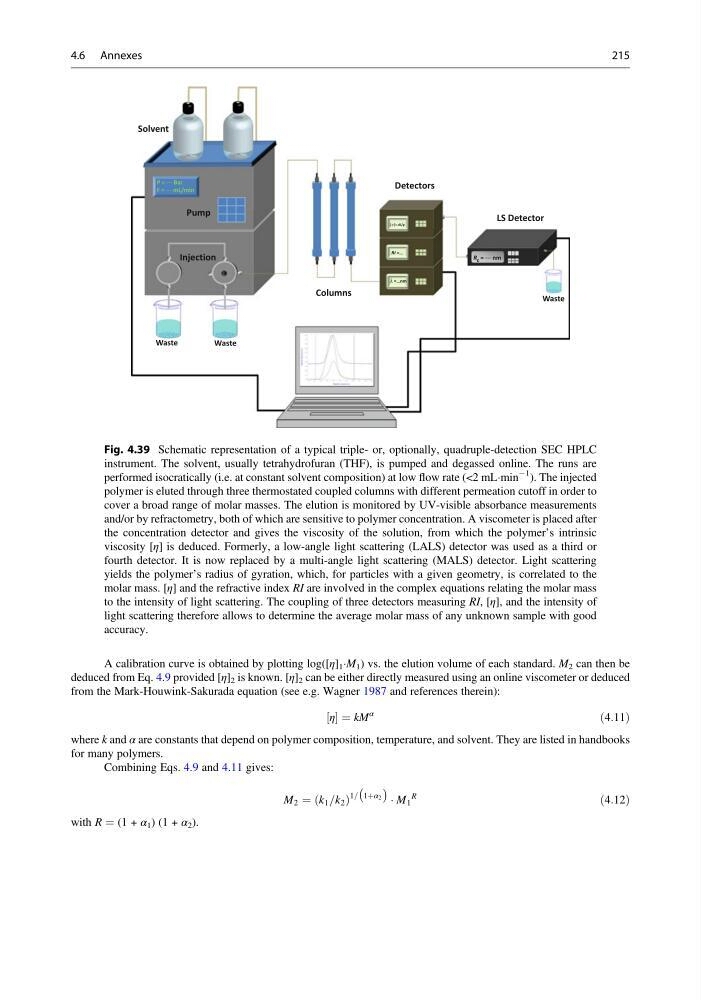
Fig. 4.39 Schematic representation of a typical triple- or, optionally, quadruple-detection SEC HPLC
instrument. The solvent, usually tetrahydrofuran (THF), is pumped and degassed online. The runs are
performed isocratically (i.e. at constant solvent composition) at low flow rate (<2 mLÁmin
À1
). The injected
polymer is eluted through three thermostated coupled columns with different permeation cutoff in order to
cover a broad range of molar masses. The elution is monitored by UV-visible absorbance measurements
and/or by refractometry, both of which are sensitive to polymer concentration. A viscometer is placed after
the concentration detector and gives the viscosity of the solution, from which the polymer’s intrinsic
viscosity [η] is deduced. Formerly, a low-angle light scattering (LALS) detector was used as a third or
fourth detector. It is now replaced by a multi-angle light scattering (MALS) detector. Light scattering
yields the polymer’s radius of gyration, which, for particles with a given geometry, is correlated to the
molar mass. [η] and the refractive index RI are involved in the complex equations relating the molar mass
to the intensity of light scattering. The coupling of three detectors measuring RI, [η], and the intensity of
light scattering therefore allows to determine the average molar mass of any unknown sample with good
accuracy.
4.6 Annexes
215
deduced from Eq. 4.9 provided [η] 2 is known. [η] 2 can be either directly measured using an online viscometer or deduced
from the Mark-Houwink-Sakurada equation (see e.g. Wagner 1987 and references therein):
η
½ ¼ kM
α
ð4:11Þ
where k and α are constants that depend on polymer composition, temperature, and solvent. They are listed in handbooks
for many polymers.
Combining Eqs. 4.9 and 4.11 gives:
M 2 ¼ k 1 =k 2
ð
Þ
1=
À
1þα2
Á
Á M 1
R
ð4:12Þ
with R ¼ (1 + α 1 ) (1 + α 2 ).
P = ‐‐‐ Bar
F = ‐‐‐ mL/min
R g = ‐‐‐ nm
Waste
Waste
Pump
Injection
Columns
=…nm
RI =…
Waste
]=.dL/g
[
Detectors
LS Detector
Solvent
h
l
Fig. 4.39 Schematic representation of a typical triple- or, optionally, quadruple-detection SEC HPLC
instrument. The solvent, usually tetrahydrofuran (THF), is pumped and degassed online. The runs are
performed isocratically (i.e. at constant solvent composition) at low flow rate (<2 mLÁmin
À1
). The injected
polymer is eluted through three thermostated coupled columns with different permeation cutoff in order to
cover a broad range of molar masses. The elution is monitored by UV-visible absorbance measurements
and/or by refractometry, both of which are sensitive to polymer concentration. A viscometer is placed after
the concentration detector and gives the viscosity of the solution, from which the polymer’s intrinsic
viscosity [η] is deduced. Formerly, a low-angle light scattering (LALS) detector was used as a third or
fourth detector. It is now replaced by a multi-angle light scattering (MALS) detector. Light scattering
yields the polymer’s radius of gyration, which, for particles with a given geometry, is correlated to the
molar mass. [η] and the refractive index RI are involved in the complex equations relating the molar mass
to the intensity of light scattering. The coupling of three detectors measuring RI, [η], and the intensity of
light scattering therefore allows to determine the average molar mass of any unknown sample with good
accuracy.
4.6 Annexes
215