

4.6.1.3 Expressing the Average Mass and Dispersity of Polymers
Whatever strategy has been adopted, the final product of any chemical polymerization is a mixture of macromolecules of
variable length and mass. By performing appropriate analyses of a polymer sample (see below), different average values
of the molar mass and statistical deviations around it can be obtained, the two most frequently used of which are the
number-average and the weight-average masses, noted respectively hM n i and hM w i, whose definitions will follow. These
two values would be identical for a perfectly homogeneous sample, but they differ if the sample is heterogeneous, and
their ratio gives a measure of the dispersity. The following summary is based on recent IUPAD recommendations about
which nomenclature and notations appear preferable (Gilbert et al. 2009).
The study of colligative properties (those properties that vary as the number of molecules per unit volume, which
can be measured, e.g. by cryoscopy, osmometry, ebullioscopy, etc.) yields the number-average molar mass of the
polymer, hM n i. hM n i represents the average molar mass of macromolecules weighed as a function of their abundance in
the sample. If the sample comprises N i macromolecules of molar mass M i , with M i stretching over a given range, hM n i is
defined as follows:
M n
h i ¼
P
i N i M i
P
i N i
ð4:1Þ
For a homopolymer, the number-average size or degree of polymerization hX n i (formerly noted hDP n i) of the polymer is
defined as:
X n
h i ¼
M n
h i
M 0
ð4:2Þ
where M 0 is the molar mass of the monomer.
Measuring the intrinsic properties of the sample (properties linked to the nature and the mass of the
macromolecules, which can be studied, e.g. by light scattering or by viscometry) gives an estimate of the weightaverage molar mass of the polymer, hM w i. The contribution to the mass of a given sample of those molecules whose
molar mass is M i is given by W i ¼ N i ÁM i . The weight-average mass is obtained by weighing the contribution of each
polymer by its mass:
M w
h i ¼
P
i W i M i
P
i W i
¼
P
i N i M i
2
P
i N i M i
ð4:3Þ
where Σ i N i M i is the total mass of the sample. The respective meanings of hM n i and hM w i are best perceived by
considering that on each side of hM n i lies an equal number of molecules, on each side of hM w i an equal mass of them. It is
therefore intuitive that for a mixture of small and big molecules, hM w i will necessarily be larger than hM n i (an example is
given below).
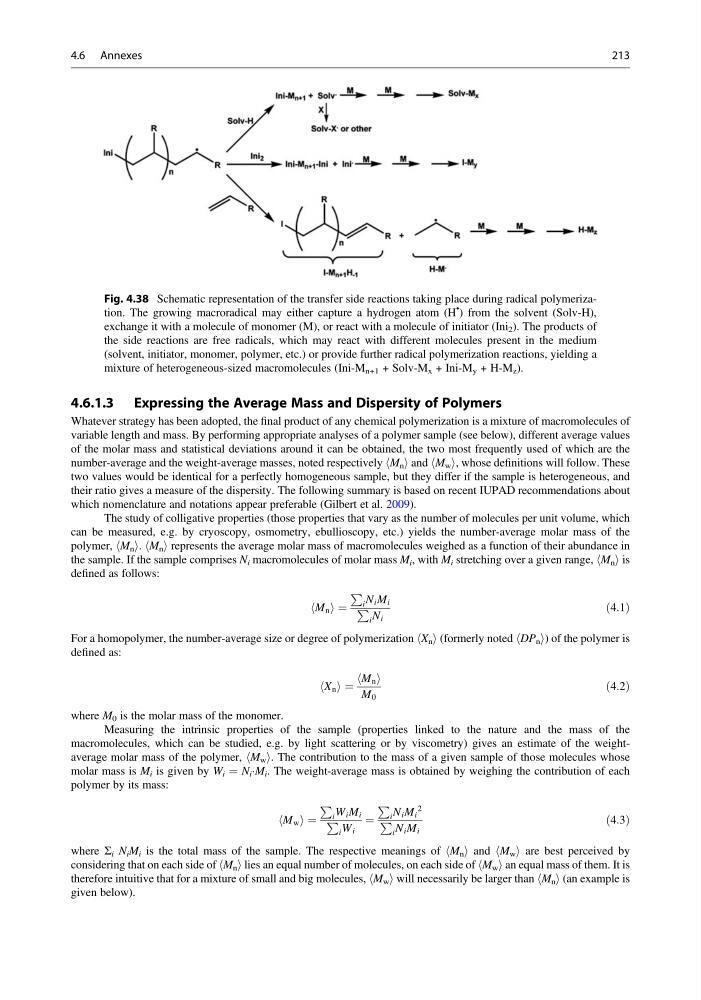
Fig. 4.38 Schematic representation of the transfer side reactions taking place during radical polymerization. The growing macroradical may either capture a hydrogen atom (H
• ) from the solvent (Solv-H),
exchange it with a molecule of monomer (M), or react with a molecule of initiator (Ini 2 ). The products of
the side reactions are free radicals, which may react with different molecules present in the medium
(solvent, initiator, monomer, polymer, etc.) or provide further radical polymerization reactions, yielding a
mixture of heterogeneous-sized macromolecules (Ini-M n+1 + Solv-M x + Ini-M y + H-M z ).
4.6 Annexes
213
Whatever strategy has been adopted, the final product of any chemical polymerization is a mixture of macromolecules of
variable length and mass. By performing appropriate analyses of a polymer sample (see below), different average values
of the molar mass and statistical deviations around it can be obtained, the two most frequently used of which are the
number-average and the weight-average masses, noted respectively hM n i and hM w i, whose definitions will follow. These
two values would be identical for a perfectly homogeneous sample, but they differ if the sample is heterogeneous, and
their ratio gives a measure of the dispersity. The following summary is based on recent IUPAD recommendations about
which nomenclature and notations appear preferable (Gilbert et al. 2009).
The study of colligative properties (those properties that vary as the number of molecules per unit volume, which
can be measured, e.g. by cryoscopy, osmometry, ebullioscopy, etc.) yields the number-average molar mass of the
polymer, hM n i. hM n i represents the average molar mass of macromolecules weighed as a function of their abundance in
the sample. If the sample comprises N i macromolecules of molar mass M i , with M i stretching over a given range, hM n i is
defined as follows:
M n
h i ¼
P
i N i M i
P
i N i
ð4:1Þ
For a homopolymer, the number-average size or degree of polymerization hX n i (formerly noted hDP n i) of the polymer is
defined as:
X n
h i ¼
M n
h i
M 0
ð4:2Þ
where M 0 is the molar mass of the monomer.
Measuring the intrinsic properties of the sample (properties linked to the nature and the mass of the
macromolecules, which can be studied, e.g. by light scattering or by viscometry) gives an estimate of the weightaverage molar mass of the polymer, hM w i. The contribution to the mass of a given sample of those molecules whose
molar mass is M i is given by W i ¼ N i ÁM i . The weight-average mass is obtained by weighing the contribution of each
polymer by its mass:
M w
h i ¼
P
i W i M i
P
i W i
¼
P
i N i M i
2
P
i N i M i
ð4:3Þ
where Σ i N i M i is the total mass of the sample. The respective meanings of hM n i and hM w i are best perceived by
considering that on each side of hM n i lies an equal number of molecules, on each side of hM w i an equal mass of them. It is
therefore intuitive that for a mixture of small and big molecules, hM w i will necessarily be larger than hM n i (an example is
given below).
Fig. 4.38 Schematic representation of the transfer side reactions taking place during radical polymerization. The growing macroradical may either capture a hydrogen atom (H
• ) from the solvent (Solv-H),
exchange it with a molecule of monomer (M), or react with a molecule of initiator (Ini 2 ). The products of
the side reactions are free radicals, which may react with different molecules present in the medium
(solvent, initiator, monomer, polymer, etc.) or provide further radical polymerization reactions, yielding a
mixture of heterogeneous-sized macromolecules (Ini-M n+1 + Solv-M x + Ini-M y + H-M z ).
4.6 Annexes
213