

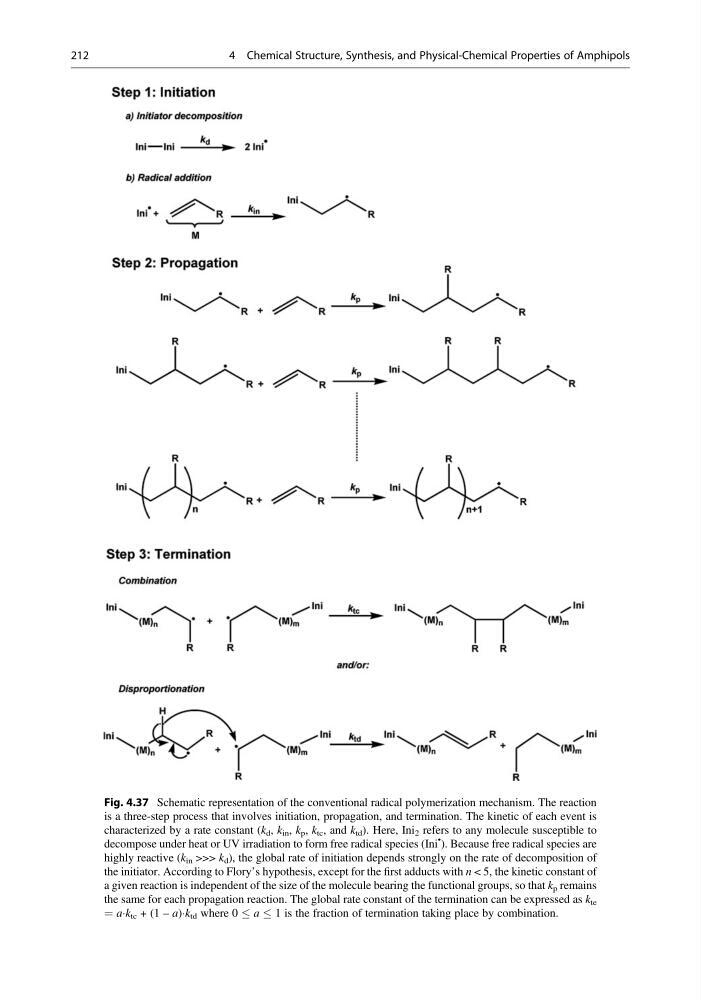
Fig. 4.37 Schematic representation of the conventional radical polymerization mechanism. The reaction
is a three-step process that involves initiation, propagation, and termination. The kinetic of each event is
characterized by a rate constant (k d , k in , k p , k tc , and k td ). Here, Ini 2 refers to any molecule susceptible to
decompose under heat or UV irradiation to form free radical species (Ini
• ). Because free radical species are
highly reactive (k in >>> k d ), the global rate of initiation depends strongly on the rate of decomposition of
the initiator. According to Flory’s hypothesis, except for the first adducts with n < 5, the kinetic constant of
a given reaction is independent of the size of the molecule bearing the functional groups, so that k p remains
the same for each propagation reaction. The global rate constant of the termination can be expressed as k te
¼ aÁk tc + (1 – a)Ák td where 0 a 1 is the fraction of termination taking place by combination.
212
4 Chemical Structure, Synthesis, and Physical-Chemical Properties of Amphipols
is a three-step process that involves initiation, propagation, and termination. The kinetic of each event is
characterized by a rate constant (k d , k in , k p , k tc , and k td ). Here, Ini 2 refers to any molecule susceptible to
decompose under heat or UV irradiation to form free radical species (Ini
• ). Because free radical species are
highly reactive (k in >>> k d ), the global rate of initiation depends strongly on the rate of decomposition of
the initiator. According to Flory’s hypothesis, except for the first adducts with n < 5, the kinetic constant of
a given reaction is independent of the size of the molecule bearing the functional groups, so that k p remains
the same for each propagation reaction. The global rate constant of the termination can be expressed as k te
¼ aÁk tc + (1 – a)Ák td where 0 a 1 is the fraction of termination taking place by combination.
212
4 Chemical Structure, Synthesis, and Physical-Chemical Properties of Amphipols