

4.6.1.2 How Can Size Dispersity Be Limited?
The chemist can resort to several strategies to try to limit the drift of polymer size. Various methods aiming at controlling,
with more or less efficiency, the size of the polymers during their formation have been developed during the last three
decades, both for chain-growth (reviewed in Starks 1974; Chen et al. 2009; Misha and Kumar 2012) and for step-growth
polymerization (reviewed in Yokozawa and Yokoyama 2004). As regards the chain-growth process, most approaches
consist in performing the polymerization in the presence of a reactant that controls the growth of the macroradicals (this
point will be discussed in § 4.6.4, Annex 4.4). In the best cases, the dispersity will be considerably reduced, but it will
never reach the ideal situation where all macromolecules in a preparation would have strictly the same size. Therefore, the
molar mass of a given polymer will always be expressed as a statistic average, and these statistics are complicated.
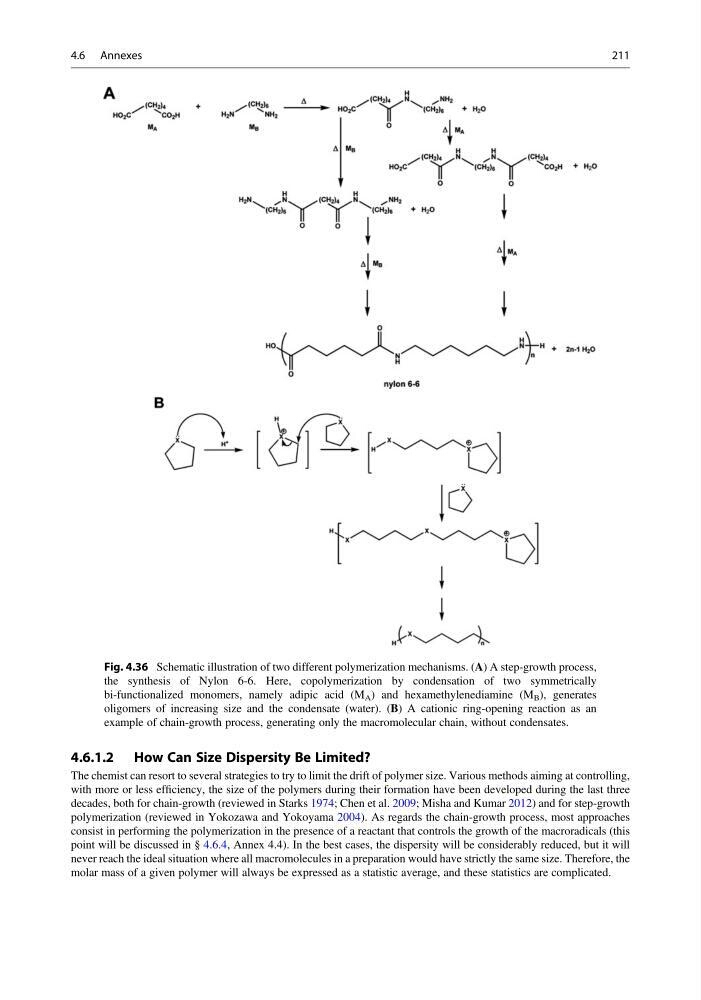
Fig. 4.36 Schematic illustration of two different polymerization mechanisms. (A) A step-growth process,
the synthesis of Nylon 6-6. Here, copolymerization by condensation of two symmetrically
bi-functionalized monomers, namely adipic acid (M A ) and hexamethylenediamine (M B ), generates
oligomers of increasing size and the condensate (water). (B) A cationic ring-opening reaction as an
example of chain-growth process, generating only the macromolecular chain, without condensates.
4.6 Annexes
211
The chemist can resort to several strategies to try to limit the drift of polymer size. Various methods aiming at controlling,
with more or less efficiency, the size of the polymers during their formation have been developed during the last three
decades, both for chain-growth (reviewed in Starks 1974; Chen et al. 2009; Misha and Kumar 2012) and for step-growth
polymerization (reviewed in Yokozawa and Yokoyama 2004). As regards the chain-growth process, most approaches
consist in performing the polymerization in the presence of a reactant that controls the growth of the macroradicals (this
point will be discussed in § 4.6.4, Annex 4.4). In the best cases, the dispersity will be considerably reduced, but it will
never reach the ideal situation where all macromolecules in a preparation would have strictly the same size. Therefore, the
molar mass of a given polymer will always be expressed as a statistic average, and these statistics are complicated.
Fig. 4.36 Schematic illustration of two different polymerization mechanisms. (A) A step-growth process,
the synthesis of Nylon 6-6. Here, copolymerization by condensation of two symmetrically
bi-functionalized monomers, namely adipic acid (M A ) and hexamethylenediamine (M B ), generates
oligomers of increasing size and the condensate (water). (B) A cationic ring-opening reaction as an
example of chain-growth process, generating only the macromolecular chain, without condensates.
4.6 Annexes
211