

Labeling or functionalizing A8-35 or A8-75 can be achieved in several ways, four of which are
schematized in Fig. 4.30. A labeled or functionalized amine may be grafted onto the polymer backbone
during (Fig. 4.30A) or after (Fig 4.30B–D) grafting hydrophobic side chains onto the PAA (HMPAS
step, for “hydrophobically modified poly(acrylic acid) synthesis”). Grafting is performed after the
synthesis if the moiety to be grafted is unstable under HMPAS conditions, or when its amine is not
soluble in N-methylpyrrolidone (NMP). In such a case, labeling can be carried out in another organic
solvent or in aqueous medium. In the latter case, grafting takes place at the surface of already formed
A8-35 or A8-75 particles (Fig. 4.30C, D), and not on isolated macromolecular chains as is the case in
NMP solution. This is expected to affect the distribution of the grafts (see below). Labeling can be
performed either onto the polymer itself (Fig. 4.30A, C) or onto a pre-functionalized version of A8-35
bearing a reactive arm (Fig. 4.30B, D). Pre-functionalizing A8-35 presents a number of advantages:
not only does it provide a route to the synthesis of labeled or tagged versions of A8-35, but it also
ensures that whole sets of derivatives will feature exactly the same average length, length distribution,
and octylamine and isopropylamine density and distribution – and, therefore, in principle, the same
solution behavior. For this reason, this kind of general precursor has been dubbed “universal
amphipol” (UAPol; somewhat of an overstatement!) (Zoonens et al. 2007). A very convenient type
of UAPol is one carrying a free amine group (UAPol-NH 2 ), which can react with isocyanate,
isothiocyanate, or activated ester derivatives of a probe. In principle, UAPol-NH 2 could also be used
to attach a functional group by reductive amination (by reacting the amine with a carbonyl derivative),
but this pathway offers limited prospects, most of the commercially available functionalized probes
that are designed to be bound using reductive amination carrying an amino group (amine or hydrazine)
rather than a carbonyl one.
On paper, a thiol-carrying APol (ThiAPol) could be a marvelous tool, because thiols react
quantitatively with maleimide or alkyl halides to form a stable thioether bond and with activated thiols
to form a covalent but reducible disulfide bond. A ThiAPol could be expected to provide higher yields
of coupling than can be achieved with UAPol-NH 2 . Moreover, the reversible character of the disulfide
bond would offer the opportunity to endow APols with removable functions. Such APols could be
used, for instance, to ensure the controlled release of drugs, probes, or other conjugates following
exposure of functionalized ThiAPols to a reducing cellular environment such as the cytosol (Sauer
et al. 2010) or the lysosomal lumen (Stefano et al. 2009). ThiAPols could also serve to immobilize
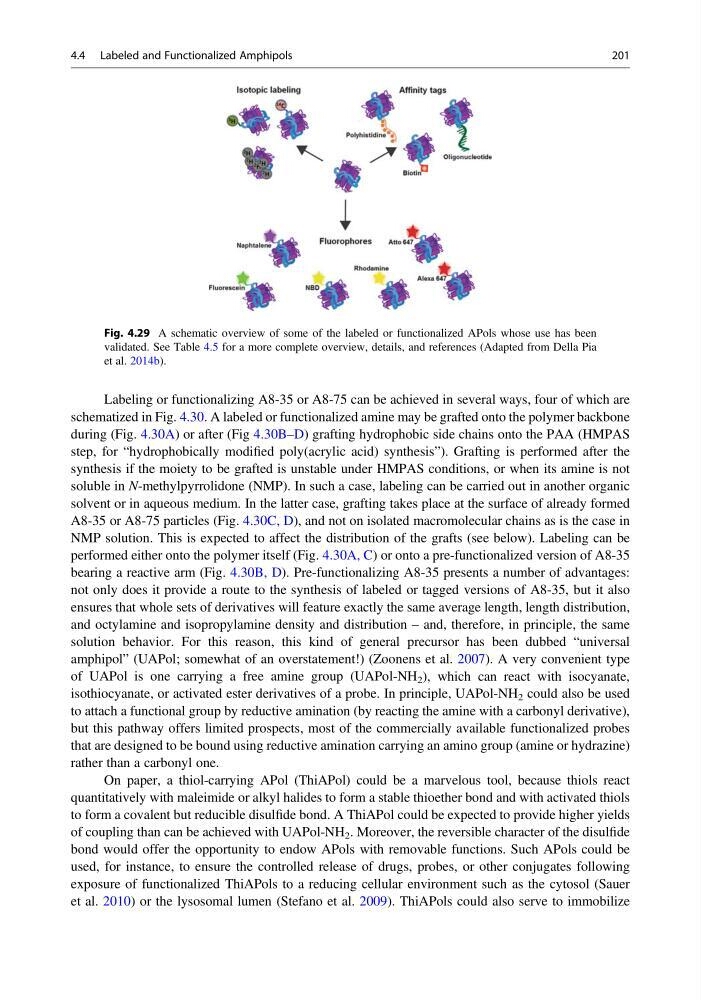
Fig. 4.29 A schematic overview of some of the labeled or functionalized APols whose use has been
validated. See Table 4.5 for a more complete overview, details, and references (Adapted from Della Pia
et al. 2014b).
4.4 Labeled and Functionalized Amphipols
201
schematized in Fig. 4.30. A labeled or functionalized amine may be grafted onto the polymer backbone
during (Fig. 4.30A) or after (Fig 4.30B–D) grafting hydrophobic side chains onto the PAA (HMPAS
step, for “hydrophobically modified poly(acrylic acid) synthesis”). Grafting is performed after the
synthesis if the moiety to be grafted is unstable under HMPAS conditions, or when its amine is not
soluble in N-methylpyrrolidone (NMP). In such a case, labeling can be carried out in another organic
solvent or in aqueous medium. In the latter case, grafting takes place at the surface of already formed
A8-35 or A8-75 particles (Fig. 4.30C, D), and not on isolated macromolecular chains as is the case in
NMP solution. This is expected to affect the distribution of the grafts (see below). Labeling can be
performed either onto the polymer itself (Fig. 4.30A, C) or onto a pre-functionalized version of A8-35
bearing a reactive arm (Fig. 4.30B, D). Pre-functionalizing A8-35 presents a number of advantages:
not only does it provide a route to the synthesis of labeled or tagged versions of A8-35, but it also
ensures that whole sets of derivatives will feature exactly the same average length, length distribution,
and octylamine and isopropylamine density and distribution – and, therefore, in principle, the same
solution behavior. For this reason, this kind of general precursor has been dubbed “universal
amphipol” (UAPol; somewhat of an overstatement!) (Zoonens et al. 2007). A very convenient type
of UAPol is one carrying a free amine group (UAPol-NH 2 ), which can react with isocyanate,
isothiocyanate, or activated ester derivatives of a probe. In principle, UAPol-NH 2 could also be used
to attach a functional group by reductive amination (by reacting the amine with a carbonyl derivative),
but this pathway offers limited prospects, most of the commercially available functionalized probes
that are designed to be bound using reductive amination carrying an amino group (amine or hydrazine)
rather than a carbonyl one.
On paper, a thiol-carrying APol (ThiAPol) could be a marvelous tool, because thiols react
quantitatively with maleimide or alkyl halides to form a stable thioether bond and with activated thiols
to form a covalent but reducible disulfide bond. A ThiAPol could be expected to provide higher yields
of coupling than can be achieved with UAPol-NH 2 . Moreover, the reversible character of the disulfide
bond would offer the opportunity to endow APols with removable functions. Such APols could be
used, for instance, to ensure the controlled release of drugs, probes, or other conjugates following
exposure of functionalized ThiAPols to a reducing cellular environment such as the cytosol (Sauer
et al. 2010) or the lysosomal lumen (Stefano et al. 2009). ThiAPols could also serve to immobilize
Fig. 4.29 A schematic overview of some of the labeled or functionalized APols whose use has been
validated. See Table 4.5 for a more complete overview, details, and references (Adapted from Della Pia
et al. 2014b).
4.4 Labeled and Functionalized Amphipols
201