

MP/APol complexes onto gold surfaces, as is classically done with soluble proteins (Yoshimoto et al.
2008), integral MPs (Terrettaz et al. 2002), or whole cells (Roberts et al. 1998; Murphy et al. 2004). For
all these reasons, a thiolated version of A8-35 appeared as a biochemist’s dream. In practice, however,
its synthesis turned out to be a chemist’s nightmare, and a satisfactory route to producing it in good
yield remains to be established (for a discussion, see Le Bon et al. 2014b). Labeling of SMA with
cysteamine has been achieved, up to a level of ~0.6 thiol per polymer, and the resulting thiolated
SMALPs labeled with thiol-reactive compounds (Lindhoud et al. 2016).
A number of derivatives of A8-35 and A8-75 have been obtained by incorporating the label or
tag during PAA hydrophobization. They include several isotopically labeled versions (Tribet et al.
1997; Gohon et al. 2004, 2006, 2008; Giusti et al. 2014), a biotinylated derivative (BAPol) (Charvolin
et al. 2009), and two derivatives carrying imidazole groups, in the form either of polyhistidine tags
(HistAPol) (Giusti et al. 2015) or of distributed imidazole moieties (ImidAPol; unpublished data cited
in Le Bon et al. 2014b) (see Table 4.5 and references therein).
When a high level of labeling is not required, as is the case, for instance, for fluorescent APols
(FAPols), an efficient course is to derivatize an intermediate such as UAPol-NH 2 . This is the method of
choice when the fluorophore is too fragile for HMPAS, or insoluble in NMP, or when no aminated
version of it is available. The synthesis of some FAPols, such as that of a naphthalene derivative of
A8-75, can proceed by HMPAS. However, this route is harsh, particularly due to the final treatment
with sodium methanolate, and few fluorophores can stand it. Rather, an activated version of the
fluorophore, carrying either an isothiocyanate or an N-hydroxysuccinimidyl ester (NHS-ester), is
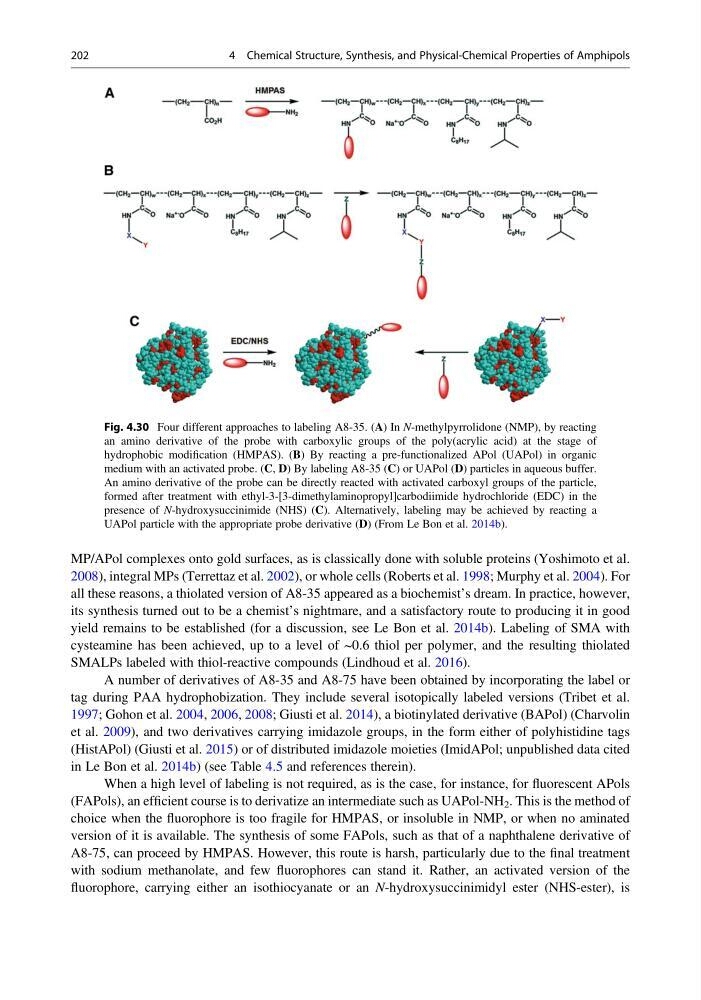
Fig. 4.30 Four different approaches to labeling A8-35. (A) In N-methylpyrrolidone (NMP), by reacting
an amino derivative of the probe with carboxylic groups of the poly(acrylic acid) at the stage of
hydrophobic modification (HMPAS). (B) By reacting a pre-functionalized APol (UAPol) in organic
medium with an activated probe. (C, D) By labeling A8-35 (C) or UAPol (D) particles in aqueous buffer.
An amino derivative of the probe can be directly reacted with activated carboxyl groups of the particle,
formed after treatment with ethyl-3-[3-dimethylaminopropyl]carbodiimide hydrochloride (EDC) in the
presence of N-hydroxysuccinimide (NHS) (C). Alternatively, labeling may be achieved by reacting a
UAPol particle with the appropriate probe derivative (D) (From Le Bon et al. 2014b).
202
4 Chemical Structure, Synthesis, and Physical-Chemical Properties of Amphipols
2008), integral MPs (Terrettaz et al. 2002), or whole cells (Roberts et al. 1998; Murphy et al. 2004). For
all these reasons, a thiolated version of A8-35 appeared as a biochemist’s dream. In practice, however,
its synthesis turned out to be a chemist’s nightmare, and a satisfactory route to producing it in good
yield remains to be established (for a discussion, see Le Bon et al. 2014b). Labeling of SMA with
cysteamine has been achieved, up to a level of ~0.6 thiol per polymer, and the resulting thiolated
SMALPs labeled with thiol-reactive compounds (Lindhoud et al. 2016).
A number of derivatives of A8-35 and A8-75 have been obtained by incorporating the label or
tag during PAA hydrophobization. They include several isotopically labeled versions (Tribet et al.
1997; Gohon et al. 2004, 2006, 2008; Giusti et al. 2014), a biotinylated derivative (BAPol) (Charvolin
et al. 2009), and two derivatives carrying imidazole groups, in the form either of polyhistidine tags
(HistAPol) (Giusti et al. 2015) or of distributed imidazole moieties (ImidAPol; unpublished data cited
in Le Bon et al. 2014b) (see Table 4.5 and references therein).
When a high level of labeling is not required, as is the case, for instance, for fluorescent APols
(FAPols), an efficient course is to derivatize an intermediate such as UAPol-NH 2 . This is the method of
choice when the fluorophore is too fragile for HMPAS, or insoluble in NMP, or when no aminated
version of it is available. The synthesis of some FAPols, such as that of a naphthalene derivative of
A8-75, can proceed by HMPAS. However, this route is harsh, particularly due to the final treatment
with sodium methanolate, and few fluorophores can stand it. Rather, an activated version of the
fluorophore, carrying either an isothiocyanate or an N-hydroxysuccinimidyl ester (NHS-ester), is
Fig. 4.30 Four different approaches to labeling A8-35. (A) In N-methylpyrrolidone (NMP), by reacting
an amino derivative of the probe with carboxylic groups of the poly(acrylic acid) at the stage of
hydrophobic modification (HMPAS). (B) By reacting a pre-functionalized APol (UAPol) in organic
medium with an activated probe. (C, D) By labeling A8-35 (C) or UAPol (D) particles in aqueous buffer.
An amino derivative of the probe can be directly reacted with activated carboxyl groups of the particle,
formed after treatment with ethyl-3-[3-dimethylaminopropyl]carbodiimide hydrochloride (EDC) in the
presence of N-hydroxysuccinimide (NHS) (C). Alternatively, labeling may be achieved by reacting a
UAPol particle with the appropriate probe derivative (D) (From Le Bon et al. 2014b).
202
4 Chemical Structure, Synthesis, and Physical-Chemical Properties of Amphipols