

sucrose gradients (SG-AUC) (Diab et al. 2007b). MP/PC-APol complexes do not aggregate at pH 5 nor
in the presence of either 1 M NaCl or 12 mM Ca
2+ (Diab et al. 2007a).
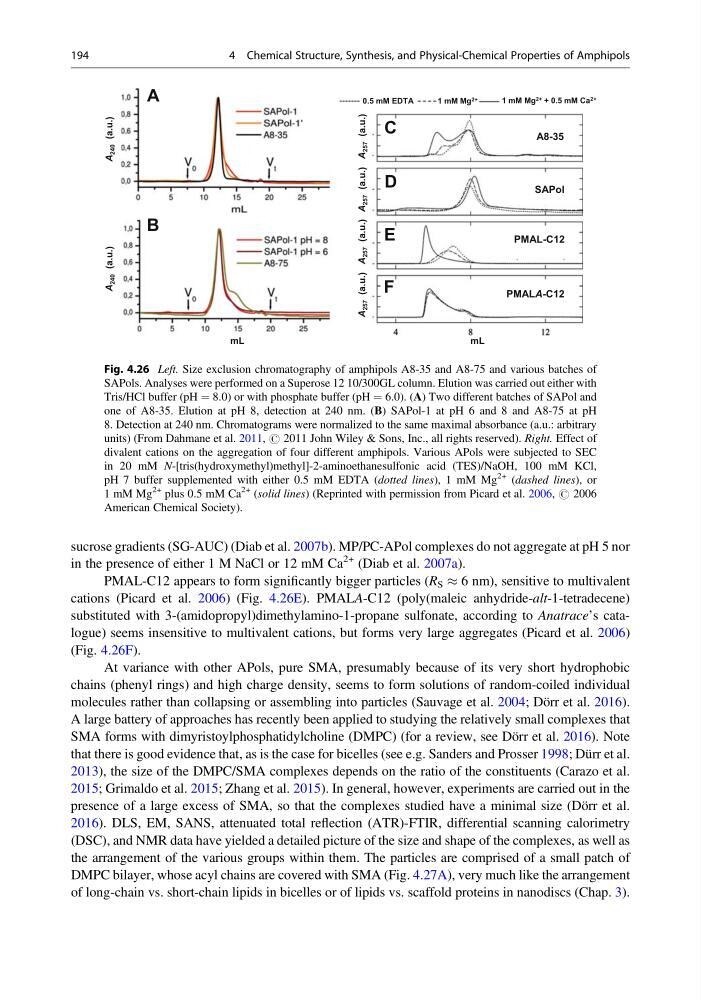
PMAL-C12 appears to form significantly bigger particles (R S % 6 nm), sensitive to multivalent
cations (Picard et al. 2006) (Fig. 4.26E). PMALA-C12 (poly(maleic anhydride-alt-1-tetradecene)
substituted with 3-(amidopropyl)dimethylamino-1-propane sulfonate, according to Anatrace’s catalogue) seems insensitive to multivalent cations, but forms very large aggregates (Picard et al. 2006)
(Fig. 4.26F).
At variance with other APols, pure SMA, presumably because of its very short hydrophobic
chains (phenyl rings) and high charge density, seems to form solutions of random-coiled individual
molecules rather than collapsing or assembling into particles (Sauvage et al. 2004; Dörr et al. 2016).
A large battery of approaches has recently been applied to studying the relatively small complexes that
SMA forms with dimyristoylphosphatidylcholine (DMPC) (for a review, see Dörr et al. 2016). Note
that there is good evidence that, as is the case for bicelles (see e.g. Sanders and Prosser 1998; Dürr et al.
2013), the size of the DMPC/SMA complexes depends on the ratio of the constituents (Carazo et al.
2015; Grimaldo et al. 2015; Zhang et al. 2015). In general, however, experiments are carried out in the
presence of a large excess of SMA, so that the complexes studied have a minimal size (Dörr et al.
2016). DLS, EM, SANS, attenuated total reflection (ATR)-FTIR, differential scanning calorimetry
(DSC), and NMR data have yielded a detailed picture of the size and shape of the complexes, as well as
the arrangement of the various groups within them. The particles are comprised of a small patch of
DMPC bilayer, whose acyl chains are covered with SMA (Fig. 4.27A), very much like the arrangement
of long-chain vs. short-chain lipids in bicelles or of lipids vs. scaffold proteins in nanodiscs (Chap. 3).
0.5 mM EDTA
1 mM Mg 2+
1 mM Mg 2+ + 0.5 mM Ca 2+
mL
mL
A
240 (a.u.)
A
240 (a.u.)
A
257 (a.u.)
A
257 (a.u.)
A
257 (a.u.)
A
257 (a.u.)
A
B
C
D
E
F
A8-35
SAPol
PMAL-C12
PMALA-C12
Fig. 4.26 Left. Size exclusion chromatography of amphipols A8-35 and A8-75 and various batches of
SAPols. Analyses were performed on a Superose 12 10/300GL column. Elution was carried out either with
Tris/HCl buffer (pH ¼ 8.0) or with phosphate buffer (pH ¼ 6.0). (A) Two different batches of SAPol and
one of A8-35. Elution at pH 8, detection at 240 nm. (B) SAPol-1 at pH 6 and 8 and A8-75 at pH
8. Detection at 240 nm. Chromatograms were normalized to the same maximal absorbance (a.u.: arbitrary
units) (From Dahmane et al. 2011, # 2011 John Wiley & Sons, Inc., all rights reserved). Right. Effect of
divalent cations on the aggregation of four different amphipols. Various APols were subjected to SEC
in 20 mM N-[tris(hydroxymethyl)methyl]-2-aminoethanesulfonic acid (TES)/NaOH, 100 mM KCl,
pH 7 buffer supplemented with either 0.5 mM EDTA (dotted lines), 1 mM Mg
2+ (dashed lines), or
1 mM Mg
2+ plus 0.5 mM Ca
2+ (solid lines) (Reprinted with permission from Picard et al. 2006, # 2006
American Chemical Society).
194
4 Chemical Structure, Synthesis, and Physical-Chemical Properties of Amphipols
in the presence of either 1 M NaCl or 12 mM Ca
2+ (Diab et al. 2007a).
PMAL-C12 appears to form significantly bigger particles (R S % 6 nm), sensitive to multivalent
cations (Picard et al. 2006) (Fig. 4.26E). PMALA-C12 (poly(maleic anhydride-alt-1-tetradecene)
substituted with 3-(amidopropyl)dimethylamino-1-propane sulfonate, according to Anatrace’s catalogue) seems insensitive to multivalent cations, but forms very large aggregates (Picard et al. 2006)
(Fig. 4.26F).
At variance with other APols, pure SMA, presumably because of its very short hydrophobic
chains (phenyl rings) and high charge density, seems to form solutions of random-coiled individual
molecules rather than collapsing or assembling into particles (Sauvage et al. 2004; Dörr et al. 2016).
A large battery of approaches has recently been applied to studying the relatively small complexes that
SMA forms with dimyristoylphosphatidylcholine (DMPC) (for a review, see Dörr et al. 2016). Note
that there is good evidence that, as is the case for bicelles (see e.g. Sanders and Prosser 1998; Dürr et al.
2013), the size of the DMPC/SMA complexes depends on the ratio of the constituents (Carazo et al.
2015; Grimaldo et al. 2015; Zhang et al. 2015). In general, however, experiments are carried out in the
presence of a large excess of SMA, so that the complexes studied have a minimal size (Dörr et al.
2016). DLS, EM, SANS, attenuated total reflection (ATR)-FTIR, differential scanning calorimetry
(DSC), and NMR data have yielded a detailed picture of the size and shape of the complexes, as well as
the arrangement of the various groups within them. The particles are comprised of a small patch of
DMPC bilayer, whose acyl chains are covered with SMA (Fig. 4.27A), very much like the arrangement
of long-chain vs. short-chain lipids in bicelles or of lipids vs. scaffold proteins in nanodiscs (Chap. 3).
0.5 mM EDTA
1 mM Mg 2+
1 mM Mg 2+ + 0.5 mM Ca 2+
mL
mL
A
240 (a.u.)
A
240 (a.u.)
A
257 (a.u.)
A
257 (a.u.)
A
257 (a.u.)
A
257 (a.u.)
A
B
C
D
E
F
A8-35
SAPol
PMAL-C12
PMALA-C12
Fig. 4.26 Left. Size exclusion chromatography of amphipols A8-35 and A8-75 and various batches of
SAPols. Analyses were performed on a Superose 12 10/300GL column. Elution was carried out either with
Tris/HCl buffer (pH ¼ 8.0) or with phosphate buffer (pH ¼ 6.0). (A) Two different batches of SAPol and
one of A8-35. Elution at pH 8, detection at 240 nm. (B) SAPol-1 at pH 6 and 8 and A8-75 at pH
8. Detection at 240 nm. Chromatograms were normalized to the same maximal absorbance (a.u.: arbitrary
units) (From Dahmane et al. 2011, # 2011 John Wiley & Sons, Inc., all rights reserved). Right. Effect of
divalent cations on the aggregation of four different amphipols. Various APols were subjected to SEC
in 20 mM N-[tris(hydroxymethyl)methyl]-2-aminoethanesulfonic acid (TES)/NaOH, 100 mM KCl,
pH 7 buffer supplemented with either 0.5 mM EDTA (dotted lines), 1 mM Mg
2+ (dashed lines), or
1 mM Mg
2+ plus 0.5 mM Ca
2+ (solid lines) (Reprinted with permission from Picard et al. 2006, # 2006
American Chemical Society).
194
4 Chemical Structure, Synthesis, and Physical-Chemical Properties of Amphipols