

larger particles, with R H typically in the range of 15–20 nm (Liu et al. 2007), and to trap hydrophobic,
non-membrane proteins (oleosins) in the form of much larger complexes than A8-35 and A8-75 do
(Gohon et al. 2011).
Phosphorylcholine-based zwitterionic APols (PC-APols), whose net charge is very low at
neutral pH, also form particles of a similar size as those of A8-35 (Diab et al. 2007b), as estimated
by DLS. Being denser, these particles migrate faster than A8-35 particles upon ultracentrifugation on
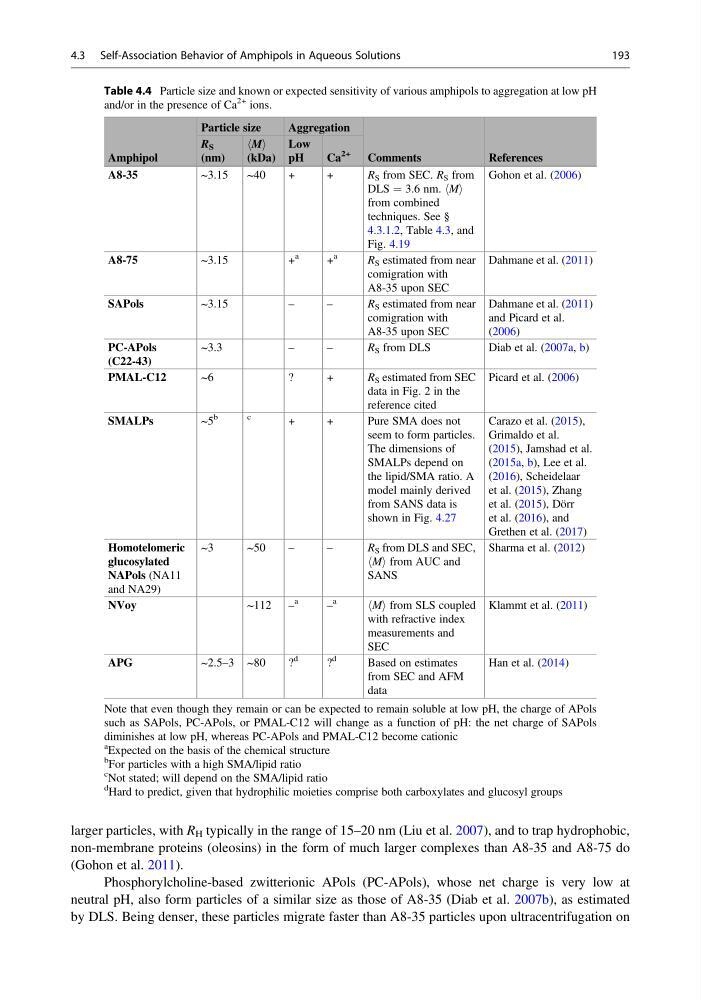
Table 4.4 Particle size and known or expected sensitivity of various amphipols to aggregation at low pH
and/or in the presence of Ca
2+ ions.
Amphipol
Particle size
Aggregation
Comments
References
R S
(nm)
hMi
(kDa)
Low
pH
Ca
2+
A8-35
~3.15
~40
+
+
R S from SEC. R S from
DLS ¼ 3.6 nm. hMi
from combined
techniques. See §
4.3.1.2, Table 4.3, and
Fig. 4.19
Gohon et al. (2006)
A8-75
~3.15
+
a
+
a
R S estimated from near
comigration with
A8-35 upon SEC
Dahmane et al. (2011)
SAPols
~3.15
–
–
R S estimated from near
comigration with
A8-35 upon SEC
Dahmane et al. (2011)
and Picard et al.
(2006)
PC-APols
(C22-43)
~3.3
–
–
R S from DLS
Diab et al. (2007a, b)
PMAL-C12
~6
?
+
R S estimated from SEC
data in Fig. 2 in the
reference cited
Picard et al. (2006)
SMALPs
~5
b
c
+
+
Pure SMA does not
seem to form particles.
The dimensions of
SMALPs depend on
the lipid/SMA ratio. A
model mainly derived
from SANS data is
shown in Fig. 4.27
Carazo et al. (2015),
Grimaldo et al.
(2015), Jamshad et al.
(2015a, b), Lee et al.
(2016), Scheidelaar
et al. (2015), Zhang
et al. (2015), Dörr
et al. (2016), and
Grethen et al. (2017)
Homotelomeric
glucosylated
NAPols (NA11
and NA29)
~3
~50
–
–
R S from DLS and SEC,
hMi from AUC and
SANS
Sharma et al. (2012)
NVoy
~112 –
a
–
a
hMi from SLS coupled
with refractive index
measurements and
SEC
Klammt et al. (2011)
APG
~2.5–3 ~80
?
d
?
d
Based on estimates
from SEC and AFM
data
Han et al. (2014)
Note that even though they remain or can be expected to remain soluble at low pH, the charge of APols
such as SAPols, PC-APols, or PMAL-C12 will change as a function of pH: the net charge of SAPols
diminishes at low pH, whereas PC-APols and PMAL-C12 become cationic
a Expected on the basis of the chemical structure
b
For particles with a high SMA/lipid ratio
c Not stated; will depend on the SMA/lipid ratio
d
Hard to predict, given that hydrophilic moieties comprise both carboxylates and glucosyl groups
4.3 Self-Association Behavior of Amphipols in Aqueous Solutions
193
non-membrane proteins (oleosins) in the form of much larger complexes than A8-35 and A8-75 do
(Gohon et al. 2011).
Phosphorylcholine-based zwitterionic APols (PC-APols), whose net charge is very low at
neutral pH, also form particles of a similar size as those of A8-35 (Diab et al. 2007b), as estimated
by DLS. Being denser, these particles migrate faster than A8-35 particles upon ultracentrifugation on
Table 4.4 Particle size and known or expected sensitivity of various amphipols to aggregation at low pH
and/or in the presence of Ca
2+ ions.
Amphipol
Particle size
Aggregation
Comments
References
R S
(nm)
hMi
(kDa)
Low
pH
Ca
2+
A8-35
~3.15
~40
+
+
R S from SEC. R S from
DLS ¼ 3.6 nm. hMi
from combined
techniques. See §
4.3.1.2, Table 4.3, and
Fig. 4.19
Gohon et al. (2006)
A8-75
~3.15
+
a
+
a
R S estimated from near
comigration with
A8-35 upon SEC
Dahmane et al. (2011)
SAPols
~3.15
–
–
R S estimated from near
comigration with
A8-35 upon SEC
Dahmane et al. (2011)
and Picard et al.
(2006)
PC-APols
(C22-43)
~3.3
–
–
R S from DLS
Diab et al. (2007a, b)
PMAL-C12
~6
?
+
R S estimated from SEC
data in Fig. 2 in the
reference cited
Picard et al. (2006)
SMALPs
~5
b
c
+
+
Pure SMA does not
seem to form particles.
The dimensions of
SMALPs depend on
the lipid/SMA ratio. A
model mainly derived
from SANS data is
shown in Fig. 4.27
Carazo et al. (2015),
Grimaldo et al.
(2015), Jamshad et al.
(2015a, b), Lee et al.
(2016), Scheidelaar
et al. (2015), Zhang
et al. (2015), Dörr
et al. (2016), and
Grethen et al. (2017)
Homotelomeric
glucosylated
NAPols (NA11
and NA29)
~3
~50
–
–
R S from DLS and SEC,
hMi from AUC and
SANS
Sharma et al. (2012)
NVoy
~112 –
a
–
a
hMi from SLS coupled
with refractive index
measurements and
SEC
Klammt et al. (2011)
APG
~2.5–3 ~80
?
d
?
d
Based on estimates
from SEC and AFM
data
Han et al. (2014)
Note that even though they remain or can be expected to remain soluble at low pH, the charge of APols
such as SAPols, PC-APols, or PMAL-C12 will change as a function of pH: the net charge of SAPols
diminishes at low pH, whereas PC-APols and PMAL-C12 become cationic
a Expected on the basis of the chemical structure
b
For particles with a high SMA/lipid ratio
c Not stated; will depend on the SMA/lipid ratio
d
Hard to predict, given that hydrophilic moieties comprise both carboxylates and glucosyl groups
4.3 Self-Association Behavior of Amphipols in Aqueous Solutions
193