

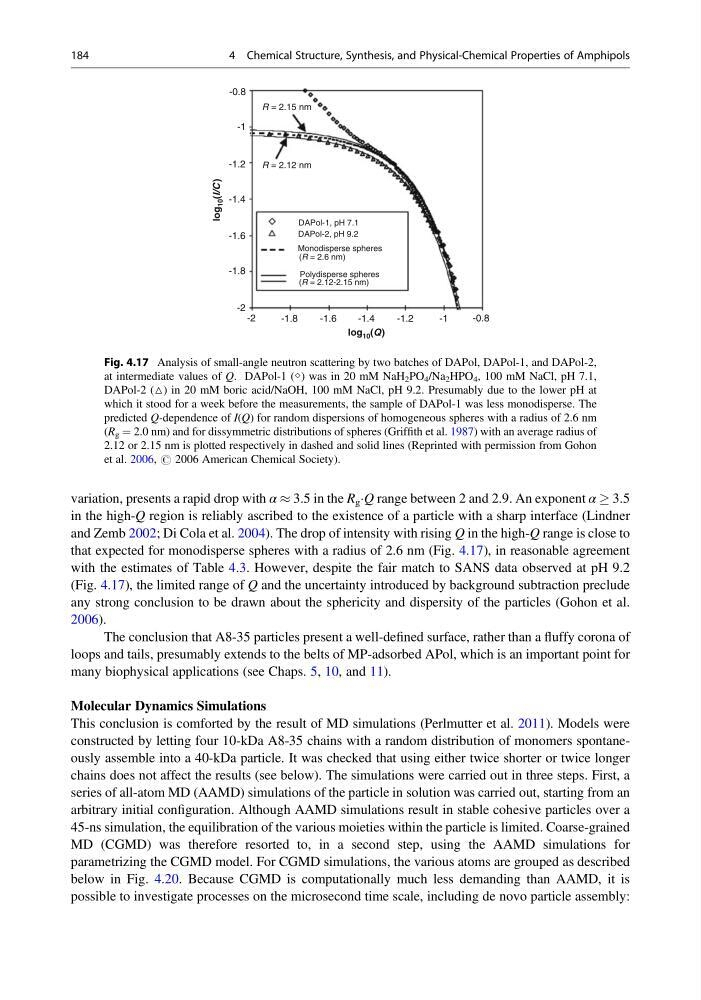
variation, presents a rapid drop with α % 3.5 in the R g ÁQ range between 2 and 2.9. An exponent α ! 3.5
in the high-Q region is reliably ascribed to the existence of a particle with a sharp interface (Lindner
and Zemb 2002; Di Cola et al. 2004). The drop of intensity with rising Q in the high-Q range is close to
that expected for monodisperse spheres with a radius of 2.6 nm (Fig. 4.17), in reasonable agreement
with the estimates of Table 4.3. However, despite the fair match to SANS data observed at pH 9.2
(Fig. 4.17), the limited range of Q and the uncertainty introduced by background subtraction preclude
any strong conclusion to be drawn about the sphericity and dispersity of the particles (Gohon et al.
2006).
The conclusion that A8-35 particles present a well-defined surface, rather than a fluffy corona of
loops and tails, presumably extends to the belts of MP-adsorbed APol, which is an important point for
many biophysical applications (see Chaps. 5, 10, and 11).
Molecular Dynamics Simulations
This conclusion is comforted by the result of MD simulations (Perlmutter et al. 2011). Models were
constructed by letting four 10-kDa A8-35 chains with a random distribution of monomers spontaneously assemble into a 40-kDa particle. It was checked that using either twice shorter or twice longer
chains does not affect the results (see below). The simulations were carried out in three steps. First, a
series of all-atom MD (AAMD) simulations of the particle in solution was carried out, starting from an
arbitrary initial configuration. Although AAMD simulations result in stable cohesive particles over a
45-ns simulation, the equilibration of the various moieties within the particle is limited. Coarse-grained
MD (CGMD) was therefore resorted to, in a second step, using the AAMD simulations for
parametrizing the CGMD model. For CGMD simulations, the various atoms are grouped as described
below in Fig. 4.20. Because CGMD is computationally much less demanding than AAMD, it is
possible to investigate processes on the microsecond time scale, including de novo particle assembly:
-0.8
R = 2.15 nm
R = 2.12 nm
-1
-1.2
-1.4
-1.6
-1.8
-2
-2
-1.8
DAPol-1, pH 7.1
(R = 2.6 nm)
(R = 2.12-2.15 nm)
DAPol-2, pH 9.2
Monodisperse spheres
Polydisperse spheres
-1.6
log 10 (Q)
log
10 (I/C )
-1.4
-1.2
-1
-0.8
Fig. 4.17 Analysis of small-angle neutron scattering by two batches of DAPol, DAPol-1, and DAPol-2,
at intermediate values of Q. DAPol-1 (◇) was in 20 mM NaH 2 PO 4 /Na 2 HPO 4 , 100 mM NaCl, pH 7.1,
DAPol-2 (△) in 20 mM boric acid/NaOH, 100 mM NaCl, pH 9.2. Presumably due to the lower pH at
which it stood for a week before the measurements, the sample of DAPol-1 was less monodisperse. The
predicted Q-dependence of I(Q) for random dispersions of homogeneous spheres with a radius of 2.6 nm
(R g ¼ 2.0 nm) and for dissymmetric distributions of spheres (Griffith et al. 1987) with an average radius of
2.12 or 2.15 nm is plotted respectively in dashed and solid lines (Reprinted with permission from Gohon
et al. 2006, # 2006 American Chemical Society).
184
4 Chemical Structure, Synthesis, and Physical-Chemical Properties of Amphipols
in the high-Q region is reliably ascribed to the existence of a particle with a sharp interface (Lindner
and Zemb 2002; Di Cola et al. 2004). The drop of intensity with rising Q in the high-Q range is close to
that expected for monodisperse spheres with a radius of 2.6 nm (Fig. 4.17), in reasonable agreement
with the estimates of Table 4.3. However, despite the fair match to SANS data observed at pH 9.2
(Fig. 4.17), the limited range of Q and the uncertainty introduced by background subtraction preclude
any strong conclusion to be drawn about the sphericity and dispersity of the particles (Gohon et al.
2006).
The conclusion that A8-35 particles present a well-defined surface, rather than a fluffy corona of
loops and tails, presumably extends to the belts of MP-adsorbed APol, which is an important point for
many biophysical applications (see Chaps. 5, 10, and 11).
Molecular Dynamics Simulations
This conclusion is comforted by the result of MD simulations (Perlmutter et al. 2011). Models were
constructed by letting four 10-kDa A8-35 chains with a random distribution of monomers spontaneously assemble into a 40-kDa particle. It was checked that using either twice shorter or twice longer
chains does not affect the results (see below). The simulations were carried out in three steps. First, a
series of all-atom MD (AAMD) simulations of the particle in solution was carried out, starting from an
arbitrary initial configuration. Although AAMD simulations result in stable cohesive particles over a
45-ns simulation, the equilibration of the various moieties within the particle is limited. Coarse-grained
MD (CGMD) was therefore resorted to, in a second step, using the AAMD simulations for
parametrizing the CGMD model. For CGMD simulations, the various atoms are grouped as described
below in Fig. 4.20. Because CGMD is computationally much less demanding than AAMD, it is
possible to investigate processes on the microsecond time scale, including de novo particle assembly:
-0.8
R = 2.15 nm
R = 2.12 nm
-1
-1.2
-1.4
-1.6
-1.8
-2
-2
-1.8
DAPol-1, pH 7.1
(R = 2.6 nm)
(R = 2.12-2.15 nm)
DAPol-2, pH 9.2
Monodisperse spheres
Polydisperse spheres
-1.6
log 10 (Q)
log
10 (I/C )
-1.4
-1.2
-1
-0.8
Fig. 4.17 Analysis of small-angle neutron scattering by two batches of DAPol, DAPol-1, and DAPol-2,
at intermediate values of Q. DAPol-1 (◇) was in 20 mM NaH 2 PO 4 /Na 2 HPO 4 , 100 mM NaCl, pH 7.1,
DAPol-2 (△) in 20 mM boric acid/NaOH, 100 mM NaCl, pH 9.2. Presumably due to the lower pH at
which it stood for a week before the measurements, the sample of DAPol-1 was less monodisperse. The
predicted Q-dependence of I(Q) for random dispersions of homogeneous spheres with a radius of 2.6 nm
(R g ¼ 2.0 nm) and for dissymmetric distributions of spheres (Griffith et al. 1987) with an average radius of
2.12 or 2.15 nm is plotted respectively in dashed and solid lines (Reprinted with permission from Gohon
et al. 2006, # 2006 American Chemical Society).
184
4 Chemical Structure, Synthesis, and Physical-Chemical Properties of Amphipols