

chains, induce the formation of larger assemblies. Guidelines are provided in Gohon et al.
(2006), about how to avoid this problem (cf. § 4.5, Protocol 4.1).
• Above pH 7, most of the free carboxylates carried by A8-35 are dissociated (Gohon et al. 2004).
Acidification of the solutions below pH 7 causes some of them to protonate, increasing the
hydrophobicity of A8-35 and promoting aggregation, which develops, even at a pH as high as
6.8 or 7.1, over a period of hours (Gohon et al. 2006). The process reverses in a few minutes if
the pH is raised again. From a practical point of view, a procedure that yields stable solutions of
well-dispersed small particles is to dissolve the sodium salt of A8-35 in distilled water. The pH
of the resulting stock solutions is ~8.5. Stock solutions in water can be stored frozen to prevent
bacterial growth. Dilute solutions should be buffered, preferably at pH ! 7.5, or kept under
neutral gas so as to prevent acidification by atmospheric CO 2 (Gohon et al. 2006).
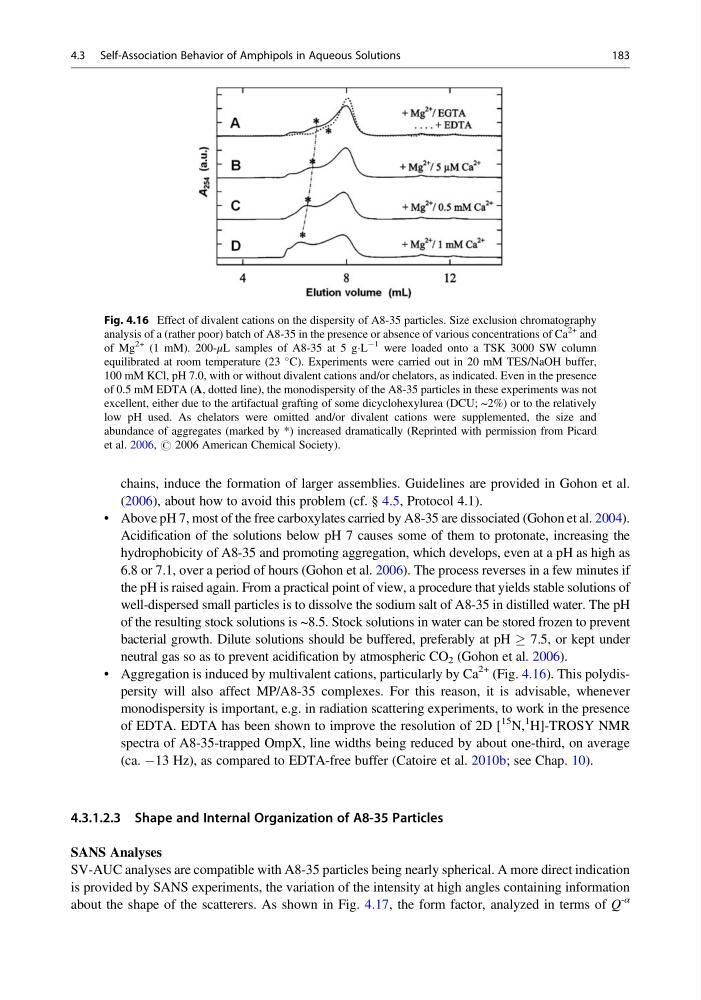
• Aggregation is induced by multivalent cations, particularly by Ca
2+ (Fig. 4.16). This polydispersity will also affect MP/A8-35 complexes. For this reason, it is advisable, whenever
monodispersity is important, e.g. in radiation scattering experiments, to work in the presence
of EDTA. EDTA has been shown to improve the resolution of 2D [
15 N,
1 H]-TROSY NMR
spectra of A8-35-trapped OmpX, line widths being reduced by about one-third, on average
(ca. À13 Hz), as compared to EDTA-free buffer (Catoire et al. 2010b; see Chap. 10).
4.3.1.2.3 Shape and Internal Organization of A8-35 Particles
SANS Analyses
SV-AUC analyses are compatible with A8-35 particles being nearly spherical. A more direct indication
is provided by SANS experiments, the variation of the intensity at high angles containing information
about the shape of the scatterers. As shown in Fig. 4.17, the form factor, analyzed in terms of Q
-α
Fig. 4.16 Effect of divalent cations on the dispersity of A8-35 particles. Size exclusion chromatography
analysis of a (rather poor) batch of A8-35 in the presence or absence of various concentrations of Ca
2+ and
of Mg
2+ (1 mM). 200-μL samples of A8-35 at 5 gÁL
À1 were loaded onto a TSK 3000 SW column
equilibrated at room temperature (23
C). Experiments were carried out in 20 mM TES/NaOH buffer,
100 mM KCl, pH 7.0, with or without divalent cations and/or chelators, as indicated. Even in the presence
of 0.5 mM EDTA (A, dotted line), the monodispersity of the A8-35 particles in these experiments was not
excellent, either due to the artifactual grafting of some dicyclohexylurea (DCU; ~2%) or to the relatively
low pH used. As chelators were omitted and/or divalent cations were supplemented, the size and
abundance of aggregates (marked by *) increased dramatically (Reprinted with permission from Picard
et al. 2006, # 2006 American Chemical Society).
4.3 Self-Association Behavior of Amphipols in Aqueous Solutions
183
(2006), about how to avoid this problem (cf. § 4.5, Protocol 4.1).
• Above pH 7, most of the free carboxylates carried by A8-35 are dissociated (Gohon et al. 2004).
Acidification of the solutions below pH 7 causes some of them to protonate, increasing the
hydrophobicity of A8-35 and promoting aggregation, which develops, even at a pH as high as
6.8 or 7.1, over a period of hours (Gohon et al. 2006). The process reverses in a few minutes if
the pH is raised again. From a practical point of view, a procedure that yields stable solutions of
well-dispersed small particles is to dissolve the sodium salt of A8-35 in distilled water. The pH
of the resulting stock solutions is ~8.5. Stock solutions in water can be stored frozen to prevent
bacterial growth. Dilute solutions should be buffered, preferably at pH ! 7.5, or kept under
neutral gas so as to prevent acidification by atmospheric CO 2 (Gohon et al. 2006).
• Aggregation is induced by multivalent cations, particularly by Ca
2+ (Fig. 4.16). This polydispersity will also affect MP/A8-35 complexes. For this reason, it is advisable, whenever
monodispersity is important, e.g. in radiation scattering experiments, to work in the presence
of EDTA. EDTA has been shown to improve the resolution of 2D [
15 N,
1 H]-TROSY NMR
spectra of A8-35-trapped OmpX, line widths being reduced by about one-third, on average
(ca. À13 Hz), as compared to EDTA-free buffer (Catoire et al. 2010b; see Chap. 10).
4.3.1.2.3 Shape and Internal Organization of A8-35 Particles
SANS Analyses
SV-AUC analyses are compatible with A8-35 particles being nearly spherical. A more direct indication
is provided by SANS experiments, the variation of the intensity at high angles containing information
about the shape of the scatterers. As shown in Fig. 4.17, the form factor, analyzed in terms of Q
-α
Fig. 4.16 Effect of divalent cations on the dispersity of A8-35 particles. Size exclusion chromatography
analysis of a (rather poor) batch of A8-35 in the presence or absence of various concentrations of Ca
2+ and
of Mg
2+ (1 mM). 200-μL samples of A8-35 at 5 gÁL
À1 were loaded onto a TSK 3000 SW column
equilibrated at room temperature (23
C). Experiments were carried out in 20 mM TES/NaOH buffer,
100 mM KCl, pH 7.0, with or without divalent cations and/or chelators, as indicated. Even in the presence
of 0.5 mM EDTA (A, dotted line), the monodispersity of the A8-35 particles in these experiments was not
excellent, either due to the artifactual grafting of some dicyclohexylurea (DCU; ~2%) or to the relatively
low pH used. As chelators were omitted and/or divalent cations were supplemented, the size and
abundance of aggregates (marked by *) increased dramatically (Reprinted with permission from Picard
et al. 2006, # 2006 American Chemical Society).
4.3 Self-Association Behavior of Amphipols in Aqueous Solutions
183