

4.3.1.2.2 Homogeneity, Mass, and Size of A8-35 Particles
Whereas individual A8-35 molecules are heterogeneous, they assemble into fairly homogeneous
particles. This was first established by SEC analysis of aqueous solutions and further analyzed by
DLS, small-angle neutron and X-ray scattering (SANS and SAXS), and AUC (Table 4.2 and Figs. 4.14
and 4.15). We will first discuss the main features that come out from these analyses and then examine
some complications.
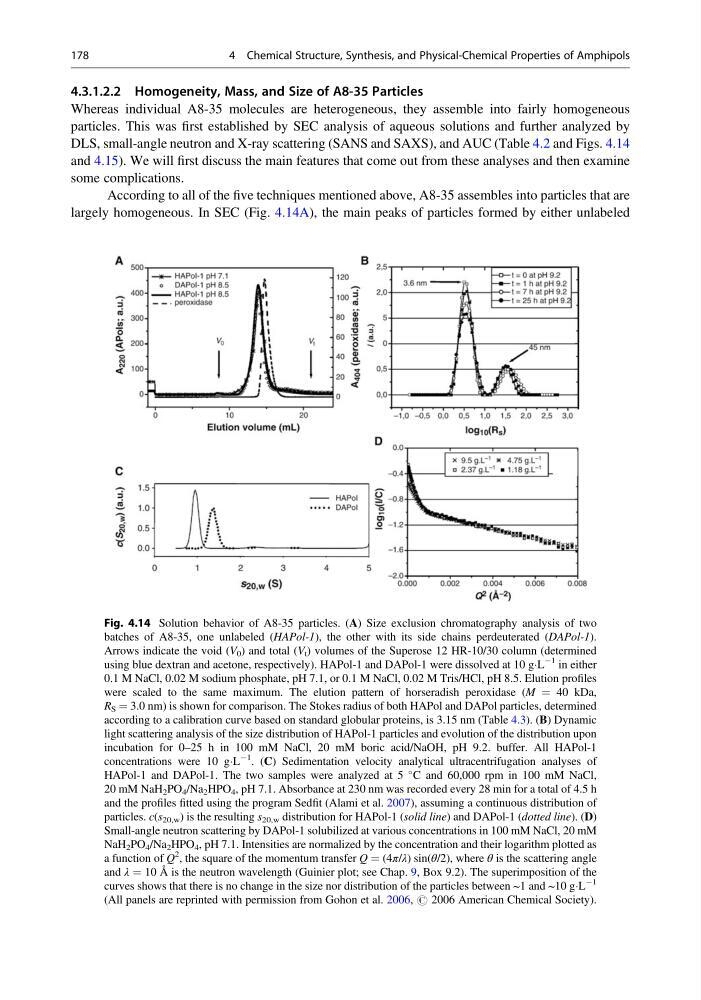
According to all of the five techniques mentioned above, A8-35 assembles into particles that are
largely homogeneous. In SEC (Fig. 4.14A), the main peaks of particles formed by either unlabeled
Fig. 4.14 Solution behavior of A8-35 particles. (A) Size exclusion chromatography analysis of two
batches of A8-35, one unlabeled (HAPol-1), the other with its side chains perdeuterated (DAPol-1).
Arrows indicate the void (V 0 ) and total (V t ) volumes of the Superose 12 HR-10/30 column (determined
using blue dextran and acetone, respectively). HAPol-1 and DAPol-1 were dissolved at 10 gÁL
À1 in either
0.1 M NaCl, 0.02 M sodium phosphate, pH 7.1, or 0.1 M NaCl, 0.02 M Tris/HCl, pH 8.5. Elution profiles
were scaled to the same maximum. The elution pattern of horseradish peroxidase (M ¼ 40 kDa,
R S ¼ 3.0 nm) is shown for comparison. The Stokes radius of both HAPol and DAPol particles, determined
according to a calibration curve based on standard globular proteins, is 3.15 nm (Table 4.3). (B) Dynamic
light scattering analysis of the size distribution of HAPol-1 particles and evolution of the distribution upon
incubation for 0–25 h in 100 mM NaCl, 20 mM boric acid/NaOH, pH 9.2. buffer. All HAPol-1
concentrations were 10 gÁL
À1
. (C) Sedimentation velocity analytical ultracentrifugation analyses of
HAPol-1 and DAPol-1. The two samples were analyzed at 5
C and 60,000 rpm in 100 mM NaCl,
20 mM NaH 2 PO 4 /Na 2 HPO 4 , pH 7.1. Absorbance at 230 nm was recorded every 28 min for a total of 4.5 h
and the profiles fitted using the program Sedfit (Alami et al. 2007), assuming a continuous distribution of
particles. c(s 20,w ) is the resulting s 20,w distribution for HAPol-1 (solid line) and DAPol-1 (dotted line). (D)
Small-angle neutron scattering by DAPol-1 solubilized at various concentrations in 100 mM NaCl, 20 mM
NaH 2 PO 4 /Na 2 HPO 4 , pH 7.1. Intensities are normalized by the concentration and their logarithm plotted as
a function of Q
2
, the square of the momentum transfer Q ¼ (4π/λ) sin(θ/2), where θ is the scattering angle
and λ ¼ 10 Å is the neutron wavelength (Guinier plot; see Chap. 9, Box 9.2). The superimposition of the
curves shows that there is no change in the size nor distribution of the particles between ~1 and ~10 gÁL
À1
(All panels are reprinted with permission from Gohon et al. 2006, # 2006 American Chemical Society).
178
4 Chemical Structure, Synthesis, and Physical-Chemical Properties of Amphipols
Whereas individual A8-35 molecules are heterogeneous, they assemble into fairly homogeneous
particles. This was first established by SEC analysis of aqueous solutions and further analyzed by
DLS, small-angle neutron and X-ray scattering (SANS and SAXS), and AUC (Table 4.2 and Figs. 4.14
and 4.15). We will first discuss the main features that come out from these analyses and then examine
some complications.
According to all of the five techniques mentioned above, A8-35 assembles into particles that are
largely homogeneous. In SEC (Fig. 4.14A), the main peaks of particles formed by either unlabeled
Fig. 4.14 Solution behavior of A8-35 particles. (A) Size exclusion chromatography analysis of two
batches of A8-35, one unlabeled (HAPol-1), the other with its side chains perdeuterated (DAPol-1).
Arrows indicate the void (V 0 ) and total (V t ) volumes of the Superose 12 HR-10/30 column (determined
using blue dextran and acetone, respectively). HAPol-1 and DAPol-1 were dissolved at 10 gÁL
À1 in either
0.1 M NaCl, 0.02 M sodium phosphate, pH 7.1, or 0.1 M NaCl, 0.02 M Tris/HCl, pH 8.5. Elution profiles
were scaled to the same maximum. The elution pattern of horseradish peroxidase (M ¼ 40 kDa,
R S ¼ 3.0 nm) is shown for comparison. The Stokes radius of both HAPol and DAPol particles, determined
according to a calibration curve based on standard globular proteins, is 3.15 nm (Table 4.3). (B) Dynamic
light scattering analysis of the size distribution of HAPol-1 particles and evolution of the distribution upon
incubation for 0–25 h in 100 mM NaCl, 20 mM boric acid/NaOH, pH 9.2. buffer. All HAPol-1
concentrations were 10 gÁL
À1
. (C) Sedimentation velocity analytical ultracentrifugation analyses of
HAPol-1 and DAPol-1. The two samples were analyzed at 5
C and 60,000 rpm in 100 mM NaCl,
20 mM NaH 2 PO 4 /Na 2 HPO 4 , pH 7.1. Absorbance at 230 nm was recorded every 28 min for a total of 4.5 h
and the profiles fitted using the program Sedfit (Alami et al. 2007), assuming a continuous distribution of
particles. c(s 20,w ) is the resulting s 20,w distribution for HAPol-1 (solid line) and DAPol-1 (dotted line). (D)
Small-angle neutron scattering by DAPol-1 solubilized at various concentrations in 100 mM NaCl, 20 mM
NaH 2 PO 4 /Na 2 HPO 4 , pH 7.1. Intensities are normalized by the concentration and their logarithm plotted as
a function of Q
2
, the square of the momentum transfer Q ¼ (4π/λ) sin(θ/2), where θ is the scattering angle
and λ ¼ 10 Å is the neutron wavelength (Guinier plot; see Chap. 9, Box 9.2). The superimposition of the
curves shows that there is no change in the size nor distribution of the particles between ~1 and ~10 gÁL
À1
(All panels are reprinted with permission from Gohon et al. 2006, # 2006 American Chemical Society).
178
4 Chemical Structure, Synthesis, and Physical-Chemical Properties of Amphipols