

type and density of alkyl chains, if the main chain is longer – e.g. A34-35 vs. A8-35 – because the
entropic cost of bringing together enough alkyl chains to constitute the particle’s core will be lower.
4.3.1.2 The Size, Shape, and Organization of A8-35 Particles
Table 4.2 provides an overview of those studies providing information about the structure of the
various APols and the techniques that have been implemented to characterize the size, shape, organization, and dynamics of the particles they form in aqueous solutions. Studies that present data bearing
on A8-35 particles are highlighted in light blue. They have resorted to the following forms of A8-35:
(i) plain, unlabeled A8-35 (often noted HAPol in comparative studies with the next two forms),
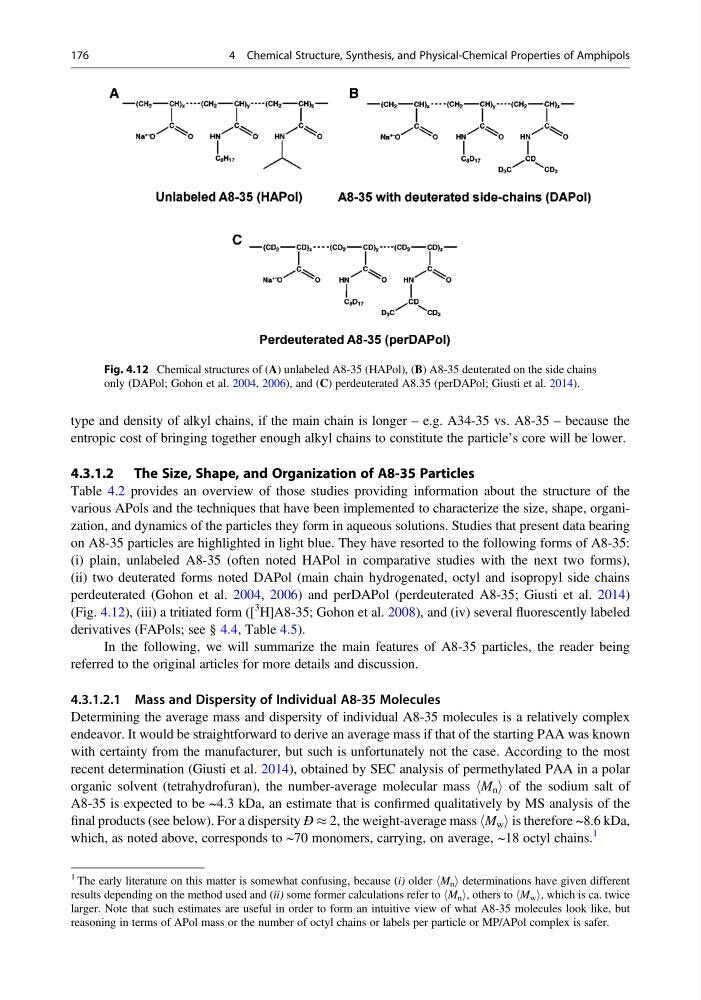
(ii) two deuterated forms noted DAPol (main chain hydrogenated, octyl and isopropyl side chains
perdeuterated (Gohon et al. 2004, 2006) and perDAPol (perdeuterated A8-35; Giusti et al. 2014)
(Fig. 4.12), (iii) a tritiated form ([
3 H]A8-35; Gohon et al. 2008), and (iv) several fluorescently labeled
derivatives (FAPols; see § 4.4, Table 4.5).
In the following, we will summarize the main features of A8-35 particles, the reader being
referred to the original articles for more details and discussion.
4.3.1.2.1 Mass and Dispersity of Individual A8-35 Molecules
Determining the average mass and dispersity of individual A8-35 molecules is a relatively complex
endeavor. It would be straightforward to derive an average mass if that of the starting PAA was known
with certainty from the manufacturer, but such is unfortunately not the case. According to the most
recent determination (Giusti et al. 2014), obtained by SEC analysis of permethylated PAA in a polar
organic solvent (tetrahydrofuran), the number-average molecular mass hM n i of the sodium salt of
A8-35 is expected to be ~4.3 kDa, an estimate that is confirmed qualitatively by MS analysis of the
final products (see below). For a dispersity Ð % 2, the weight-average mass hM w i is therefore ~8.6 kDa,
which, as noted above, corresponds to ~70 monomers, carrying, on average, ~18 octyl chains.
1
Fig. 4.12 Chemical structures of (A) unlabeled A8-35 (HAPol), (B) A8-35 deuterated on the side chains
only (DAPol; Gohon et al. 2004, 2006), and (C) perdeuterated A8.35 (perDAPol; Giusti et al. 2014).
1 The early literature on this matter is somewhat confusing, because (i) older hM n i determinations have given different
results depending on the method used and (ii) some former calculations refer to hM n i, others to hM w i, which is ca. twice
larger. Note that such estimates are useful in order to form an intuitive view of what A8-35 molecules look like, but
reasoning in terms of APol mass or the number of octyl chains or labels per particle or MP/APol complex is safer.
176
4 Chemical Structure, Synthesis, and Physical-Chemical Properties of Amphipols
entropic cost of bringing together enough alkyl chains to constitute the particle’s core will be lower.
4.3.1.2 The Size, Shape, and Organization of A8-35 Particles
Table 4.2 provides an overview of those studies providing information about the structure of the
various APols and the techniques that have been implemented to characterize the size, shape, organization, and dynamics of the particles they form in aqueous solutions. Studies that present data bearing
on A8-35 particles are highlighted in light blue. They have resorted to the following forms of A8-35:
(i) plain, unlabeled A8-35 (often noted HAPol in comparative studies with the next two forms),
(ii) two deuterated forms noted DAPol (main chain hydrogenated, octyl and isopropyl side chains
perdeuterated (Gohon et al. 2004, 2006) and perDAPol (perdeuterated A8-35; Giusti et al. 2014)
(Fig. 4.12), (iii) a tritiated form ([
3 H]A8-35; Gohon et al. 2008), and (iv) several fluorescently labeled
derivatives (FAPols; see § 4.4, Table 4.5).
In the following, we will summarize the main features of A8-35 particles, the reader being
referred to the original articles for more details and discussion.
4.3.1.2.1 Mass and Dispersity of Individual A8-35 Molecules
Determining the average mass and dispersity of individual A8-35 molecules is a relatively complex
endeavor. It would be straightforward to derive an average mass if that of the starting PAA was known
with certainty from the manufacturer, but such is unfortunately not the case. According to the most
recent determination (Giusti et al. 2014), obtained by SEC analysis of permethylated PAA in a polar
organic solvent (tetrahydrofuran), the number-average molecular mass hM n i of the sodium salt of
A8-35 is expected to be ~4.3 kDa, an estimate that is confirmed qualitatively by MS analysis of the
final products (see below). For a dispersity Ð % 2, the weight-average mass hM w i is therefore ~8.6 kDa,
which, as noted above, corresponds to ~70 monomers, carrying, on average, ~18 octyl chains.
1
Fig. 4.12 Chemical structures of (A) unlabeled A8-35 (HAPol), (B) A8-35 deuterated on the side chains
only (DAPol; Gohon et al. 2004, 2006), and (C) perdeuterated A8.35 (perDAPol; Giusti et al. 2014).
1 The early literature on this matter is somewhat confusing, because (i) older hM n i determinations have given different
results depending on the method used and (ii) some former calculations refer to hM n i, others to hM w i, which is ca. twice
larger. Note that such estimates are useful in order to form an intuitive view of what A8-35 molecules look like, but
reasoning in terms of APol mass or the number of octyl chains or labels per particle or MP/APol complex is safer.
176
4 Chemical Structure, Synthesis, and Physical-Chemical Properties of Amphipols