

over a tenfold range of concentrations (Fig. 4.10C). This is consistent with particles forming at the
CAC and retaining the same size over the whole range of concentrations investigated.
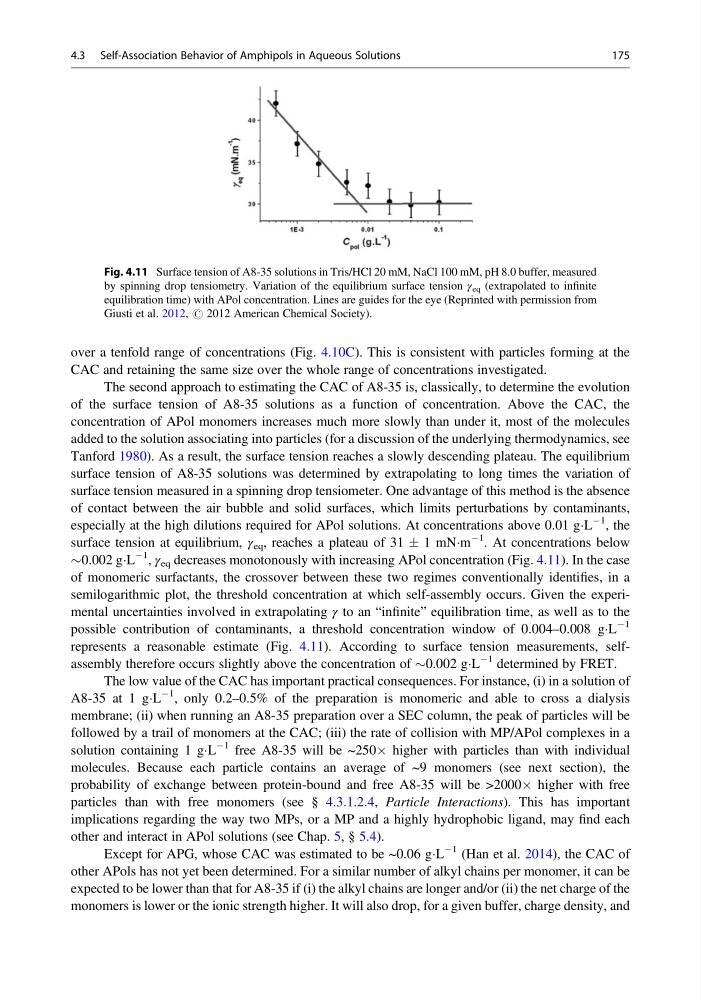
The second approach to estimating the CAC of A8-35 is, classically, to determine the evolution
of the surface tension of A8-35 solutions as a function of concentration. Above the CAC, the
concentration of APol monomers increases much more slowly than under it, most of the molecules
added to the solution associating into particles (for a discussion of the underlying thermodynamics, see
Tanford 1980). As a result, the surface tension reaches a slowly descending plateau. The equilibrium
surface tension of A8-35 solutions was determined by extrapolating to long times the variation of
surface tension measured in a spinning drop tensiometer. One advantage of this method is the absence
of contact between the air bubble and solid surfaces, which limits perturbations by contaminants,
especially at the high dilutions required for APol solutions. At concentrations above 0.01 gÁL
À1 , the
surface tension at equilibrium, γ eq , reaches a plateau of 31 Æ 1 mNÁm
À1 . At concentrations below
$0.002 gÁL
À1 , γ eq decreases monotonously with increasing APol concentration (Fig. 4.11). In the case
of monomeric surfactants, the crossover between these two regimes conventionally identifies, in a
semilogarithmic plot, the threshold concentration at which self-assembly occurs. Given the experimental uncertainties involved in extrapolating γ to an “infinite” equilibration time, as well as to the
possible contribution of contaminants, a threshold concentration window of 0.004–0.008 gÁL
À1
represents a reasonable estimate (Fig. 4.11). According to surface tension measurements, selfassembly therefore occurs slightly above the concentration of $0.002 gÁL
À1 determined by FRET.
The low value of the CAC has important practical consequences. For instance, (i) in a solution of
A8-35 at 1 gÁL
À1 , only 0.2–0.5% of the preparation is monomeric and able to cross a dialysis
membrane; (ii) when running an A8-35 preparation over a SEC column, the peak of particles will be
followed by a trail of monomers at the CAC; (iii) the rate of collision with MP/APol complexes in a
solution containing 1 gÁL
À1 free A8-35 will be ~250Â higher with particles than with individual
molecules. Because each particle contains an average of ~9 monomers (see next section), the
probability of exchange between protein-bound and free A8-35 will be >2000Â higher with free
particles than with free monomers (see § 4.3.1.2.4, Particle Interactions). This has important
implications regarding the way two MPs, or a MP and a highly hydrophobic ligand, may find each
other and interact in APol solutions (see Chap. 5, § 5.4).
Except for APG, whose CAC was estimated to be ~0.06 gÁL
À1 (Han et al. 2014), the CAC of
other APols has not yet been determined. For a similar number of alkyl chains per monomer, it can be
expected to be lower than that for A8-35 if (i) the alkyl chains are longer and/or (ii) the net charge of the
monomers is lower or the ionic strength higher. It will also drop, for a given buffer, charge density, and
Fig. 4.11 Surface tension of A8-35 solutions in Tris/HCl 20 mM, NaCl 100 mM, pH 8.0 buffer, measured
by spinning drop tensiometry. Variation of the equilibrium surface tension γ eq (extrapolated to infinite
equilibration time) with APol concentration. Lines are guides for the eye (Reprinted with permission from
Giusti et al. 2012, # 2012 American Chemical Society).
4.3 Self-Association Behavior of Amphipols in Aqueous Solutions
175
CAC and retaining the same size over the whole range of concentrations investigated.
The second approach to estimating the CAC of A8-35 is, classically, to determine the evolution
of the surface tension of A8-35 solutions as a function of concentration. Above the CAC, the
concentration of APol monomers increases much more slowly than under it, most of the molecules
added to the solution associating into particles (for a discussion of the underlying thermodynamics, see
Tanford 1980). As a result, the surface tension reaches a slowly descending plateau. The equilibrium
surface tension of A8-35 solutions was determined by extrapolating to long times the variation of
surface tension measured in a spinning drop tensiometer. One advantage of this method is the absence
of contact between the air bubble and solid surfaces, which limits perturbations by contaminants,
especially at the high dilutions required for APol solutions. At concentrations above 0.01 gÁL
À1 , the
surface tension at equilibrium, γ eq , reaches a plateau of 31 Æ 1 mNÁm
À1 . At concentrations below
$0.002 gÁL
À1 , γ eq decreases monotonously with increasing APol concentration (Fig. 4.11). In the case
of monomeric surfactants, the crossover between these two regimes conventionally identifies, in a
semilogarithmic plot, the threshold concentration at which self-assembly occurs. Given the experimental uncertainties involved in extrapolating γ to an “infinite” equilibration time, as well as to the
possible contribution of contaminants, a threshold concentration window of 0.004–0.008 gÁL
À1
represents a reasonable estimate (Fig. 4.11). According to surface tension measurements, selfassembly therefore occurs slightly above the concentration of $0.002 gÁL
À1 determined by FRET.
The low value of the CAC has important practical consequences. For instance, (i) in a solution of
A8-35 at 1 gÁL
À1 , only 0.2–0.5% of the preparation is monomeric and able to cross a dialysis
membrane; (ii) when running an A8-35 preparation over a SEC column, the peak of particles will be
followed by a trail of monomers at the CAC; (iii) the rate of collision with MP/APol complexes in a
solution containing 1 gÁL
À1 free A8-35 will be ~250Â higher with particles than with individual
molecules. Because each particle contains an average of ~9 monomers (see next section), the
probability of exchange between protein-bound and free A8-35 will be >2000Â higher with free
particles than with free monomers (see § 4.3.1.2.4, Particle Interactions). This has important
implications regarding the way two MPs, or a MP and a highly hydrophobic ligand, may find each
other and interact in APol solutions (see Chap. 5, § 5.4).
Except for APG, whose CAC was estimated to be ~0.06 gÁL
À1 (Han et al. 2014), the CAC of
other APols has not yet been determined. For a similar number of alkyl chains per monomer, it can be
expected to be lower than that for A8-35 if (i) the alkyl chains are longer and/or (ii) the net charge of the
monomers is lower or the ionic strength higher. It will also drop, for a given buffer, charge density, and
Fig. 4.11 Surface tension of A8-35 solutions in Tris/HCl 20 mM, NaCl 100 mM, pH 8.0 buffer, measured
by spinning drop tensiometry. Variation of the equilibrium surface tension γ eq (extrapolated to infinite
equilibration time) with APol concentration. Lines are guides for the eye (Reprinted with permission from
Giusti et al. 2012, # 2012 American Chemical Society).
4.3 Self-Association Behavior of Amphipols in Aqueous Solutions
175