

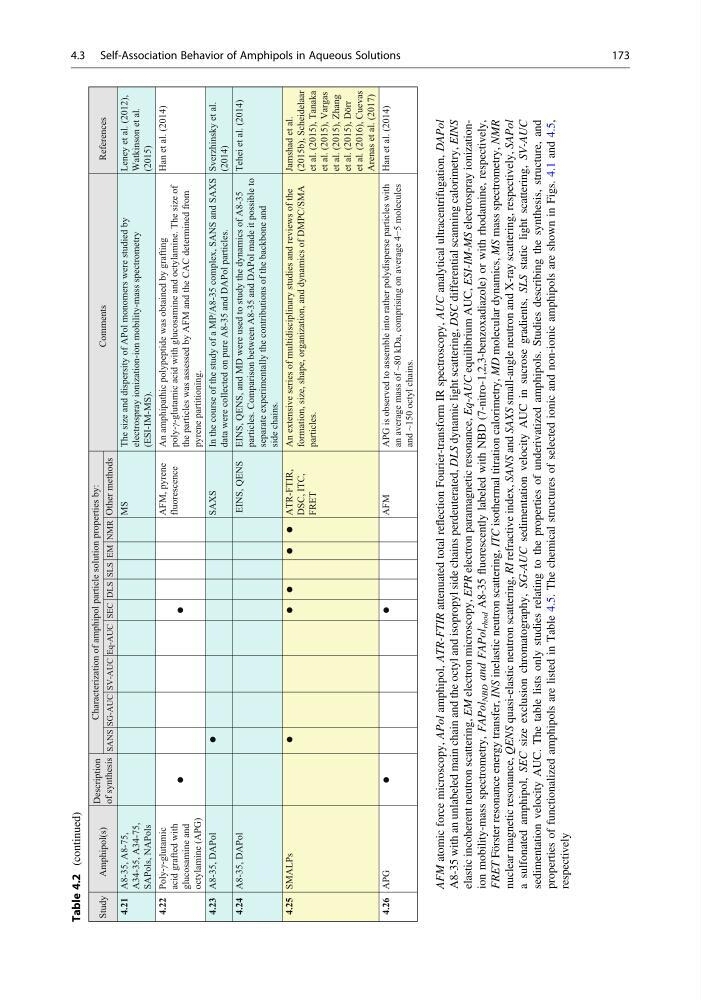
Table 4.2
(continued)
4.23 A8-35, DAPol
SAXS
In the course of the study of a MP/A8-35 complex, SANS and SAXS
data were collected on pure A8-35 and DAPol particles.
Sverzhinsky et al.
(2014)
4.24 A8-35,
DAPol
EINS, QENS EINS, QENS, and MD were used to study the dynamics of A8-35
particles. Comparison between A8-35
and DAPol made it possible to
separate experimentally the contributions of the backbone and
side chains.
Tehei et al.
(2014)
4.25 SMALPs
ATR-FTIR,
DSC, ITC,
FRET
An extensive series of multidisciplinary studies and reviews of the
formation, size, shape, organization, and dynamics of DMPC/SMA
particles.
Jamshad et al.
(2015b), Scheidelaar
et al.
(2015), Tanaka
et al.
(2015), Vargas
et al.
(2015), Zhang
et al.
(2015), Dörr
et al. (2016), Cuevas
Arenas et al.
(2017)
4.26 APG
AFM
APG is observed to assemble into rather polydisperse particles with
an average mass of ~80 kDa, comprising on average 4−5 molecules
and ~150 octyl chains.
Han et al.
(2014)
4.21
MS
4.22 Poly-γ-glutamic
acid grafted with
glucosamine and
octylamine (APG)
AFM, pyrene
fluorescence
An amphipathic polypeptide was obtained by grafting
poly-γ-glutamic acid with glucosamine
and octylamine. The size of
the particles was assessed by AFM and the CAC determined from
pyrene partitioning.
Study
Amphipol(s)
Description
of synthesis
Characterization of amphipol particle solution properties by:
Comments
References
SANS SG-AUC SV-AUC Eq-AUC
SEC DLS SLS EM NMR Other methods
A8-35, A8-75,
A34-35,
A34-75,
SAPols, NAPols
The size and dispersity of APol monomers were studied by
electrospray ionization-ion mobility-mass spectrometry
(ESI-IM-MS).
Leney et al. (2012),
Watkinson et al.
(2015)
Han et al. (2014)
AFM
atomic force microscopy, APol
amphipol, ATR-FTIR
attenuated total reflection Fourier-transform IR spectroscopy, AUC
analytical ultracentrifugation, DAPol
A8-35 with an unlabeled main chain and the octyl and isopropyl side chains perdeuterated, DLS
dynamic light scattering, DSC
differential scanning calorimetry, EINS
elastic incoherent neutron scattering, EM
electron microscopy, EPR
electron paramagnetic resonance, Eq-AUC
equilibrium AUC, ESI-IM-MS
electrospray ionizationion mobility-mass spectrometry, FAPol
NBD and FAPol
rhod A8-35
fluorescently labeled with NBD (7-nitro-1,2,3-benzoxadiazole) or with rhodamine, respectively,
FRET
Förster resonance energy transfer, INS
inelastic neutron scattering, ITC
isothermal titration calorimetry, MD
molecular dynamics, MS
mass spectrometry, NMR
nuclear magnetic resonance, QENS
quasi-elastic neutron scattering, RI
refractive index, SANS
and SAXS
small-angle neutron and X-ray scattering, respectively, SAPol
a sulfonated amphipol, SEC
size exclusion chromatography, SG-AUC
sedimentation velocity AUC in sucrose gradients, SLS
static light scattering, SV-AUC
sedimentation velocity AUC. The table lists only studies relating to the properties of underivatized amphipols. Studies describing the synthesis, structure, and
properties of functionalized amphipols are listed in Table 4.5. The chemical structures of selected ionic and non-ionic amphipols are shown in Figs. 4.1 and 4.5,
respectively
4.3 Self-Association Behavior of Amphipols in Aqueous Solutions
173
(continued)
4.23 A8-35, DAPol
SAXS
In the course of the study of a MP/A8-35 complex, SANS and SAXS
data were collected on pure A8-35 and DAPol particles.
Sverzhinsky et al.
(2014)
4.24 A8-35,
DAPol
EINS, QENS EINS, QENS, and MD were used to study the dynamics of A8-35
particles. Comparison between A8-35
and DAPol made it possible to
separate experimentally the contributions of the backbone and
side chains.
Tehei et al.
(2014)
4.25 SMALPs
ATR-FTIR,
DSC, ITC,
FRET
An extensive series of multidisciplinary studies and reviews of the
formation, size, shape, organization, and dynamics of DMPC/SMA
particles.
Jamshad et al.
(2015b), Scheidelaar
et al.
(2015), Tanaka
et al.
(2015), Vargas
et al.
(2015), Zhang
et al.
(2015), Dörr
et al. (2016), Cuevas
Arenas et al.
(2017)
4.26 APG
AFM
APG is observed to assemble into rather polydisperse particles with
an average mass of ~80 kDa, comprising on average 4−5 molecules
and ~150 octyl chains.
Han et al.
(2014)
4.21
MS
4.22 Poly-γ-glutamic
acid grafted with
glucosamine and
octylamine (APG)
AFM, pyrene
fluorescence
An amphipathic polypeptide was obtained by grafting
poly-γ-glutamic acid with glucosamine
and octylamine. The size of
the particles was assessed by AFM and the CAC determined from
pyrene partitioning.
Study
Amphipol(s)
Description
of synthesis
Characterization of amphipol particle solution properties by:
Comments
References
SANS SG-AUC SV-AUC Eq-AUC
SEC DLS SLS EM NMR Other methods
A8-35, A8-75,
A34-35,
A34-75,
SAPols, NAPols
The size and dispersity of APol monomers were studied by
electrospray ionization-ion mobility-mass spectrometry
(ESI-IM-MS).
Leney et al. (2012),
Watkinson et al.
(2015)
Han et al. (2014)
AFM
atomic force microscopy, APol
amphipol, ATR-FTIR
attenuated total reflection Fourier-transform IR spectroscopy, AUC
analytical ultracentrifugation, DAPol
A8-35 with an unlabeled main chain and the octyl and isopropyl side chains perdeuterated, DLS
dynamic light scattering, DSC
differential scanning calorimetry, EINS
elastic incoherent neutron scattering, EM
electron microscopy, EPR
electron paramagnetic resonance, Eq-AUC
equilibrium AUC, ESI-IM-MS
electrospray ionizationion mobility-mass spectrometry, FAPol
NBD and FAPol
rhod A8-35
fluorescently labeled with NBD (7-nitro-1,2,3-benzoxadiazole) or with rhodamine, respectively,
FRET
Förster resonance energy transfer, INS
inelastic neutron scattering, ITC
isothermal titration calorimetry, MD
molecular dynamics, MS
mass spectrometry, NMR
nuclear magnetic resonance, QENS
quasi-elastic neutron scattering, RI
refractive index, SANS
and SAXS
small-angle neutron and X-ray scattering, respectively, SAPol
a sulfonated amphipol, SEC
size exclusion chromatography, SG-AUC
sedimentation velocity AUC in sucrose gradients, SLS
static light scattering, SV-AUC
sedimentation velocity AUC. The table lists only studies relating to the properties of underivatized amphipols. Studies describing the synthesis, structure, and
properties of functionalized amphipols are listed in Table 4.5. The chemical structures of selected ionic and non-ionic amphipols are shown in Figs. 4.1 and 4.5,
respectively
4.3 Self-Association Behavior of Amphipols in Aqueous Solutions
173