

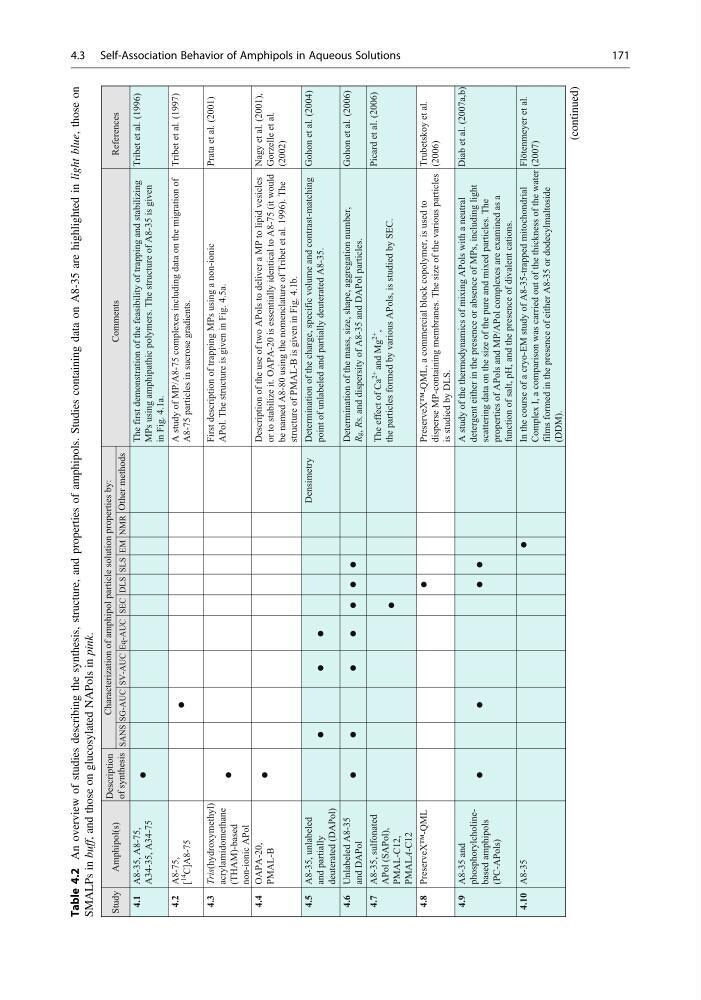
Table 4.2
An overview of studies describing the synthesis, structure, and properties of amphipols. Studies containing data on A8-35 are highlighted in light blue,
those on
SMALPs in buff,
and those on glucosylated NAPols in pink.
Study
Amphipol(s)
Description
of synthesis
Characterization of amphipol particle solution properties by:
Comments
References
SANS SG-AUC SV-AUC Eq-AUC SEC DLS SLS EM NMR Other methods
4.1 A8-35, A8-75,
A34-35, A34-75
The first demonstration of the feasibility of trapping and stabilizing
MPs using amphipathic polymers. The structure of A8-35 is given
in Fig. 4.1a.
Tribet et al. (1996)
4.2 A8-75,
[
14
C]A8-75
A study of MP/A8-75 complexes including data on the migration of
A8-75 particles in sucrose gradients.
Tribet et al. (1997)
4.3 Tris(hydroxymethyl)
acrylamidomethane
(THAM)-based
non-ionic APol
First description of trapping MPs using a non-ionic
APol. The structure is given in Fig. 4.5a.
Prata et al. (2001)
4.4 OAPA-20,
PMAL-B
Description of the use of two APols to deliver a MP to lipid vesicles
or to stabilize it. OAPA-20 is essentially identical to A8-75 (it would
be named A8-80 using the nomenclature of Tribet et al. 1996). The
structure of PMAL-B is given in Fig. 4.1b.
Nagy et al. (2001),
Gorzelle et al.
(2002)
4.5 A8-35, unlabeled
and partially
deuterated (DAPol)
Densimetry
Determination of the charge, specific volume and contrast-matching
point of unlabeled and partially deuterated A8-35.
Gohon et al. (2004)
4.6 Unlabeled A8-35
and DAPol
Determination of the mass, size, shape, aggregation number,
Rg, RS, and dispersity of A8-35 and DAPol particles.
Gohon et al. (2006)
4.7 A8-35, sulfonated
APol (SAPol),
PMAL-C12,
PMALA-C12
The effect of Ca
2+
and Mg
2+
,
the particles formed by various APols, is studied by SEC.
Picard et al. (2006)
4.8 PreserveX™-QML
PreserveX™-QML, a commercial block copolymer, is used to
disperse MP-containing membranes. The size of the various particles
is studied by DLS.
Trubetskoy et al.
(2006)
4.9 A8-35 and
phosphorylcholinebased amphipols
(PC-APols)
A study of the thermodynamics of mixing APols with a neutral
detergent either in the presence or absence of MPs, including light
scattering data on the size of the pure and mixed particles. The
properties of APols and MP/APol complexes are examined as a
function of salt, pH, and the presence of divalent cations.
Diab et al. (2007a,b)
4.10 A8-35
In the course of a cryo-EM study of A8-35-trapped mitochondrial
Complex I, a comparison was carried out of the thickness of the water
films formed
in the presence of either A8-35 or dodecylmaltoside
(DDM).
Flötenmeyer et al.
(2007)
(continued)
4.3 Self-Association Behavior of Amphipols in Aqueous Solutions
171
An overview of studies describing the synthesis, structure, and properties of amphipols. Studies containing data on A8-35 are highlighted in light blue,
those on
SMALPs in buff,
and those on glucosylated NAPols in pink.
Study
Amphipol(s)
Description
of synthesis
Characterization of amphipol particle solution properties by:
Comments
References
SANS SG-AUC SV-AUC Eq-AUC SEC DLS SLS EM NMR Other methods
4.1 A8-35, A8-75,
A34-35, A34-75
The first demonstration of the feasibility of trapping and stabilizing
MPs using amphipathic polymers. The structure of A8-35 is given
in Fig. 4.1a.
Tribet et al. (1996)
4.2 A8-75,
[
14
C]A8-75
A study of MP/A8-75 complexes including data on the migration of
A8-75 particles in sucrose gradients.
Tribet et al. (1997)
4.3 Tris(hydroxymethyl)
acrylamidomethane
(THAM)-based
non-ionic APol
First description of trapping MPs using a non-ionic
APol. The structure is given in Fig. 4.5a.
Prata et al. (2001)
4.4 OAPA-20,
PMAL-B
Description of the use of two APols to deliver a MP to lipid vesicles
or to stabilize it. OAPA-20 is essentially identical to A8-75 (it would
be named A8-80 using the nomenclature of Tribet et al. 1996). The
structure of PMAL-B is given in Fig. 4.1b.
Nagy et al. (2001),
Gorzelle et al.
(2002)
4.5 A8-35, unlabeled
and partially
deuterated (DAPol)
Densimetry
Determination of the charge, specific volume and contrast-matching
point of unlabeled and partially deuterated A8-35.
Gohon et al. (2004)
4.6 Unlabeled A8-35
and DAPol
Determination of the mass, size, shape, aggregation number,
Rg, RS, and dispersity of A8-35 and DAPol particles.
Gohon et al. (2006)
4.7 A8-35, sulfonated
APol (SAPol),
PMAL-C12,
PMALA-C12
The effect of Ca
2+
and Mg
2+
,
the particles formed by various APols, is studied by SEC.
Picard et al. (2006)
4.8 PreserveX™-QML
PreserveX™-QML, a commercial block copolymer, is used to
disperse MP-containing membranes. The size of the various particles
is studied by DLS.
Trubetskoy et al.
(2006)
4.9 A8-35 and
phosphorylcholinebased amphipols
(PC-APols)
A study of the thermodynamics of mixing APols with a neutral
detergent either in the presence or absence of MPs, including light
scattering data on the size of the pure and mixed particles. The
properties of APols and MP/APol complexes are examined as a
function of salt, pH, and the presence of divalent cations.
Diab et al. (2007a,b)
4.10 A8-35
In the course of a cryo-EM study of A8-35-trapped mitochondrial
Complex I, a comparison was carried out of the thickness of the water
films formed
in the presence of either A8-35 or dodecylmaltoside
(DDM).
Flötenmeyer et al.
(2007)
(continued)
4.3 Self-Association Behavior of Amphipols in Aqueous Solutions
171