

and the length and density of the hydrophobic moieties, the particles formed can be unimolecular
or multimolecular and have or not a tendency to associate one with another (see e.g. Noda and
Morishima 1999; Yamamoto et al. 2000b; Di Cola et al. 2004; Sauvage et al. 2004). Those polymers
that are currently used as APols are too small to form stable unimolecular particles, there being a deficit
of hydrophobic groups to form a stable core and of hydrophilic groups to shield it from the aqueous
solution. Several molecules therefore associate, until the number of hydrophobic and hydrophilic
groups matches the constraints of forming a hydrophobic core and covering it with hydrophilic
moieties (see § 4.3.1). Among the many APols described in § 4.2, only a handful have been studied
by a large variety of physical techniques (Table 4.2). Among those, A8-35 is by far the most
extensively characterized. We will therefore first review in some detail, in § 4.3.1, what is known of
the formation, structure, and dynamics of A8-35 particles, taking it as the prototypical APol. In § 4.3.2,
we will summarize more briefly what is known of the solution behavior of other APols.
4.3.1
Formation, Structure, and Dynamics of A8-35 Particles
4.3.1.1 Critical Association Concentration
At extreme dilutions, entropy prevents the association of surfactant molecules, the entropic cost of
bringing them together exceeding the free energy drop that results from shielding water-insoluble
moieties from water. As the concentration is increased, a balance is reached when the two ΔG
contributions cancel each other, and the first particles form. For detergents, the particles are called
micelles, and the concentration at which micelles start forming is called the critical micellar concentration (CMC; see Chap. 2, § 2.2.2). The CMC of the detergents used in biochemistry lies typically
between a few tens or hundreds of μM to a few tens of mM, corresponding roughly to 0.01–100 gÁL
À1 .
For non-ionic detergents, the CMC depends essentially on the size of the hydrophobic moiety or
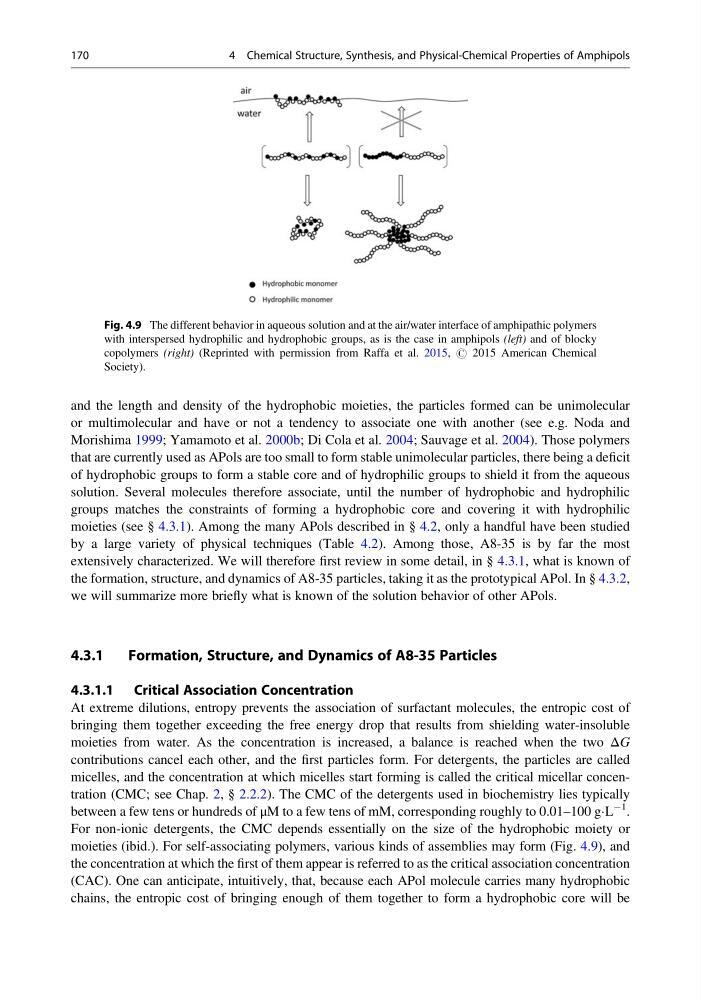
moieties (ibid.). For self-associating polymers, various kinds of assemblies may form (Fig. 4.9), and
the concentration at which the first of them appear is referred to as the critical association concentration
(CAC). One can anticipate, intuitively, that, because each APol molecule carries many hydrophobic
chains, the entropic cost of bringing enough of them together to form a hydrophobic core will be
Fig. 4.9 The different behavior in aqueous solution and at the air/water interface of amphipathic polymers
with interspersed hydrophilic and hydrophobic groups, as is the case in amphipols (left) and of blocky
copolymers (right) (Reprinted with permission from Raffa et al. 2015, # 2015 American Chemical
Society).
170
4 Chemical Structure, Synthesis, and Physical-Chemical Properties of Amphipols
or multimolecular and have or not a tendency to associate one with another (see e.g. Noda and
Morishima 1999; Yamamoto et al. 2000b; Di Cola et al. 2004; Sauvage et al. 2004). Those polymers
that are currently used as APols are too small to form stable unimolecular particles, there being a deficit
of hydrophobic groups to form a stable core and of hydrophilic groups to shield it from the aqueous
solution. Several molecules therefore associate, until the number of hydrophobic and hydrophilic
groups matches the constraints of forming a hydrophobic core and covering it with hydrophilic
moieties (see § 4.3.1). Among the many APols described in § 4.2, only a handful have been studied
by a large variety of physical techniques (Table 4.2). Among those, A8-35 is by far the most
extensively characterized. We will therefore first review in some detail, in § 4.3.1, what is known of
the formation, structure, and dynamics of A8-35 particles, taking it as the prototypical APol. In § 4.3.2,
we will summarize more briefly what is known of the solution behavior of other APols.
4.3.1
Formation, Structure, and Dynamics of A8-35 Particles
4.3.1.1 Critical Association Concentration
At extreme dilutions, entropy prevents the association of surfactant molecules, the entropic cost of
bringing them together exceeding the free energy drop that results from shielding water-insoluble
moieties from water. As the concentration is increased, a balance is reached when the two ΔG
contributions cancel each other, and the first particles form. For detergents, the particles are called
micelles, and the concentration at which micelles start forming is called the critical micellar concentration (CMC; see Chap. 2, § 2.2.2). The CMC of the detergents used in biochemistry lies typically
between a few tens or hundreds of μM to a few tens of mM, corresponding roughly to 0.01–100 gÁL
À1 .
For non-ionic detergents, the CMC depends essentially on the size of the hydrophobic moiety or
moieties (ibid.). For self-associating polymers, various kinds of assemblies may form (Fig. 4.9), and
the concentration at which the first of them appear is referred to as the critical association concentration
(CAC). One can anticipate, intuitively, that, because each APol molecule carries many hydrophobic
chains, the entropic cost of bringing enough of them together to form a hydrophobic core will be
Fig. 4.9 The different behavior in aqueous solution and at the air/water interface of amphipathic polymers
with interspersed hydrophilic and hydrophobic groups, as is the case in amphipols (left) and of blocky
copolymers (right) (Reprinted with permission from Raffa et al. 2015, # 2015 American Chemical
Society).
170
4 Chemical Structure, Synthesis, and Physical-Chemical Properties of Amphipols