

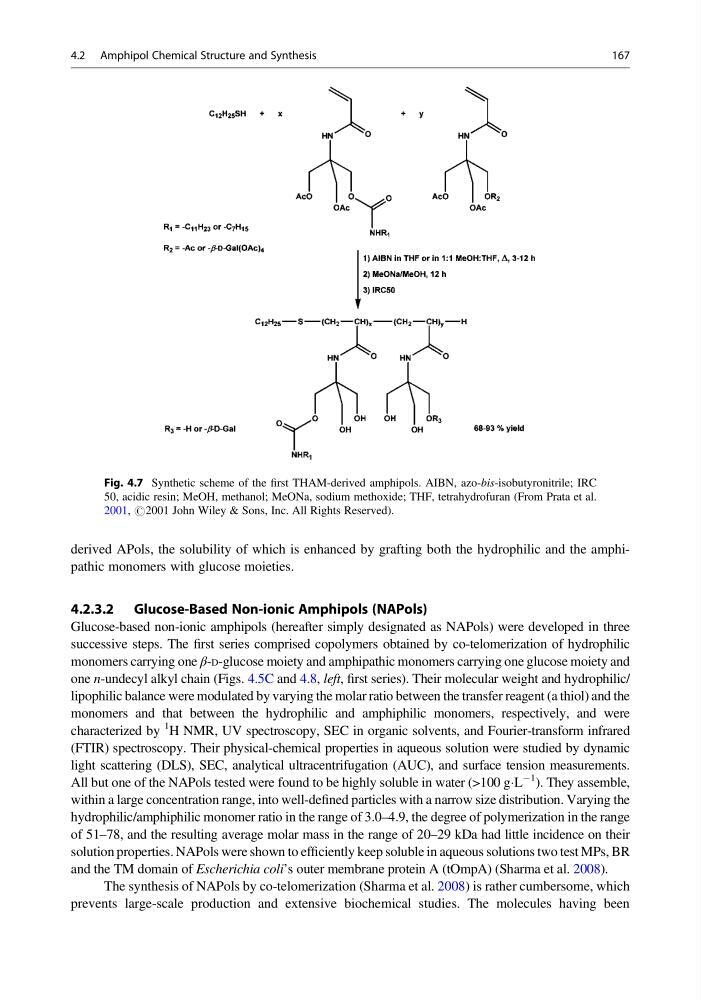
derived APols, the solubility of which is enhanced by grafting both the hydrophilic and the amphipathic monomers with glucose moieties.
4.2.3.2 Glucose-Based Non-ionic Amphipols (NAPols)
Glucose-based non-ionic amphipols (hereafter simply designated as NAPols) were developed in three
successive steps. The first series comprised copolymers obtained by co-telomerization of hydrophilic
monomers carrying one β-D-glucose moiety and amphipathic monomers carrying one glucose moiety and
one n-undecyl alkyl chain (Figs. 4.5C and 4.8, left, first series). Their molecular weight and hydrophilic/
lipophilic balance were modulated by varying the molar ratio between the transfer reagent (a thiol) and the
monomers and that between the hydrophilic and amphiphilic monomers, respectively, and were
characterized by
1
H NMR, UV spectroscopy, SEC in organic solvents, and Fourier-transform infrared
(FTIR) spectroscopy. Their physical-chemical properties in aqueous solution were studied by dynamic
light scattering (DLS), SEC, analytical ultracentrifugation (AUC), and surface tension measurements.
All but one of the NAPols tested were found to be highly soluble in water (>100 gÁL
À1
). They assemble,
within a large concentration range, into well-defined particles with a narrow size distribution. Varying the
hydrophilic/amphiphilic monomer ratio in the range of 3.0–4.9, the degree of polymerization in the range
of 51–78, and the resulting average molar mass in the range of 20–29 kDa had little incidence on their
solution properties. NAPols were shown to efficiently keep soluble in aqueous solutions two test MPs, BR
and the TM domain of Escherichia coli’s outer membrane protein A (tOmpA) (Sharma et al. 2008).
The synthesis of NAPols by co-telomerization (Sharma et al. 2008) is rather cumbersome, which
prevents large-scale production and extensive biochemical studies. The molecules having been
Fig. 4.7 Synthetic scheme of the first THAM-derived amphipols. AIBN, azo-bis-isobutyronitrile; IRC
50, acidic resin; MeOH, methanol; MeONa, sodium methoxide; THF, tetrahydrofuran (From Prata et al.
2001, #2001 John Wiley & Sons, Inc. All Rights Reserved).
4.2 Amphipol Chemical Structure and Synthesis
167
4.2.3.2 Glucose-Based Non-ionic Amphipols (NAPols)
Glucose-based non-ionic amphipols (hereafter simply designated as NAPols) were developed in three
successive steps. The first series comprised copolymers obtained by co-telomerization of hydrophilic
monomers carrying one β-D-glucose moiety and amphipathic monomers carrying one glucose moiety and
one n-undecyl alkyl chain (Figs. 4.5C and 4.8, left, first series). Their molecular weight and hydrophilic/
lipophilic balance were modulated by varying the molar ratio between the transfer reagent (a thiol) and the
monomers and that between the hydrophilic and amphiphilic monomers, respectively, and were
characterized by
1
H NMR, UV spectroscopy, SEC in organic solvents, and Fourier-transform infrared
(FTIR) spectroscopy. Their physical-chemical properties in aqueous solution were studied by dynamic
light scattering (DLS), SEC, analytical ultracentrifugation (AUC), and surface tension measurements.
All but one of the NAPols tested were found to be highly soluble in water (>100 gÁL
À1
). They assemble,
within a large concentration range, into well-defined particles with a narrow size distribution. Varying the
hydrophilic/amphiphilic monomer ratio in the range of 3.0–4.9, the degree of polymerization in the range
of 51–78, and the resulting average molar mass in the range of 20–29 kDa had little incidence on their
solution properties. NAPols were shown to efficiently keep soluble in aqueous solutions two test MPs, BR
and the TM domain of Escherichia coli’s outer membrane protein A (tOmpA) (Sharma et al. 2008).
The synthesis of NAPols by co-telomerization (Sharma et al. 2008) is rather cumbersome, which
prevents large-scale production and extensive biochemical studies. The molecules having been
Fig. 4.7 Synthetic scheme of the first THAM-derived amphipols. AIBN, azo-bis-isobutyronitrile; IRC
50, acidic resin; MeOH, methanol; MeONa, sodium methoxide; THF, tetrahydrofuran (From Prata et al.
2001, #2001 John Wiley & Sons, Inc. All Rights Reserved).
4.2 Amphipol Chemical Structure and Synthesis
167