

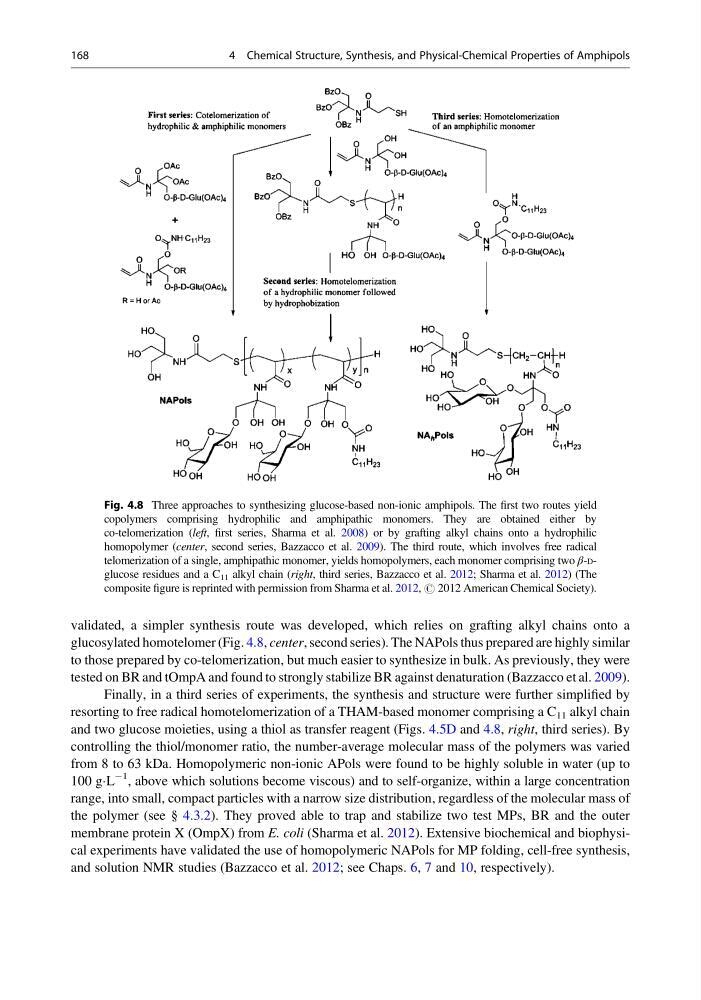
validated, a simpler synthesis route was developed, which relies on grafting alkyl chains onto a
glucosylated homotelomer (Fig. 4.8, center, second series). The NAPols thus prepared are highly similar
to those prepared by co-telomerization, but much easier to synthesize in bulk. As previously, they were
tested on BR and tOmpA and found to strongly stabilize BR against denaturation (Bazzacco et al. 2009).
Finally, in a third series of experiments, the synthesis and structure were further simplified by
resorting to free radical homotelomerization of a THAM-based monomer comprising a C 11 alkyl chain
and two glucose moieties, using a thiol as transfer reagent (Figs. 4.5D and 4.8, right, third series). By
controlling the thiol/monomer ratio, the number-average molecular mass of the polymers was varied
from 8 to 63 kDa. Homopolymeric non-ionic APols were found to be highly soluble in water (up to
100 gÁL
À1 , above which solutions become viscous) and to self-organize, within a large concentration
range, into small, compact particles with a narrow size distribution, regardless of the molecular mass of
the polymer (see § 4.3.2). They proved able to trap and stabilize two test MPs, BR and the outer
membrane protein X (OmpX) from E. coli (Sharma et al. 2012). Extensive biochemical and biophysical experiments have validated the use of homopolymeric NAPols for MP folding, cell-free synthesis,
and solution NMR studies (Bazzacco et al. 2012; see Chaps. 6, 7 and 10, respectively).
Fig. 4.8 Three approaches to synthesizing glucose-based non-ionic amphipols. The first two routes yield
copolymers comprising hydrophilic and amphipathic monomers. They are obtained either by
co-telomerization (left, first series, Sharma et al. 2008) or by grafting alkyl chains onto a hydrophilic
homopolymer (center, second series, Bazzacco et al. 2009). The third route, which involves free radical
telomerization of a single, amphipathic monomer, yields homopolymers, each monomer comprising two β-Dglucose residues and a C 11 alkyl chain (right, third series, Bazzacco et al. 2012; Sharma et al. 2012) (The
composite figure is reprinted with permission from Sharma et al. 2012, # 2012 American Chemical Society).
168
4 Chemical Structure, Synthesis, and Physical-Chemical Properties of Amphipols
glucosylated homotelomer (Fig. 4.8, center, second series). The NAPols thus prepared are highly similar
to those prepared by co-telomerization, but much easier to synthesize in bulk. As previously, they were
tested on BR and tOmpA and found to strongly stabilize BR against denaturation (Bazzacco et al. 2009).
Finally, in a third series of experiments, the synthesis and structure were further simplified by
resorting to free radical homotelomerization of a THAM-based monomer comprising a C 11 alkyl chain
and two glucose moieties, using a thiol as transfer reagent (Figs. 4.5D and 4.8, right, third series). By
controlling the thiol/monomer ratio, the number-average molecular mass of the polymers was varied
from 8 to 63 kDa. Homopolymeric non-ionic APols were found to be highly soluble in water (up to
100 gÁL
À1 , above which solutions become viscous) and to self-organize, within a large concentration
range, into small, compact particles with a narrow size distribution, regardless of the molecular mass of
the polymer (see § 4.3.2). They proved able to trap and stabilize two test MPs, BR and the outer
membrane protein X (OmpX) from E. coli (Sharma et al. 2012). Extensive biochemical and biophysical experiments have validated the use of homopolymeric NAPols for MP folding, cell-free synthesis,
and solution NMR studies (Bazzacco et al. 2012; see Chaps. 6, 7 and 10, respectively).
Fig. 4.8 Three approaches to synthesizing glucose-based non-ionic amphipols. The first two routes yield
copolymers comprising hydrophilic and amphipathic monomers. They are obtained either by
co-telomerization (left, first series, Sharma et al. 2008) or by grafting alkyl chains onto a hydrophilic
homopolymer (center, second series, Bazzacco et al. 2009). The third route, which involves free radical
telomerization of a single, amphipathic monomer, yields homopolymers, each monomer comprising two β-Dglucose residues and a C 11 alkyl chain (right, third series, Bazzacco et al. 2012; Sharma et al. 2012) (The
composite figure is reprinted with permission from Sharma et al. 2012, # 2012 American Chemical Society).
168
4 Chemical Structure, Synthesis, and Physical-Chemical Properties of Amphipols