

cytochrome b 6 f, the latter a particularly fragile, detergent-sensitive complex (Breyton et al. 1997) and
therefore an excellent model to evaluate the mildness or harshness of novel surfactants (see e.g. Chae
et al. 2010; Hovers et al. 2011). The best results, in terms of MP solubility, dispersity as estimated by
sucrose gradient velocity sedimentation analysis, and stability over extended storage (2 weeks), were
obtained with C 11 -grafted polymers with a molecular mass of 3–5 kDa and a ratio of hydrophilic to
amphipathic monomers of 3–3.5:1 (Prata et al. 2001).
These first studies established that non-ionic amphipathic polymers can be used to keep MPs
soluble, stable, and functional. However, biochemical studies indicated that increasing the solubility of
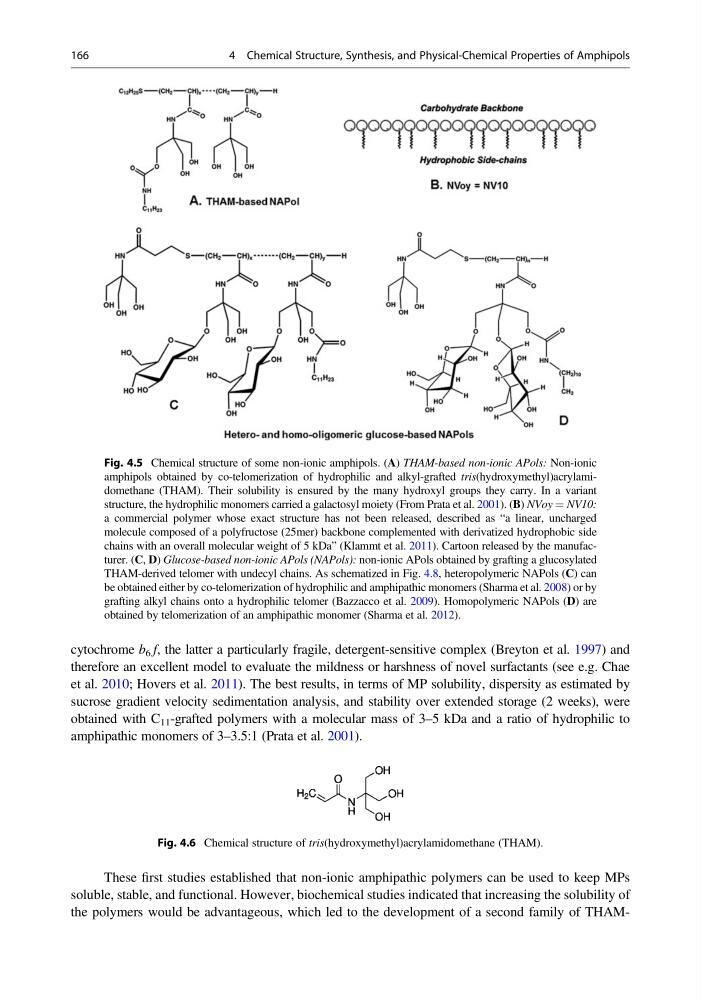
the polymers would be advantageous, which led to the development of a second family of THAMFig. 4.5 Chemical structure of some non-ionic amphipols. (A) THAM-based non-ionic APols: Non-ionic
amphipols obtained by co-telomerization of hydrophilic and alkyl-grafted tris(hydroxymethyl)acrylamidomethane (THAM). Their solubility is ensured by the many hydroxyl groups they carry. In a variant
structure, the hydrophilic monomers carried a galactosyl moiety (From Prata et al. 2001). (B) NVoy ¼ NV10:
a commercial polymer whose exact structure has not been released, described as “a linear, uncharged
molecule composed of a polyfructose (25mer) backbone complemented with derivatized hydrophobic side
chains with an overall molecular weight of 5 kDa” (Klammt et al. 2011). Cartoon released by the manufacturer. (C, D) Glucose-based non-ionic APols (NAPols): non-ionic APols obtained by grafting a glucosylated
THAM-derived telomer with undecyl chains. As schematized in Fig. 4.8, heteropolymeric NAPols (C) can
be obtained either by co-telomerization of hydrophilic and amphipathic monomers (Sharma et al. 2008) or by
grafting alkyl chains onto a hydrophilic telomer (Bazzacco et al. 2009). Homopolymeric NAPols (D) are
obtained by telomerization of an amphipathic monomer (Sharma et al. 2012).
Fig. 4.6 Chemical structure of tris(hydroxymethyl)acrylamidomethane (THAM).
166
4 Chemical Structure, Synthesis, and Physical-Chemical Properties of Amphipols
therefore an excellent model to evaluate the mildness or harshness of novel surfactants (see e.g. Chae
et al. 2010; Hovers et al. 2011). The best results, in terms of MP solubility, dispersity as estimated by
sucrose gradient velocity sedimentation analysis, and stability over extended storage (2 weeks), were
obtained with C 11 -grafted polymers with a molecular mass of 3–5 kDa and a ratio of hydrophilic to
amphipathic monomers of 3–3.5:1 (Prata et al. 2001).
These first studies established that non-ionic amphipathic polymers can be used to keep MPs
soluble, stable, and functional. However, biochemical studies indicated that increasing the solubility of
the polymers would be advantageous, which led to the development of a second family of THAMFig. 4.5 Chemical structure of some non-ionic amphipols. (A) THAM-based non-ionic APols: Non-ionic
amphipols obtained by co-telomerization of hydrophilic and alkyl-grafted tris(hydroxymethyl)acrylamidomethane (THAM). Their solubility is ensured by the many hydroxyl groups they carry. In a variant
structure, the hydrophilic monomers carried a galactosyl moiety (From Prata et al. 2001). (B) NVoy ¼ NV10:
a commercial polymer whose exact structure has not been released, described as “a linear, uncharged
molecule composed of a polyfructose (25mer) backbone complemented with derivatized hydrophobic side
chains with an overall molecular weight of 5 kDa” (Klammt et al. 2011). Cartoon released by the manufacturer. (C, D) Glucose-based non-ionic APols (NAPols): non-ionic APols obtained by grafting a glucosylated
THAM-derived telomer with undecyl chains. As schematized in Fig. 4.8, heteropolymeric NAPols (C) can
be obtained either by co-telomerization of hydrophilic and amphipathic monomers (Sharma et al. 2008) or by
grafting alkyl chains onto a hydrophilic telomer (Bazzacco et al. 2009). Homopolymeric NAPols (D) are
obtained by telomerization of an amphipathic monomer (Sharma et al. 2012).
Fig. 4.6 Chemical structure of tris(hydroxymethyl)acrylamidomethane (THAM).
166
4 Chemical Structure, Synthesis, and Physical-Chemical Properties of Amphipols