

C 8 E 4 (~300 Da) (see Chap. 2, Fig. 2.1). Above pH 7, the solubility of A8-35 in water and aqueous
buffers is >30% w/w (>320 gÁL
À1 ) (Gohon et al. 2006). Using NMR spectroscopy to document the
vicinity between the various moieties, it has been shown that, under the conditions used, the grafts
distribute randomly along the macromolecular chain (Magny et al. 1992). This polymer was named
A8-35, where A stands for anionic, or acrylate, 8 for its approximate weight-average molecular mass,
in kDa, and 35 for the percentage of carboxylates left free. In A8-75, there are ~25 octyl chains and ~75
free carboxylates per 100 monomers. A34-75 and A34-35 were obtained in the same way starting from
a longer PAA. All of them were validated as APols in the original publication, inasmuch as they all
efficiently trapped MPs and kept them soluble without denaturing them (Tribet et al. 1996). Only
A8-35, however, has been heavily used for MP studies (for an overview, see Table 5.1 in Chap. 5).
Estimates of its mass have varied. Using improved analytical methods (see below), its number-average
length has been recently determined to be ~35 acrylate units, corresponding, for A8-35, to a numberaverage molecular mass hM n i % 4.3 kDa (Giusti et al. 2014). Given a dispersity (formerly called
polydispersity index; see Gilbert et al. 2009 and § 4.6.1, Annex 4.1) Ð % 2, its weight-average mass
hM w i is ~8.6 kDa. Its length distribution is quite broad: upon hydrophobic size exclusion chromatography (SEC) analysis, the low-R S and high-R S half-height limits on each side of the maximum
correspond to ~15 and ~200 units or ~1.2 and ~18 kDa, respectively (J. Rieger and F. Giusti,
unpublished data) (about the definition and measurement of hM n i, hM w i, and Ð, see § 4.6.1, Annex
4.1). A8-75, with the same length distribution and octylamine density as A8-35, but no isopropylamine
grafts, has been mostly used in early EM studies (see Chap. 12, Table 12.1), in some comparative mass
spectrometry studies (Watkinson et al. 2015; see Chap. 14), and in studies of its interactions with lipid
vesicles or cells (see Chap. 5, § 5.2.2.2).
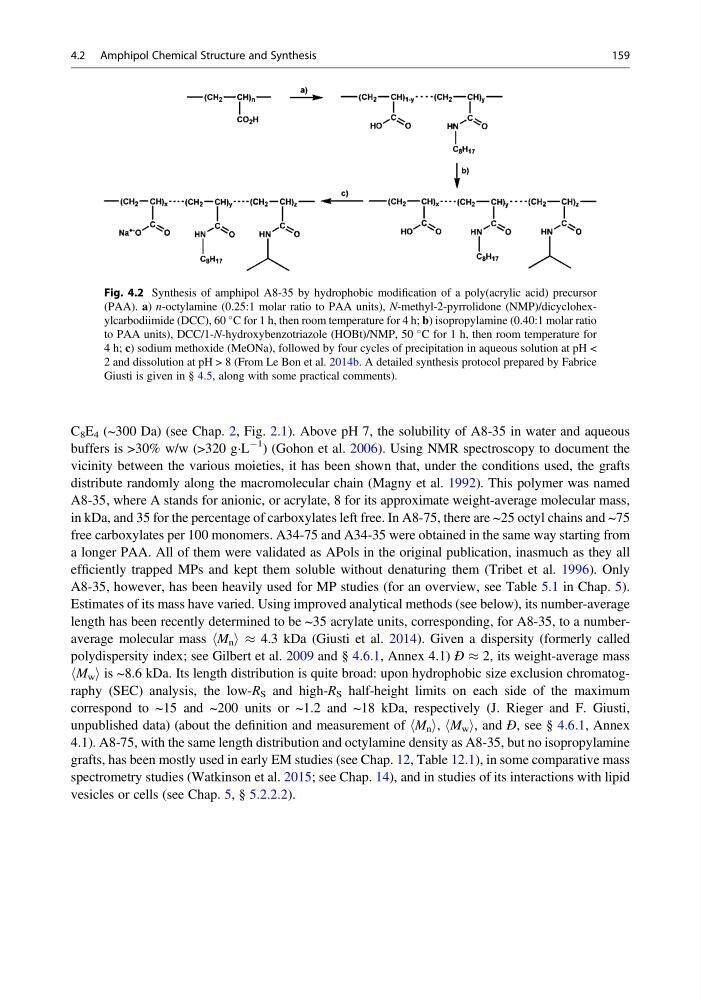
Fig. 4.2 Synthesis of amphipol A8-35 by hydrophobic modification of a poly(acrylic acid) precursor
(PAA). a) n-octylamine (0.25:1 molar ratio to PAA units), N-methyl-2-pyrrolidone (NMP)/dicyclohexylcarbodiimide (DCC), 60
C for 1 h, then room temperature for 4 h; b) isopropylamine (0.40:1 molar ratio
to PAA units), DCC/1-N-hydroxybenzotriazole (HOBt)/NMP, 50
C for 1 h, then room temperature for
4 h; c) sodium methoxide (MeONa), followed by four cycles of precipitation in aqueous solution at pH <
2 and dissolution at pH > 8 (From Le Bon et al. 2014b. A detailed synthesis protocol prepared by Fabrice
Giusti is given in § 4.5, along with some practical comments).
4.2 Amphipol Chemical Structure and Synthesis
159
buffers is >30% w/w (>320 gÁL
À1 ) (Gohon et al. 2006). Using NMR spectroscopy to document the
vicinity between the various moieties, it has been shown that, under the conditions used, the grafts
distribute randomly along the macromolecular chain (Magny et al. 1992). This polymer was named
A8-35, where A stands for anionic, or acrylate, 8 for its approximate weight-average molecular mass,
in kDa, and 35 for the percentage of carboxylates left free. In A8-75, there are ~25 octyl chains and ~75
free carboxylates per 100 monomers. A34-75 and A34-35 were obtained in the same way starting from
a longer PAA. All of them were validated as APols in the original publication, inasmuch as they all
efficiently trapped MPs and kept them soluble without denaturing them (Tribet et al. 1996). Only
A8-35, however, has been heavily used for MP studies (for an overview, see Table 5.1 in Chap. 5).
Estimates of its mass have varied. Using improved analytical methods (see below), its number-average
length has been recently determined to be ~35 acrylate units, corresponding, for A8-35, to a numberaverage molecular mass hM n i % 4.3 kDa (Giusti et al. 2014). Given a dispersity (formerly called
polydispersity index; see Gilbert et al. 2009 and § 4.6.1, Annex 4.1) Ð % 2, its weight-average mass
hM w i is ~8.6 kDa. Its length distribution is quite broad: upon hydrophobic size exclusion chromatography (SEC) analysis, the low-R S and high-R S half-height limits on each side of the maximum
correspond to ~15 and ~200 units or ~1.2 and ~18 kDa, respectively (J. Rieger and F. Giusti,
unpublished data) (about the definition and measurement of hM n i, hM w i, and Ð, see § 4.6.1, Annex
4.1). A8-75, with the same length distribution and octylamine density as A8-35, but no isopropylamine
grafts, has been mostly used in early EM studies (see Chap. 12, Table 12.1), in some comparative mass
spectrometry studies (Watkinson et al. 2015; see Chap. 14), and in studies of its interactions with lipid
vesicles or cells (see Chap. 5, § 5.2.2.2).
Fig. 4.2 Synthesis of amphipol A8-35 by hydrophobic modification of a poly(acrylic acid) precursor
(PAA). a) n-octylamine (0.25:1 molar ratio to PAA units), N-methyl-2-pyrrolidone (NMP)/dicyclohexylcarbodiimide (DCC), 60
C for 1 h, then room temperature for 4 h; b) isopropylamine (0.40:1 molar ratio
to PAA units), DCC/1-N-hydroxybenzotriazole (HOBt)/NMP, 50
C for 1 h, then room temperature for
4 h; c) sodium methoxide (MeONa), followed by four cycles of precipitation in aqueous solution at pH <
2 and dissolution at pH > 8 (From Le Bon et al. 2014b. A detailed synthesis protocol prepared by Fabrice
Giusti is given in § 4.5, along with some practical comments).
4.2 Amphipol Chemical Structure and Synthesis
159