

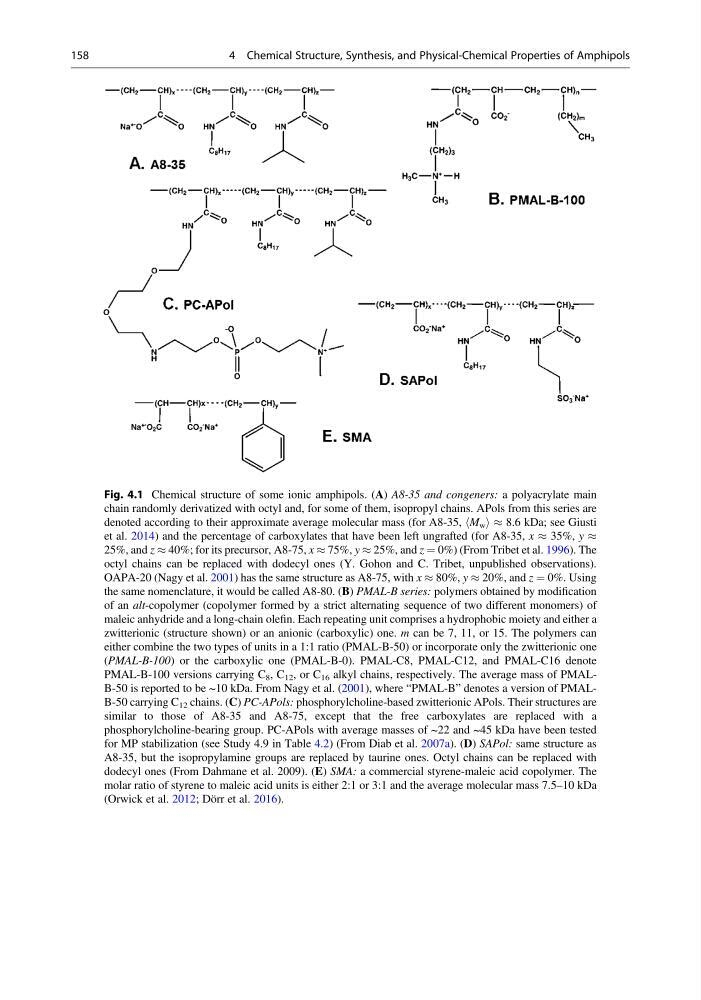
Fig. 4.1 Chemical structure of some ionic amphipols. (A) A8-35 and congeners: a polyacrylate main
chain randomly derivatized with octyl and, for some of them, isopropyl chains. APols from this series are
denoted according to their approximate average molecular mass (for A8-35, hM w i % 8.6 kDa; see Giusti
et al. 2014) and the percentage of carboxylates that have been left ungrafted (for A8-35, x % 35%, y %
25%, and z % 40%; for its precursor, A8-75, x % 75%, y % 25%, and z ¼ 0%) (From Tribet et al. 1996). The
octyl chains can be replaced with dodecyl ones (Y. Gohon and C. Tribet, unpublished observations).
OAPA-20 (Nagy et al. 2001) has the same structure as A8-75, with x % 80%, y % 20%, and z ¼ 0%. Using
the same nomenclature, it would be called A8-80. (B) PMAL-B series: polymers obtained by modification
of an alt-copolymer (copolymer formed by a strict alternating sequence of two different monomers) of
maleic anhydride and a long-chain olefin. Each repeating unit comprises a hydrophobic moiety and either a
zwitterionic (structure shown) or an anionic (carboxylic) one. m can be 7, 11, or 15. The polymers can
either combine the two types of units in a 1:1 ratio (PMAL-B-50) or incorporate only the zwitterionic one
(PMAL-B-100) or the carboxylic one (PMAL-B-0). PMAL-C8, PMAL-C12, and PMAL-C16 denote
PMAL-B-100 versions carrying C 8 , C 12 , or C 16 alkyl chains, respectively. The average mass of PMALB-50 is reported to be ~10 kDa. From Nagy et al. (2001), where “PMAL-B” denotes a version of PMALB-50 carrying C 12 chains. (C) PC-APols: phosphorylcholine-based zwitterionic APols. Their structures are
similar to those of A8-35 and A8-75, except that the free carboxylates are replaced with a
phosphorylcholine-bearing group. PC-APols with average masses of ~22 and ~45 kDa have been tested
for MP stabilization (see Study 4.9 in Table 4.2) (From Diab et al. 2007a). (D) SAPol: same structure as
A8-35, but the isopropylamine groups are replaced by taurine ones. Octyl chains can be replaced with
dodecyl ones (From Dahmane et al. 2009). (E) SMA: a commercial styrene-maleic acid copolymer. The
molar ratio of styrene to maleic acid units is either 2:1 or 3:1 and the average molecular mass 7.5–10 kDa
(Orwick et al. 2012; Dörr et al. 2016).
158
4 Chemical Structure, Synthesis, and Physical-Chemical Properties of Amphipols
chain randomly derivatized with octyl and, for some of them, isopropyl chains. APols from this series are
denoted according to their approximate average molecular mass (for A8-35, hM w i % 8.6 kDa; see Giusti
et al. 2014) and the percentage of carboxylates that have been left ungrafted (for A8-35, x % 35%, y %
25%, and z % 40%; for its precursor, A8-75, x % 75%, y % 25%, and z ¼ 0%) (From Tribet et al. 1996). The
octyl chains can be replaced with dodecyl ones (Y. Gohon and C. Tribet, unpublished observations).
OAPA-20 (Nagy et al. 2001) has the same structure as A8-75, with x % 80%, y % 20%, and z ¼ 0%. Using
the same nomenclature, it would be called A8-80. (B) PMAL-B series: polymers obtained by modification
of an alt-copolymer (copolymer formed by a strict alternating sequence of two different monomers) of
maleic anhydride and a long-chain olefin. Each repeating unit comprises a hydrophobic moiety and either a
zwitterionic (structure shown) or an anionic (carboxylic) one. m can be 7, 11, or 15. The polymers can
either combine the two types of units in a 1:1 ratio (PMAL-B-50) or incorporate only the zwitterionic one
(PMAL-B-100) or the carboxylic one (PMAL-B-0). PMAL-C8, PMAL-C12, and PMAL-C16 denote
PMAL-B-100 versions carrying C 8 , C 12 , or C 16 alkyl chains, respectively. The average mass of PMALB-50 is reported to be ~10 kDa. From Nagy et al. (2001), where “PMAL-B” denotes a version of PMALB-50 carrying C 12 chains. (C) PC-APols: phosphorylcholine-based zwitterionic APols. Their structures are
similar to those of A8-35 and A8-75, except that the free carboxylates are replaced with a
phosphorylcholine-bearing group. PC-APols with average masses of ~22 and ~45 kDa have been tested
for MP stabilization (see Study 4.9 in Table 4.2) (From Diab et al. 2007a). (D) SAPol: same structure as
A8-35, but the isopropylamine groups are replaced by taurine ones. Octyl chains can be replaced with
dodecyl ones (From Dahmane et al. 2009). (E) SMA: a commercial styrene-maleic acid copolymer. The
molar ratio of styrene to maleic acid units is either 2:1 or 3:1 and the average molecular mass 7.5–10 kDa
(Orwick et al. 2012; Dörr et al. 2016).
158
4 Chemical Structure, Synthesis, and Physical-Chemical Properties of Amphipols