

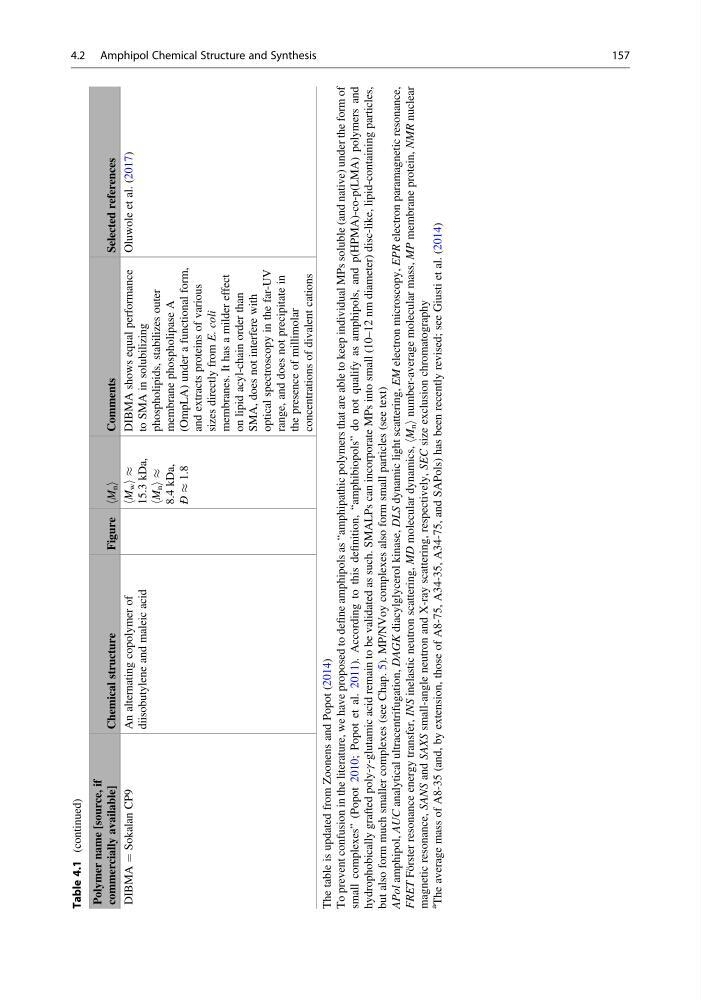
Table 4.1
(continued)
Polymer name [source, if
commercially available]
Chemical structure
Figure
hM n
i
Comments
Selected references
DIBMA
¼ Sokalan CP9
An alternating copolymer of
diisobutylene and maleic acid
hM w
i %
15.3 kDa,
hM n
i %
8.4 kDa,
Ð
% 1.8
DIBMA shows equal performance
to SMA in solubilizing
phospholipids, stabilizes outer
membrane phospholipase A
(OmpLA) under a functional form,
and extracts proteins of various
sizes directly from E. coli
membranes. It has a milder effect
on lipid acyl-chain order than
SMA, does not interfere with
optical spectroscopy in the far-UV
range, and does not precipitate in
the presence of millimolar
concentrations of divalent cations
Oluwole et al. (2017)
The table is updated from Zoonens and Popot (2014)
To prevent confusion in the literature, we have proposed to define amphipols as
“amphipathic polymers that are able to keep individual MPs soluble (and native) under the form of
small complexes” (Popot 2010; Popot et al. 2011). According to this definition,
“amphibiopols” do not qualify as amphipols, and p(HPMA)-co-p(LMA) polymers and
hydrophobically grafted poly-γ-glutamic acid remain to be validated as such. SMALPs can incorporate MPs into small (10–12 nm diameter) disc-like, lipid-containing particles,
but also form much smaller complexes (see Chap. 5). MP/NVoy complexes also form small particles (see text)
APol
amphipol, AUC
analytical ultracentrifugation, DAGK
diacylglycerol kinase, DLS
dynamic light scattering, EM
electron microscopy, EPR
electron paramagnetic resonance,
FRET
Förster resonance energy transfer, INS
inelastic neutron scattering, MD
molecular dynamics,
hM n
i number-average molecular mass, MP
membrane protein, NMR
nuclear
magnetic resonance, SANS
and SAXS
small-angle neutron and X-ray scattering, respectively, SEC
size exclusion chromatography
a
The average mass of A8-35 (and, by extension, those of A8-75, A34-35, A34-75, and SAPols) has been recently revised; see Giusti et al. (2014)
4.2 Amphipol Chemical Structure and Synthesis
157
(continued)
Polymer name [source, if
commercially available]
Chemical structure
Figure
hM n
i
Comments
Selected references
DIBMA
¼ Sokalan CP9
An alternating copolymer of
diisobutylene and maleic acid
hM w
i %
15.3 kDa,
hM n
i %
8.4 kDa,
Ð
% 1.8
DIBMA shows equal performance
to SMA in solubilizing
phospholipids, stabilizes outer
membrane phospholipase A
(OmpLA) under a functional form,
and extracts proteins of various
sizes directly from E. coli
membranes. It has a milder effect
on lipid acyl-chain order than
SMA, does not interfere with
optical spectroscopy in the far-UV
range, and does not precipitate in
the presence of millimolar
concentrations of divalent cations
Oluwole et al. (2017)
The table is updated from Zoonens and Popot (2014)
To prevent confusion in the literature, we have proposed to define amphipols as
“amphipathic polymers that are able to keep individual MPs soluble (and native) under the form of
small complexes” (Popot 2010; Popot et al. 2011). According to this definition,
“amphibiopols” do not qualify as amphipols, and p(HPMA)-co-p(LMA) polymers and
hydrophobically grafted poly-γ-glutamic acid remain to be validated as such. SMALPs can incorporate MPs into small (10–12 nm diameter) disc-like, lipid-containing particles,
but also form much smaller complexes (see Chap. 5). MP/NVoy complexes also form small particles (see text)
APol
amphipol, AUC
analytical ultracentrifugation, DAGK
diacylglycerol kinase, DLS
dynamic light scattering, EM
electron microscopy, EPR
electron paramagnetic resonance,
FRET
Förster resonance energy transfer, INS
inelastic neutron scattering, MD
molecular dynamics,
hM n
i number-average molecular mass, MP
membrane protein, NMR
nuclear
magnetic resonance, SANS
and SAXS
small-angle neutron and X-ray scattering, respectively, SEC
size exclusion chromatography
a
The average mass of A8-35 (and, by extension, those of A8-75, A34-35, A34-75, and SAPols) has been recently revised; see Giusti et al. (2014)
4.2 Amphipol Chemical Structure and Synthesis
157