

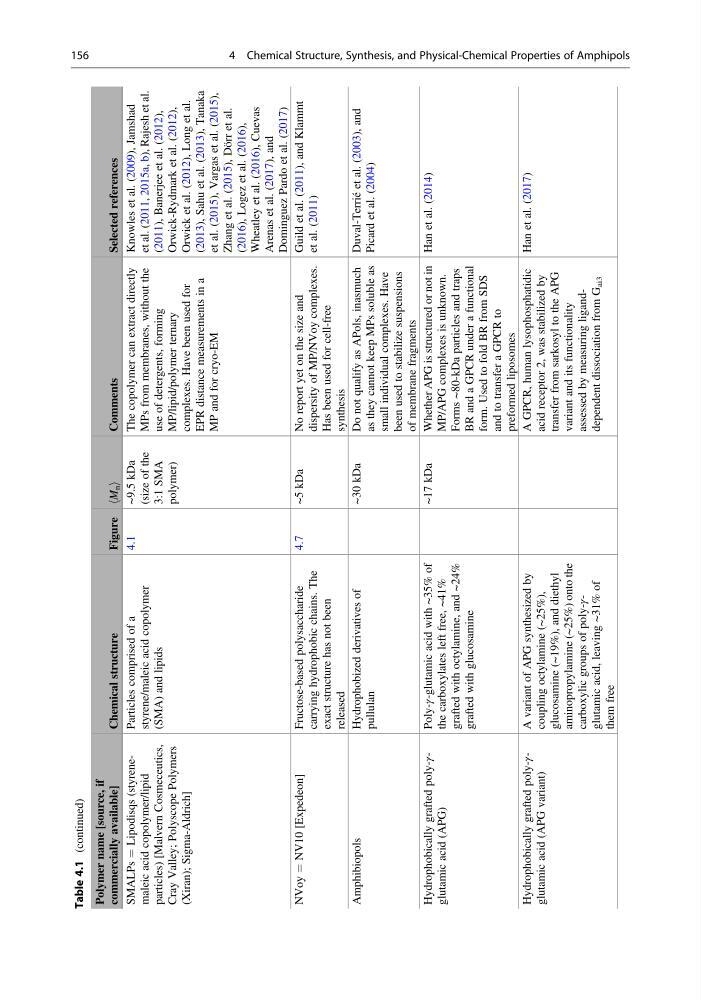
Table 4.1
(continued)
Polymer name [source, if
commercially available]
Chemical structure
Figure
hM n
i
Comments
Selected references
SMALPs
¼ Lipodisqs (styrenemaleic acid copolymer/lipid
particles) [Malvern Cosmeceutics,
Cray Valley; Polyscope Polymers
(Xiran); Sigma-Aldrich]
Particles comprised of a
styrene/maleic acid copolymer
(SMA) and lipids
4.1
~9.5 kDa
(size of the
3:1 SMA
polymer)
The copolymer can extract directly
MPs from membranes, without the
use of detergents, forming
MP/lipid/polymer ternary
complexes. Have been used for
EPR distance measurements in a
MP and for cryo-EM
Knowles et al. (2009), Jamshad
et al. (2011, 2015a, b), Rajesh et al.
(2011), Banerjee et al. (2012),
Orwick-Rydmark et al. (2012),
Orwick et al. (2012), Long et al.
(2013), Sahu et al. (2013), Tanaka
et al. (2015), Vargas et al. (2015),
Zhang et al. (2015), Dörr et al.
(2016), Logez et al. (2016),
Wheatley et al. (2016), Cuevas
Arenas et al. (2017), and
Dominguez Pardo et al. (2017)
NVoy
¼ NV10 [Expedeon]
Fructose-based polysaccharide
carrying hydrophobic chains. The
exact structure has not been
released
4.7
~5 kDa
No report yet on the size and
dispersity of MP/NVoy complexes.
Has been used for cell-free
synthesis
Guild et al. (2011), and Klammt
et al. (2011)
Amphibiopols
Hydrophobized derivatives of
pullulan
~30 kDa
Do not qualify as APols, inasmuch
as they cannot keep MPs soluble as
small individual complexes. Have
been used to stabilize suspensions
of membrane fragments
Duval-Terrié et al. (2003), and
Picard et al. (2004)
Hydrophobically grafted poly-γglutamic acid (APG)
Poly-γ-glutamic acid with ~35% of
the carboxylates left free, ~41%
grafted with octylamine, and ~24%
grafted with glucosamine
~17 kDa
Whether APG is structured or not in
MP/APG complexes is unknown.
Forms ~80-kDa particles and traps
BR and a GPCR under a functional
form. Used to fold BR from SDS
and to transfer a GPCR to
preformed liposomes
Han et al. (2014)
Hydrophobically grafted poly-γglutamic acid (APG variant)
A variant of APG synthesized by
coupling octylamine (~25%),
glucosamine (~19%), and diethyl
aminopropylamine (~25%) onto the
carboxylic groups of poly-γglutamic acid, leaving ~31% of
them free
A GPCR, human lysophosphatidic
acid receptor 2, was stabilized by
transfer from sarkosyl to the APG
variant and its functionality
assessed by measuring liganddependent dissociation from G
ai3
Han et al. (2017)
156
4 Chemical Structure, Synthesis, and Physical-Chemical Properties of Amphipols
(continued)
Polymer name [source, if
commercially available]
Chemical structure
Figure
hM n
i
Comments
Selected references
SMALPs
¼ Lipodisqs (styrenemaleic acid copolymer/lipid
particles) [Malvern Cosmeceutics,
Cray Valley; Polyscope Polymers
(Xiran); Sigma-Aldrich]
Particles comprised of a
styrene/maleic acid copolymer
(SMA) and lipids
4.1
~9.5 kDa
(size of the
3:1 SMA
polymer)
The copolymer can extract directly
MPs from membranes, without the
use of detergents, forming
MP/lipid/polymer ternary
complexes. Have been used for
EPR distance measurements in a
MP and for cryo-EM
Knowles et al. (2009), Jamshad
et al. (2011, 2015a, b), Rajesh et al.
(2011), Banerjee et al. (2012),
Orwick-Rydmark et al. (2012),
Orwick et al. (2012), Long et al.
(2013), Sahu et al. (2013), Tanaka
et al. (2015), Vargas et al. (2015),
Zhang et al. (2015), Dörr et al.
(2016), Logez et al. (2016),
Wheatley et al. (2016), Cuevas
Arenas et al. (2017), and
Dominguez Pardo et al. (2017)
NVoy
¼ NV10 [Expedeon]
Fructose-based polysaccharide
carrying hydrophobic chains. The
exact structure has not been
released
4.7
~5 kDa
No report yet on the size and
dispersity of MP/NVoy complexes.
Has been used for cell-free
synthesis
Guild et al. (2011), and Klammt
et al. (2011)
Amphibiopols
Hydrophobized derivatives of
pullulan
~30 kDa
Do not qualify as APols, inasmuch
as they cannot keep MPs soluble as
small individual complexes. Have
been used to stabilize suspensions
of membrane fragments
Duval-Terrié et al. (2003), and
Picard et al. (2004)
Hydrophobically grafted poly-γglutamic acid (APG)
Poly-γ-glutamic acid with ~35% of
the carboxylates left free, ~41%
grafted with octylamine, and ~24%
grafted with glucosamine
~17 kDa
Whether APG is structured or not in
MP/APG complexes is unknown.
Forms ~80-kDa particles and traps
BR and a GPCR under a functional
form. Used to fold BR from SDS
and to transfer a GPCR to
preformed liposomes
Han et al. (2014)
Hydrophobically grafted poly-γglutamic acid (APG variant)
A variant of APG synthesized by
coupling octylamine (~25%),
glucosamine (~19%), and diethyl
aminopropylamine (~25%) onto the
carboxylic groups of poly-γglutamic acid, leaving ~31% of
them free
A GPCR, human lysophosphatidic
acid receptor 2, was stabilized by
transfer from sarkosyl to the APG
variant and its functionality
assessed by measuring liganddependent dissociation from G
ai3
Han et al. (2017)
156
4 Chemical Structure, Synthesis, and Physical-Chemical Properties of Amphipols