

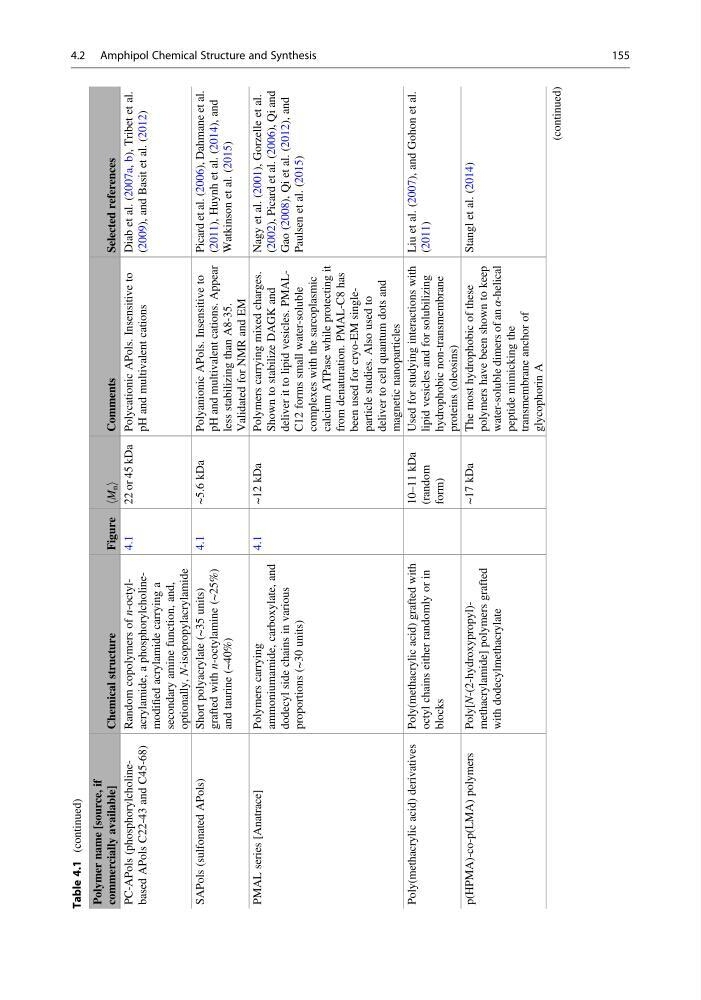
Table 4.1
(continued)
Polymer name [source, if
commercially available]
Chemical structure
Figure
hM n
i
Comments
Selected references
PC-APols (phosphorylcholinebased APols C22-43 and C45-68)
Random copolymers of n-octylacrylamide, a phosphorylcholinemodified acrylamide carrying a
secondary amine function, and,
optionally, N-isopropylacrylamide
4.1
22 or 45 kDa Polycationic APols. Insensitive to
pH and multivalent cations
Diab et al. (2007a, b), Tribet et al.
(2009), and Basit et al. (2012)
SAPols (sulfonated APols)
Short polyacrylate (~35 units)
grafted with n-octylamine
(~25%)
and taurine (~40%)
4.1
~5.6 kDa
Polyanionic APols. Insensitive to
pH and multivalent cations. Appear
less stabilizing than A8-35.
Validated for NMR and EM
Picard et al. (2006), Dahmane et al.
(2011), Huynh et al. (2014), and
Watkinson et al. (2015)
PMAL series [Anatrace]
Polymers carrying
ammoniumamide, carboxylate, and
dodecyl side chains in various
proportions (~30 units)
4.1
~12 kDa
Polymers carrying mixed charges.
Shown to stabilize DAGK and
deliver it to lipid vesicles. PMALC12 forms small water-soluble
complexes with the sarcoplasmic
calcium ATPase while protecting it
from denaturation. PMAL-C8 has
been used for cryo-EM singleparticle studies. Also used to
deliver to cell quantum dots and
magnetic nanoparticles
Nagy et al. (2001), Gorzelle et al.
(2002), Picard et al. (2006), Qi and
Gao (2008), Qi et al. (2012), and
Paulsen et al. (2015)
Poly(methacrylic acid) derivatives Poly(methacrylic acid) grafted with
octyl chains either randomly or in
blocks
10–11 kDa
(random
form)
Used for studying interactions with
lipid vesicles and for solubilizing
hydrophobic non-transmembrane
proteins (oleosins)
Liu et al. (2007), and Gohon et al.
(2011)
p(HPMA)-co-p(LMA) polymers
Poly[N-(2-hydroxypropyl)methacrylamide] polymers grafted
with dodecylmethacrylate
~17 kDa
The most hydrophobic of these
polymers have been shown to keep
water-soluble dimers of an
α-helical
peptide mimicking the
transmembrane anchor of
glycophorin A
Stangl et al. (2014)
(continued)
4.2 Amphipol Chemical Structure and Synthesis
155
(continued)
Polymer name [source, if
commercially available]
Chemical structure
Figure
hM n
i
Comments
Selected references
PC-APols (phosphorylcholinebased APols C22-43 and C45-68)
Random copolymers of n-octylacrylamide, a phosphorylcholinemodified acrylamide carrying a
secondary amine function, and,
optionally, N-isopropylacrylamide
4.1
22 or 45 kDa Polycationic APols. Insensitive to
pH and multivalent cations
Diab et al. (2007a, b), Tribet et al.
(2009), and Basit et al. (2012)
SAPols (sulfonated APols)
Short polyacrylate (~35 units)
grafted with n-octylamine
(~25%)
and taurine (~40%)
4.1
~5.6 kDa
Polyanionic APols. Insensitive to
pH and multivalent cations. Appear
less stabilizing than A8-35.
Validated for NMR and EM
Picard et al. (2006), Dahmane et al.
(2011), Huynh et al. (2014), and
Watkinson et al. (2015)
PMAL series [Anatrace]
Polymers carrying
ammoniumamide, carboxylate, and
dodecyl side chains in various
proportions (~30 units)
4.1
~12 kDa
Polymers carrying mixed charges.
Shown to stabilize DAGK and
deliver it to lipid vesicles. PMALC12 forms small water-soluble
complexes with the sarcoplasmic
calcium ATPase while protecting it
from denaturation. PMAL-C8 has
been used for cryo-EM singleparticle studies. Also used to
deliver to cell quantum dots and
magnetic nanoparticles
Nagy et al. (2001), Gorzelle et al.
(2002), Picard et al. (2006), Qi and
Gao (2008), Qi et al. (2012), and
Paulsen et al. (2015)
Poly(methacrylic acid) derivatives Poly(methacrylic acid) grafted with
octyl chains either randomly or in
blocks
10–11 kDa
(random
form)
Used for studying interactions with
lipid vesicles and for solubilizing
hydrophobic non-transmembrane
proteins (oleosins)
Liu et al. (2007), and Gohon et al.
(2011)
p(HPMA)-co-p(LMA) polymers
Poly[N-(2-hydroxypropyl)methacrylamide] polymers grafted
with dodecylmethacrylate
~17 kDa
The most hydrophobic of these
polymers have been shown to keep
water-soluble dimers of an
α-helical
peptide mimicking the
transmembrane anchor of
glycophorin A
Stangl et al. (2014)
(continued)
4.2 Amphipol Chemical Structure and Synthesis
155