

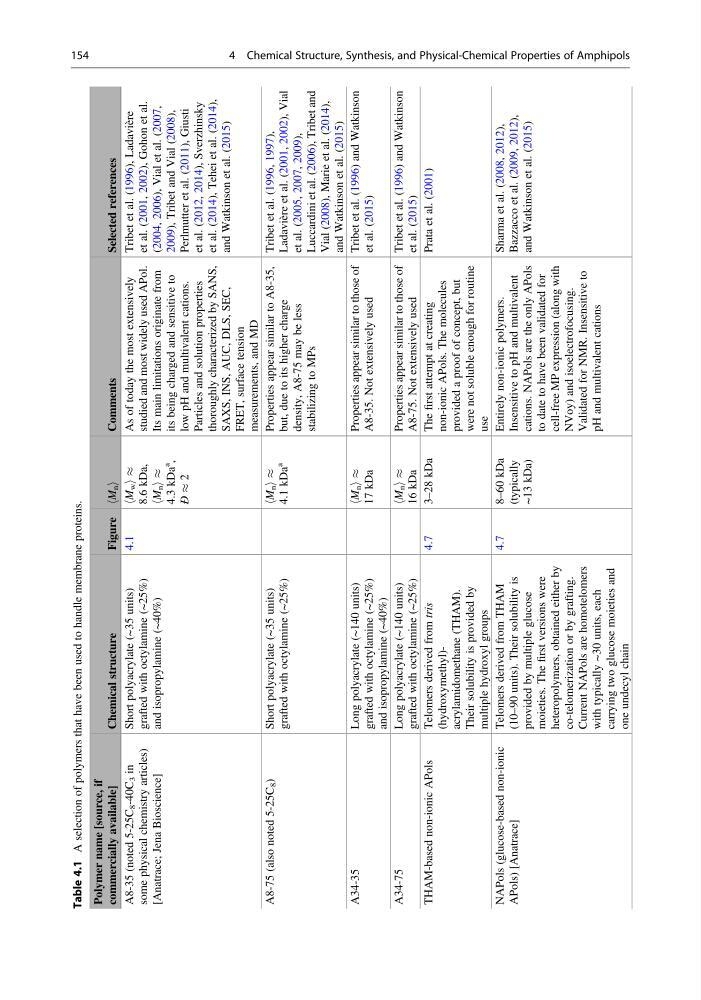
Table 4.1
A selection of polymers that have been used to handle membrane proteins.
Polymer name [source, if
commercially available]
Chemical structure
Figure
hM n
i
Comments
Selected references
A8-35 (noted 5-25C
8 -40C
3 in
some physical chemistry articles)
[Anatrace; Jena Bioscience]
Short polyacrylate (~35 units)
grafted with octylamine (~25%)
and isopropylamine (~40%)
4.1
hM w
i %
8.6 kDa,
hM n
i %
4.3 kDa
a
,
Ð
% 2
As of today the most extensively
studied and most widely used APol.
Its main limitations originate from
its being charged and sensitive to
low pH and multivalent cations.
Particles and solution properties
thoroughly characterized by SANS,
SAXS, INS, AUC, DLS, SEC,
FRET, surface tension
measurements, and MD
Tribet et al. (1996), Ladavière
et al. (2001, 2002), Gohon et al.
(2004, 2006), Vial et al. (2007,
2009), Tribet and Vial (2008),
Perlmutter et al. (2011), Giusti
et al. (2012, 2014), Sverzhinsky
et al. (2014), Tehei et al. (2014),
and Watkinson et al. (2015)
A8-75 (also noted 5-25C
8 )
Short polyacrylate (~35 units)
grafted with octylamine (~25%)
hM n
i %
4.1 kDa
a
Properties appear similar to A8-35,
but, due to its higher charge
density, A8-75 may be less
stabilizing to MPs
Tribet et al. (1996, 1997),
Ladavière et al. (2001, 2002), Vial
et al. (2005, 2007, 2009),
Luccardini et al. (2006), Tribet and
Vial (2008), Marie et al. (2014),
and Watkinson et al. (2015)
A34-35
Long polyacrylate (~140 units)
grafted with octylamine (~25%)
and isopropylamine (~40%)
hM n
i %
17 kDa
Properties appear similar to those of
A8-35. Not extensively used
Tribet et al. (1996) and Watkinson
et al. (2015)
A34-75
Long polyacrylate (~140 units)
grafted with octylamine (~25%)
hM n
i %
16 kDa
Properties appear similar to those of
A8-75. Not extensively used
Tribet et al. (1996) and Watkinson
et al. (2015)
THAM-based non-ionic APols
Telomers derived from tris
(hydroxymethyl)acrylamidomethane (THAM).
Their solubility is provided by
multiple hydroxyl groups
4.7
3–28 kDa
The
first attempt at creating
non-ionic APols. The molecules
provided a proof of concept, but
were not soluble enough for routine
use
Prata et al. (2001)
NAPols (glucose-based non-ionic
APols) [Anatrace]
Telomers derived from THAM
(10–90 units). Their solubility is
provided by multiple glucose
moieties. The
first versions were
heteropolymers, obtained either by
co-telomerization or by grafting.
Current NAPols are homotelomers
with typically ~30 units, each
carrying two glucose moieties and
one undecyl chain
4.7
8–60 kDa
(typically
~13 kDa)
Entirely non-ionic polymers.
Insensitive to pH and multivalent
cations. NAPols are the only APols
to date to have been validated for
cell-free MP expression (along with
NVoy) and isoelectrofocusing.
Validated for NMR. Insensitive to
pH and multivalent cations
Sharma et al. (2008, 2012),
Bazzacco et al. (2009, 2012),
and Watkinson et al. (2015)
154
4 Chemical Structure, Synthesis, and Physical-Chemical Properties of Amphipols
A selection of polymers that have been used to handle membrane proteins.
Polymer name [source, if
commercially available]
Chemical structure
Figure
hM n
i
Comments
Selected references
A8-35 (noted 5-25C
8 -40C
3 in
some physical chemistry articles)
[Anatrace; Jena Bioscience]
Short polyacrylate (~35 units)
grafted with octylamine (~25%)
and isopropylamine (~40%)
4.1
hM w
i %
8.6 kDa,
hM n
i %
4.3 kDa
a
,
Ð
% 2
As of today the most extensively
studied and most widely used APol.
Its main limitations originate from
its being charged and sensitive to
low pH and multivalent cations.
Particles and solution properties
thoroughly characterized by SANS,
SAXS, INS, AUC, DLS, SEC,
FRET, surface tension
measurements, and MD
Tribet et al. (1996), Ladavière
et al. (2001, 2002), Gohon et al.
(2004, 2006), Vial et al. (2007,
2009), Tribet and Vial (2008),
Perlmutter et al. (2011), Giusti
et al. (2012, 2014), Sverzhinsky
et al. (2014), Tehei et al. (2014),
and Watkinson et al. (2015)
A8-75 (also noted 5-25C
8 )
Short polyacrylate (~35 units)
grafted with octylamine (~25%)
hM n
i %
4.1 kDa
a
Properties appear similar to A8-35,
but, due to its higher charge
density, A8-75 may be less
stabilizing to MPs
Tribet et al. (1996, 1997),
Ladavière et al. (2001, 2002), Vial
et al. (2005, 2007, 2009),
Luccardini et al. (2006), Tribet and
Vial (2008), Marie et al. (2014),
and Watkinson et al. (2015)
A34-35
Long polyacrylate (~140 units)
grafted with octylamine (~25%)
and isopropylamine (~40%)
hM n
i %
17 kDa
Properties appear similar to those of
A8-35. Not extensively used
Tribet et al. (1996) and Watkinson
et al. (2015)
A34-75
Long polyacrylate (~140 units)
grafted with octylamine (~25%)
hM n
i %
16 kDa
Properties appear similar to those of
A8-75. Not extensively used
Tribet et al. (1996) and Watkinson
et al. (2015)
THAM-based non-ionic APols
Telomers derived from tris
(hydroxymethyl)acrylamidomethane (THAM).
Their solubility is provided by
multiple hydroxyl groups
4.7
3–28 kDa
The
first attempt at creating
non-ionic APols. The molecules
provided a proof of concept, but
were not soluble enough for routine
use
Prata et al. (2001)
NAPols (glucose-based non-ionic
APols) [Anatrace]
Telomers derived from THAM
(10–90 units). Their solubility is
provided by multiple glucose
moieties. The
first versions were
heteropolymers, obtained either by
co-telomerization or by grafting.
Current NAPols are homotelomers
with typically ~30 units, each
carrying two glucose moieties and
one undecyl chain
4.7
8–60 kDa
(typically
~13 kDa)
Entirely non-ionic polymers.
Insensitive to pH and multivalent
cations. NAPols are the only APols
to date to have been validated for
cell-free MP expression (along with
NVoy) and isoelectrofocusing.
Validated for NMR. Insensitive to
pH and multivalent cations
Sharma et al. (2008, 2012),
Bazzacco et al. (2009, 2012),
and Watkinson et al. (2015)
154
4 Chemical Structure, Synthesis, and Physical-Chemical Properties of Amphipols