

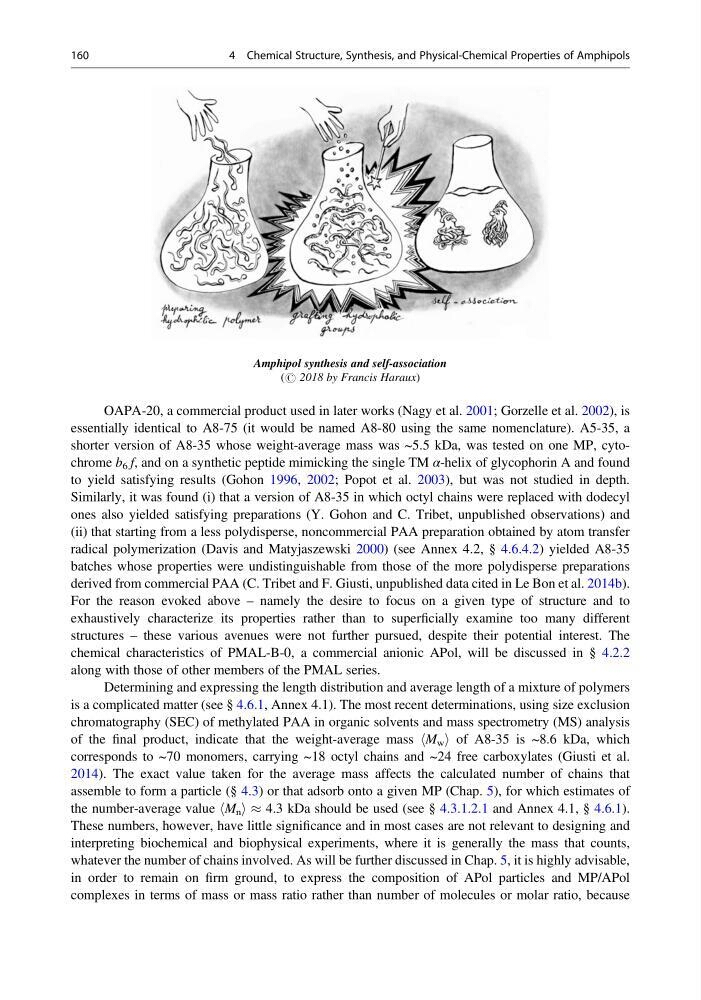
Amphipol synthesis and self-association
(# 2018 by Francis Haraux)
OAPA-20, a commercial product used in later works (Nagy et al. 2001; Gorzelle et al. 2002), is
essentially identical to A8-75 (it would be named A8-80 using the same nomenclature). A5-35, a
shorter version of A8-35 whose weight-average mass was ~5.5 kDa, was tested on one MP, cytochrome b 6 f, and on a synthetic peptide mimicking the single TM α-helix of glycophorin A and found
to yield satisfying results (Gohon 1996, 2002; Popot et al. 2003), but was not studied in depth.
Similarly, it was found (i) that a version of A8-35 in which octyl chains were replaced with dodecyl
ones also yielded satisfying preparations (Y. Gohon and C. Tribet, unpublished observations) and
(ii) that starting from a less polydisperse, noncommercial PAA preparation obtained by atom transfer
radical polymerization (Davis and Matyjaszewski 2000) (see Annex 4.2, § 4.6.4.2) yielded A8-35
batches whose properties were undistinguishable from those of the more polydisperse preparations
derived from commercial PAA (C. Tribet and F. Giusti, unpublished data cited in Le Bon et al. 2014b).
For the reason evoked above – namely the desire to focus on a given type of structure and to
exhaustively characterize its properties rather than to superficially examine too many different
structures – these various avenues were not further pursued, despite their potential interest. The
chemical characteristics of PMAL-B-0, a commercial anionic APol, will be discussed in § 4.2.2
along with those of other members of the PMAL series.
Determining and expressing the length distribution and average length of a mixture of polymers
is a complicated matter (see § 4.6.1, Annex 4.1). The most recent determinations, using size exclusion
chromatography (SEC) of methylated PAA in organic solvents and mass spectrometry (MS) analysis
of the final product, indicate that the weight-average mass hM w i of A8-35 is ~8.6 kDa, which
corresponds to ~70 monomers, carrying ~18 octyl chains and ~24 free carboxylates (Giusti et al.
2014). The exact value taken for the average mass affects the calculated number of chains that
assemble to form a particle (§ 4.3) or that adsorb onto a given MP (Chap. 5), for which estimates of
the number-average value hM n i % 4.3 kDa should be used (see § 4.3.1.2.1 and Annex 4.1, § 4.6.1).
These numbers, however, have little significance and in most cases are not relevant to designing and
interpreting biochemical and biophysical experiments, where it is generally the mass that counts,
whatever the number of chains involved. As will be further discussed in Chap. 5, it is highly advisable,
in order to remain on firm ground, to express the composition of APol particles and MP/APol
complexes in terms of mass or mass ratio rather than number of molecules or molar ratio, because
160
4 Chemical Structure, Synthesis, and Physical-Chemical Properties of Amphipols
(# 2018 by Francis Haraux)
OAPA-20, a commercial product used in later works (Nagy et al. 2001; Gorzelle et al. 2002), is
essentially identical to A8-75 (it would be named A8-80 using the same nomenclature). A5-35, a
shorter version of A8-35 whose weight-average mass was ~5.5 kDa, was tested on one MP, cytochrome b 6 f, and on a synthetic peptide mimicking the single TM α-helix of glycophorin A and found
to yield satisfying results (Gohon 1996, 2002; Popot et al. 2003), but was not studied in depth.
Similarly, it was found (i) that a version of A8-35 in which octyl chains were replaced with dodecyl
ones also yielded satisfying preparations (Y. Gohon and C. Tribet, unpublished observations) and
(ii) that starting from a less polydisperse, noncommercial PAA preparation obtained by atom transfer
radical polymerization (Davis and Matyjaszewski 2000) (see Annex 4.2, § 4.6.4.2) yielded A8-35
batches whose properties were undistinguishable from those of the more polydisperse preparations
derived from commercial PAA (C. Tribet and F. Giusti, unpublished data cited in Le Bon et al. 2014b).
For the reason evoked above – namely the desire to focus on a given type of structure and to
exhaustively characterize its properties rather than to superficially examine too many different
structures – these various avenues were not further pursued, despite their potential interest. The
chemical characteristics of PMAL-B-0, a commercial anionic APol, will be discussed in § 4.2.2
along with those of other members of the PMAL series.
Determining and expressing the length distribution and average length of a mixture of polymers
is a complicated matter (see § 4.6.1, Annex 4.1). The most recent determinations, using size exclusion
chromatography (SEC) of methylated PAA in organic solvents and mass spectrometry (MS) analysis
of the final product, indicate that the weight-average mass hM w i of A8-35 is ~8.6 kDa, which
corresponds to ~70 monomers, carrying ~18 octyl chains and ~24 free carboxylates (Giusti et al.
2014). The exact value taken for the average mass affects the calculated number of chains that
assemble to form a particle (§ 4.3) or that adsorb onto a given MP (Chap. 5), for which estimates of
the number-average value hM n i % 4.3 kDa should be used (see § 4.3.1.2.1 and Annex 4.1, § 4.6.1).
These numbers, however, have little significance and in most cases are not relevant to designing and
interpreting biochemical and biophysical experiments, where it is generally the mass that counts,
whatever the number of chains involved. As will be further discussed in Chap. 5, it is highly advisable,
in order to remain on firm ground, to express the composition of APol particles and MP/APol
complexes in terms of mass or mass ratio rather than number of molecules or molar ratio, because
160
4 Chemical Structure, Synthesis, and Physical-Chemical Properties of Amphipols