

3.5
Fluorinated Surfactants
Up till now, we have considered, in this chapter, surfactants or surfactant mixtures that provide
solubilized MPs with an environment less aggressive than detergents and comprised of the same
chemical moieties as those encountered in biological membranes: lipids, acyl chains, peptides, or small
proteins. Fluorinated surfactants (FSs) exploit a different principle: their hydrophobic moieties are
highly non-biological, and their mildness is due precisely to this peculiarity.
3.5.1
Background
The chemical structure of FSs resembles that of classical detergents (see Fig. 3.25), but their hydrophobic moieties contain fluorine atoms. The rationale behind the use of such compounds is the poor
miscibility of hydrocarbons and fluorocarbons (see e.g. Kissa 1994; Mukerjee 1994; Nakano et al.
2002; Kirsch 2004; Riess 2005). This phenomenon is due to the fact that, because of the lesser
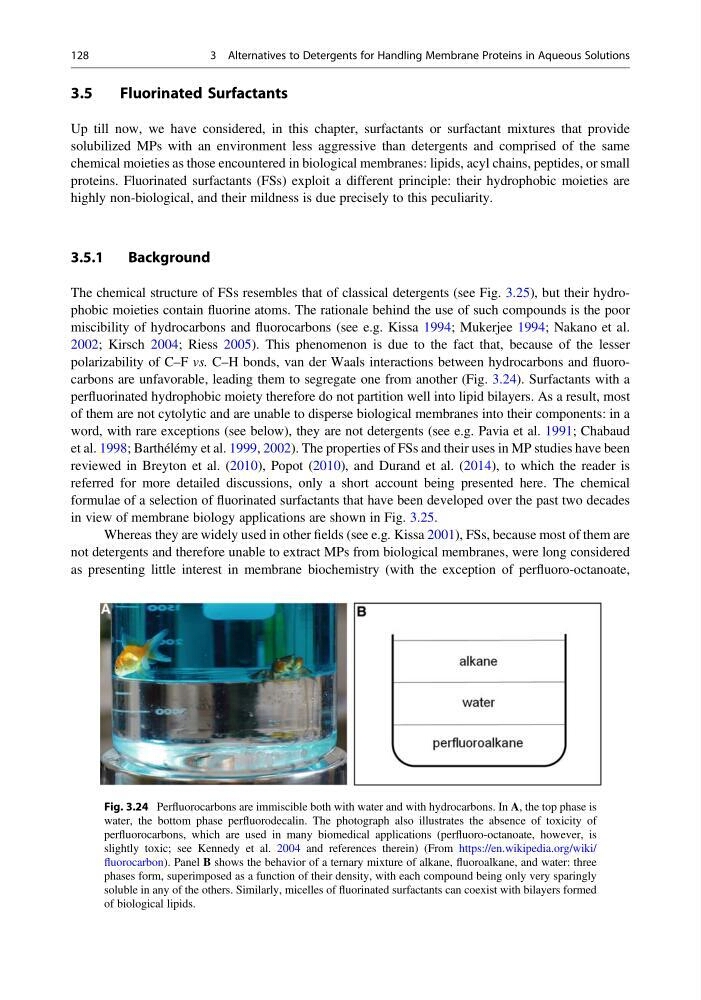
polarizability of C–F vs. C–H bonds, van der Waals interactions between hydrocarbons and fluorocarbons are unfavorable, leading them to segregate one from another (Fig. 3.24). Surfactants with a
perfluorinated hydrophobic moiety therefore do not partition well into lipid bilayers. As a result, most
of them are not cytolytic and are unable to disperse biological membranes into their components: in a
word, with rare exceptions (see below), they are not detergents (see e.g. Pavia et al. 1991; Chabaud
et al. 1998; Barthélémy et al. 1999, 2002). The properties of FSs and their uses in MP studies have been
reviewed in Breyton et al. (2010), Popot (2010), and Durand et al. (2014), to which the reader is
referred for more detailed discussions, only a short account being presented here. The chemical
formulae of a selection of fluorinated surfactants that have been developed over the past two decades
in view of membrane biology applications are shown in Fig. 3.25.
Whereas they are widely used in other fields (see e.g. Kissa 2001), FSs, because most of them are
not detergents and therefore unable to extract MPs from biological membranes, were long considered
as presenting little interest in membrane biochemistry (with the exception of perfluoro-octanoate,
Fig. 3.24 Perfluorocarbons are immiscible both with water and with hydrocarbons. In A, the top phase is
water, the bottom phase perfluorodecalin. The photograph also illustrates the absence of toxicity of
perfluorocarbons, which are used in many biomedical applications (perfluoro-octanoate, however, is
slightly toxic; see Kennedy et al. 2004 and references therein) (From https://en.wikipedia.org/wiki/
fluorocarbon). Panel B shows the behavior of a ternary mixture of alkane, fluoroalkane, and water: three
phases form, superimposed as a function of their density, with each compound being only very sparingly
soluble in any of the others. Similarly, micelles of fluorinated surfactants can coexist with bilayers formed
of biological lipids.
128
3 Alternatives to Detergents for Handling Membrane Proteins in Aqueous Solutions
Fluorinated Surfactants
Up till now, we have considered, in this chapter, surfactants or surfactant mixtures that provide
solubilized MPs with an environment less aggressive than detergents and comprised of the same
chemical moieties as those encountered in biological membranes: lipids, acyl chains, peptides, or small
proteins. Fluorinated surfactants (FSs) exploit a different principle: their hydrophobic moieties are
highly non-biological, and their mildness is due precisely to this peculiarity.
3.5.1
Background
The chemical structure of FSs resembles that of classical detergents (see Fig. 3.25), but their hydrophobic moieties contain fluorine atoms. The rationale behind the use of such compounds is the poor
miscibility of hydrocarbons and fluorocarbons (see e.g. Kissa 1994; Mukerjee 1994; Nakano et al.
2002; Kirsch 2004; Riess 2005). This phenomenon is due to the fact that, because of the lesser
polarizability of C–F vs. C–H bonds, van der Waals interactions between hydrocarbons and fluorocarbons are unfavorable, leading them to segregate one from another (Fig. 3.24). Surfactants with a
perfluorinated hydrophobic moiety therefore do not partition well into lipid bilayers. As a result, most
of them are not cytolytic and are unable to disperse biological membranes into their components: in a
word, with rare exceptions (see below), they are not detergents (see e.g. Pavia et al. 1991; Chabaud
et al. 1998; Barthélémy et al. 1999, 2002). The properties of FSs and their uses in MP studies have been
reviewed in Breyton et al. (2010), Popot (2010), and Durand et al. (2014), to which the reader is
referred for more detailed discussions, only a short account being presented here. The chemical
formulae of a selection of fluorinated surfactants that have been developed over the past two decades
in view of membrane biology applications are shown in Fig. 3.25.
Whereas they are widely used in other fields (see e.g. Kissa 2001), FSs, because most of them are
not detergents and therefore unable to extract MPs from biological membranes, were long considered
as presenting little interest in membrane biochemistry (with the exception of perfluoro-octanoate,
Fig. 3.24 Perfluorocarbons are immiscible both with water and with hydrocarbons. In A, the top phase is
water, the bottom phase perfluorodecalin. The photograph also illustrates the absence of toxicity of
perfluorocarbons, which are used in many biomedical applications (perfluoro-octanoate, however, is
slightly toxic; see Kennedy et al. 2004 and references therein) (From https://en.wikipedia.org/wiki/
fluorocarbon). Panel B shows the behavior of a ternary mixture of alkane, fluoroalkane, and water: three
phases form, superimposed as a function of their density, with each compound being only very sparingly
soluble in any of the others. Similarly, micelles of fluorinated surfactants can coexist with bilayers formed
of biological lipids.
128
3 Alternatives to Detergents for Handling Membrane Proteins in Aqueous Solutions