

which has been used for MP electrophoresis; Shepherd and Holzenburg 1995; Ramjeesingh et al.
1999). There were nevertheless two good reasons to expect that FSs, assuming that they could keep
MPs soluble after they have been extracted with a classical detergent, might provide them with less
destabilizing an environment: (i) lipids, subunits, and hydrophobic cofactors, having TM surfaces
covered with methyl and methylene groups, should partition less favorably into FS micelle than into
detergent ones, reducing the entropic drive toward dissociation, and (ii) because fluorinated alkyl
chains are more bulky and more rigid than alkanes (see e.g. Kirsch 2004; Riess 2005), and they have
little affinity for hydrogenated TM protein segments, they ought to be less efficient than detergents at
disrupting stabilizing protein/protein and protein/lipid interactions. By the same token, however, it was
to be feared that FSs might be ineffective as well at preventing MPs from aggregating, which early data
seemed to bear out (Chabaud et al. 1998; Der Mardirossian et al. 1998). To try to improve interactions
with the methyl group-covered TM surfaces of MPs while preserving the overall lyophobic (“lipidfearing”) character of FS micelles, a hydrogenated tip was therefore grafted onto the fluorinated tail,
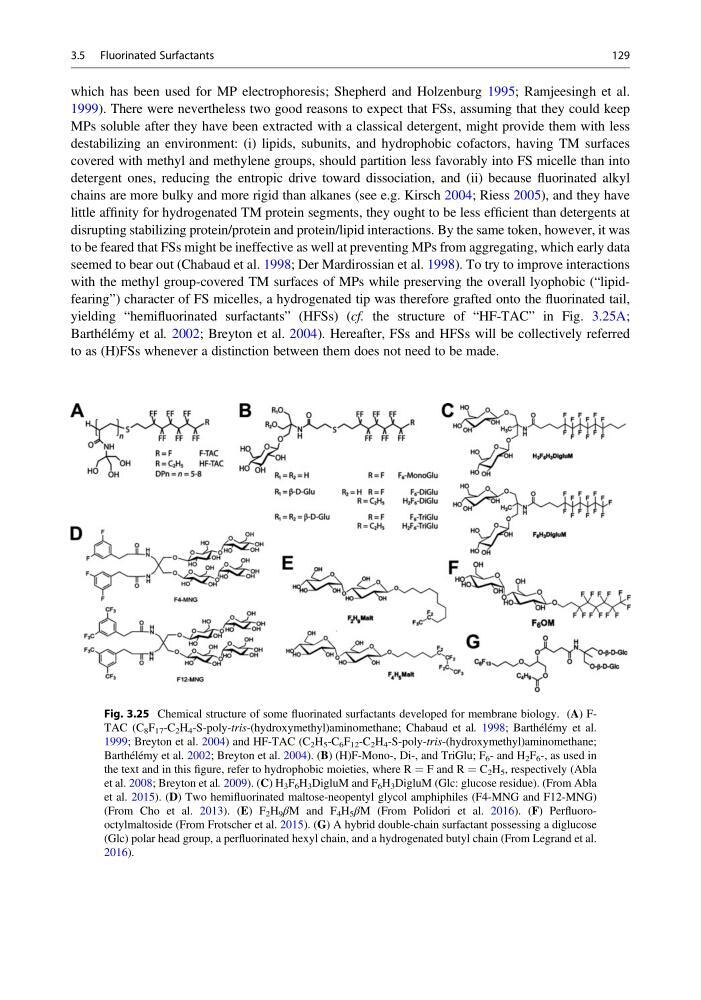
yielding “hemifluorinated surfactants” (HFSs) (cf. the structure of “HF-TAC” in Fig. 3.25A;
Barthélémy et al. 2002; Breyton et al. 2004). Hereafter, FSs and HFSs will be collectively referred
to as (H)FSs whenever a distinction between them does not need to be made.
Fig. 3.25 Chemical structure of some fluorinated surfactants developed for membrane biology. (A) FTAC (C 8 F 17 -C 2 H 4 -S-poly-tris-(hydroxymethyl)aminomethane; Chabaud et al. 1998; Barthélémy et al.
1999; Breyton et al. 2004) and HF-TAC (C 2 H 5 -C 6 F 12 -C 2 H 4 -S-poly-tris-(hydroxymethyl)aminomethane;
Barthélémy et al. 2002; Breyton et al. 2004). (B) (H)F-Mono-, Di-, and TriGlu; F 6 - and H 2 F 6 -, as used in
the text and in this figure, refer to hydrophobic moieties, where R ¼ F and R ¼ C 2 H 5 , respectively (Abla
et al. 2008; Breyton et al. 2009). (C) H 3 F 6 H 3 DigluM and F 6 H 3 DigluM (Glc: glucose residue). (From Abla
et al. 2015). (D) Two hemifluorinated maltose-neopentyl glycol amphiphiles (F4-MNG and F12-MNG)
(From Cho et al. 2013). (E) F 2 H 9 βM and F 4 H 5 βM (From Polidori et al. 2016). (F) Perfluorooctylmaltoside (From Frotscher et al. 2015). (G) A hybrid double-chain surfactant possessing a diglucose
(Glc) polar head group, a perfluorinated hexyl chain, and a hydrogenated butyl chain (From Legrand et al.
2016).
3.5 Fluorinated Surfactants
129
1999). There were nevertheless two good reasons to expect that FSs, assuming that they could keep
MPs soluble after they have been extracted with a classical detergent, might provide them with less
destabilizing an environment: (i) lipids, subunits, and hydrophobic cofactors, having TM surfaces
covered with methyl and methylene groups, should partition less favorably into FS micelle than into
detergent ones, reducing the entropic drive toward dissociation, and (ii) because fluorinated alkyl
chains are more bulky and more rigid than alkanes (see e.g. Kirsch 2004; Riess 2005), and they have
little affinity for hydrogenated TM protein segments, they ought to be less efficient than detergents at
disrupting stabilizing protein/protein and protein/lipid interactions. By the same token, however, it was
to be feared that FSs might be ineffective as well at preventing MPs from aggregating, which early data
seemed to bear out (Chabaud et al. 1998; Der Mardirossian et al. 1998). To try to improve interactions
with the methyl group-covered TM surfaces of MPs while preserving the overall lyophobic (“lipidfearing”) character of FS micelles, a hydrogenated tip was therefore grafted onto the fluorinated tail,
yielding “hemifluorinated surfactants” (HFSs) (cf. the structure of “HF-TAC” in Fig. 3.25A;
Barthélémy et al. 2002; Breyton et al. 2004). Hereafter, FSs and HFSs will be collectively referred
to as (H)FSs whenever a distinction between them does not need to be made.
Fig. 3.25 Chemical structure of some fluorinated surfactants developed for membrane biology. (A) FTAC (C 8 F 17 -C 2 H 4 -S-poly-tris-(hydroxymethyl)aminomethane; Chabaud et al. 1998; Barthélémy et al.
1999; Breyton et al. 2004) and HF-TAC (C 2 H 5 -C 6 F 12 -C 2 H 4 -S-poly-tris-(hydroxymethyl)aminomethane;
Barthélémy et al. 2002; Breyton et al. 2004). (B) (H)F-Mono-, Di-, and TriGlu; F 6 - and H 2 F 6 -, as used in
the text and in this figure, refer to hydrophobic moieties, where R ¼ F and R ¼ C 2 H 5 , respectively (Abla
et al. 2008; Breyton et al. 2009). (C) H 3 F 6 H 3 DigluM and F 6 H 3 DigluM (Glc: glucose residue). (From Abla
et al. 2015). (D) Two hemifluorinated maltose-neopentyl glycol amphiphiles (F4-MNG and F12-MNG)
(From Cho et al. 2013). (E) F 2 H 9 βM and F 4 H 5 βM (From Polidori et al. 2016). (F) Perfluorooctylmaltoside (From Frotscher et al. 2015). (G) A hybrid double-chain surfactant possessing a diglucose
(Glc) polar head group, a perfluorinated hexyl chain, and a hydrogenated butyl chain (From Legrand et al.
2016).
3.5 Fluorinated Surfactants
129