

the other surfactants, (ii) situations where using one or another system is optional, and (iii) situations
where the use of NDs presents particular challenges.
In the first category, one may cite two particular types of issues, namely (i) determining whether
a given protein functions as a monomer or an oligomer and (ii) examining the role of the lipid
environment. An example of the first circumstance is the long-standing controversy about whether
GPCRs function as monomers or multimers. By preventing oligomerization of MPs trapped as
monomers, NDs provide an unprecedented opportunity to investigate the functional roles of oligomerization. Complexes comprising either one or two rhodopsin molecules per standard ND were produced. Efficient transducin activation and isolation of a high-affinity transducin-metarhodopsin II
complex was demonstrated for monodisperse monomeric rhodopsin. In the case of the two-rhodopsin
population, only one of them was able to form a stable metarhodopsin II-G protein complex (Bayburt
et al. 2007). These experiments thus provided clear evidence that monomeric rhodopsin is capable of
fully coupling signal detection to transduction, a demonstration that is not easy to achieve unambiguously using other types of preparations. The demonstration was later extended to rhodopsin kinase
(GRK1) phosphorylation and the binding of arrestin-1 (Bayburt et al. 2011). A similar demonstration
has been achieved for the μ-opioid GPCR (Kuszak et al. 2009). Two other nice examples of this type of
investigations are a study of the role played by the formation of oligomers of dimers in TM signalization by chemoreceptors (Boldog et al. 2006) and the demonstration that talin activates unclustered
integrins (Ye et al. 2010). Similarly, NDs have been used to demonstrate that SecYEG monomers are
functional for pre-protein translocation (Taufik et al. 2013) and to compare the affinity of neutralizing
antibodies for monomeric vs. trimeric HIV TM peptides (Reichart et al. 2016).
Another case of figure where the resort to NDs is, if not always compulsory, at least extremely
useful is the influence of the lipid environment. For MPs that are small enough and integrated within
large enough NDs, the latter offer an opportunity to study the interactions of the protein with its lipid
environment under conditions of limited perturbation. To take a single example, BLT2, a GPCR
involved in inflammatory processes, was initially folded from inclusion bodies using APols and the
structure of its bound ligand, LTB 4 , determined by solution NMR in a BLT2/APol complex (Catoire
et al. 2010a; see Chap. 10, § 10.3.3.3). In order to study the allosteric modulation of BLT2 by
cholesterol, however, the receptor was transferred from APols to NDs (Casiraghi et al. 2016; see
Protocol 5.3 in Chap. 5, § 5.9.3). NDs have been used to examine the role of specific lipids in many
other cases, for instance, in activating pre-protein transport by SecYEG/SecA complexes (Koch et al.
2016).
The interactions between the extramembrane domains of three proteins involved in membrane
fusion, VAMP-2 (vesicle-associated membrane protein 2) and syntaxin-1a, on the one hand, and
SNAREs (soluble N-ethylmaleimide-sensitive factor attachment protein receptors), on the other hand,
have been studied by EPR and Förster resonance energy transfer (FRET) after trapping the first two
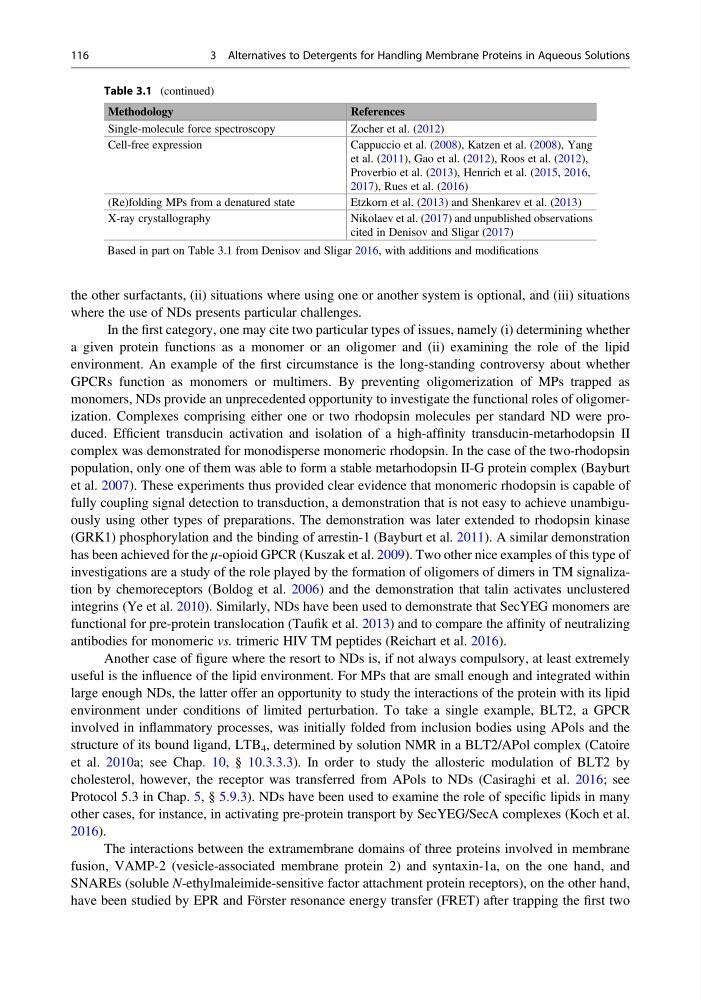
Table 3.1 (continued)
Methodology
References
Single-molecule force spectroscopy
Zocher et al. (2012)
Cell-free expression
Cappuccio et al. (2008), Katzen et al. (2008), Yang
et al. (2011), Gao et al. (2012), Roos et al. (2012),
Proverbio et al. (2013), Henrich et al. (2015, 2016,
2017), Rues et al. (2016)
(Re)folding MPs from a denatured state
Etzkorn et al. (2013) and Shenkarev et al. (2013)
X-ray crystallography
Nikolaev et al. (2017) and unpublished observations
cited in Denisov and Sligar (2017)
Based in part on Table 3.1 from Denisov and Sligar 2016, with additions and modifications
116
3 Alternatives to Detergents for Handling Membrane Proteins in Aqueous Solutions
where the use of NDs presents particular challenges.
In the first category, one may cite two particular types of issues, namely (i) determining whether
a given protein functions as a monomer or an oligomer and (ii) examining the role of the lipid
environment. An example of the first circumstance is the long-standing controversy about whether
GPCRs function as monomers or multimers. By preventing oligomerization of MPs trapped as
monomers, NDs provide an unprecedented opportunity to investigate the functional roles of oligomerization. Complexes comprising either one or two rhodopsin molecules per standard ND were produced. Efficient transducin activation and isolation of a high-affinity transducin-metarhodopsin II
complex was demonstrated for monodisperse monomeric rhodopsin. In the case of the two-rhodopsin
population, only one of them was able to form a stable metarhodopsin II-G protein complex (Bayburt
et al. 2007). These experiments thus provided clear evidence that monomeric rhodopsin is capable of
fully coupling signal detection to transduction, a demonstration that is not easy to achieve unambiguously using other types of preparations. The demonstration was later extended to rhodopsin kinase
(GRK1) phosphorylation and the binding of arrestin-1 (Bayburt et al. 2011). A similar demonstration
has been achieved for the μ-opioid GPCR (Kuszak et al. 2009). Two other nice examples of this type of
investigations are a study of the role played by the formation of oligomers of dimers in TM signalization by chemoreceptors (Boldog et al. 2006) and the demonstration that talin activates unclustered
integrins (Ye et al. 2010). Similarly, NDs have been used to demonstrate that SecYEG monomers are
functional for pre-protein translocation (Taufik et al. 2013) and to compare the affinity of neutralizing
antibodies for monomeric vs. trimeric HIV TM peptides (Reichart et al. 2016).
Another case of figure where the resort to NDs is, if not always compulsory, at least extremely
useful is the influence of the lipid environment. For MPs that are small enough and integrated within
large enough NDs, the latter offer an opportunity to study the interactions of the protein with its lipid
environment under conditions of limited perturbation. To take a single example, BLT2, a GPCR
involved in inflammatory processes, was initially folded from inclusion bodies using APols and the
structure of its bound ligand, LTB 4 , determined by solution NMR in a BLT2/APol complex (Catoire
et al. 2010a; see Chap. 10, § 10.3.3.3). In order to study the allosteric modulation of BLT2 by
cholesterol, however, the receptor was transferred from APols to NDs (Casiraghi et al. 2016; see
Protocol 5.3 in Chap. 5, § 5.9.3). NDs have been used to examine the role of specific lipids in many
other cases, for instance, in activating pre-protein transport by SecYEG/SecA complexes (Koch et al.
2016).
The interactions between the extramembrane domains of three proteins involved in membrane
fusion, VAMP-2 (vesicle-associated membrane protein 2) and syntaxin-1a, on the one hand, and
SNAREs (soluble N-ethylmaleimide-sensitive factor attachment protein receptors), on the other hand,
have been studied by EPR and Förster resonance energy transfer (FRET) after trapping the first two
Table 3.1 (continued)
Methodology
References
Single-molecule force spectroscopy
Zocher et al. (2012)
Cell-free expression
Cappuccio et al. (2008), Katzen et al. (2008), Yang
et al. (2011), Gao et al. (2012), Roos et al. (2012),
Proverbio et al. (2013), Henrich et al. (2015, 2016,
2017), Rues et al. (2016)
(Re)folding MPs from a denatured state
Etzkorn et al. (2013) and Shenkarev et al. (2013)
X-ray crystallography
Nikolaev et al. (2017) and unpublished observations
cited in Denisov and Sligar (2017)
Based in part on Table 3.1 from Denisov and Sligar 2016, with additions and modifications
116
3 Alternatives to Detergents for Handling Membrane Proteins in Aqueous Solutions