

protein (Fig. 3.8B
0 ) (Shih et al. 2005). This is reflected in the restricted dynamics of both the protein
and the lipids upon insertion of proteorhodopsin into DMPC NDs, as observed by NMR (Mörs et al.
2013). Stiffening may actually contribute to MP stabilization (for a discussion on the relationship
between MP dynamics and stability, see Chap. 5, § 5.6). A detailed NMR comparison of the dynamics
of OmpX either solubilized in dodecylphosphocholine (DPC) or trapped in medium-sized NDs
(167-residue MSP1D1ΔH5, from which only helix 5 has been deleted; see Fig. 3.7) showed that, on
the ps and ns time ranges, there are few differences at the level of the TM β-barrel and more in the loop
regions (Hagn et al. 2013). A recent NMR study reports, surprisingly, that the TM β-strands of OmpX
are less dynamic in DPC solution than they are in DMPC/diC 6 PC bicelles or DMPC nanodiscs (Frey
et al. 2017), whereas MD data suggest that the dynamics of rhodopsin/lipid interactions is slowed
down in NDs as compared to bicelles (Vestergaard et al. 2015). Broader studies are clearly needed to
sort out these various effects and assess their generality.
We have hitherto considered the case where a target MP has been purified in detergent solution
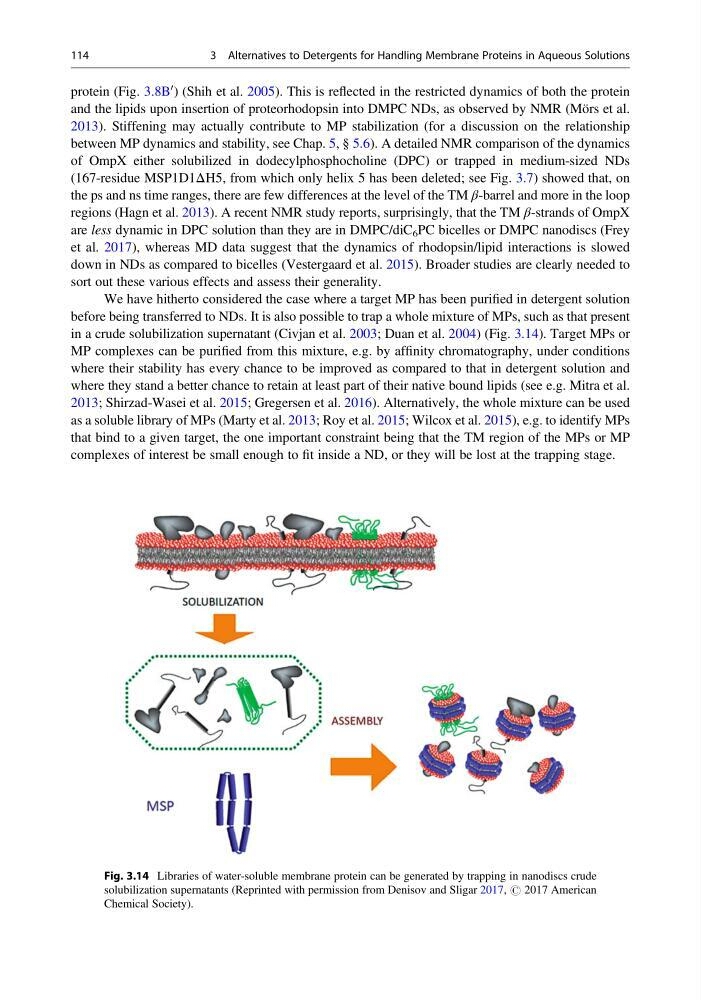
before being transferred to NDs. It is also possible to trap a whole mixture of MPs, such as that present
in a crude solubilization supernatant (Civjan et al. 2003; Duan et al. 2004) (Fig. 3.14). Target MPs or
MP complexes can be purified from this mixture, e.g. by affinity chromatography, under conditions
where their stability has every chance to be improved as compared to that in detergent solution and
where they stand a better chance to retain at least part of their native bound lipids (see e.g. Mitra et al.
2013; Shirzad-Wasei et al. 2015; Gregersen et al. 2016). Alternatively, the whole mixture can be used
as a soluble library of MPs (Marty et al. 2013; Roy et al. 2015; Wilcox et al. 2015), e.g. to identify MPs
that bind to a given target, the one important constraint being that the TM region of the MPs or MP
complexes of interest be small enough to fit inside a ND, or they will be lost at the trapping stage.
Fig. 3.14 Libraries of water-soluble membrane protein can be generated by trapping in nanodiscs crude
solubilization supernatants (Reprinted with permission from Denisov and Sligar 2017, # 2017 American
Chemical Society).
114
3 Alternatives to Detergents for Handling Membrane Proteins in Aqueous Solutions
0 ) (Shih et al. 2005). This is reflected in the restricted dynamics of both the protein
and the lipids upon insertion of proteorhodopsin into DMPC NDs, as observed by NMR (Mörs et al.
2013). Stiffening may actually contribute to MP stabilization (for a discussion on the relationship
between MP dynamics and stability, see Chap. 5, § 5.6). A detailed NMR comparison of the dynamics
of OmpX either solubilized in dodecylphosphocholine (DPC) or trapped in medium-sized NDs
(167-residue MSP1D1ΔH5, from which only helix 5 has been deleted; see Fig. 3.7) showed that, on
the ps and ns time ranges, there are few differences at the level of the TM β-barrel and more in the loop
regions (Hagn et al. 2013). A recent NMR study reports, surprisingly, that the TM β-strands of OmpX
are less dynamic in DPC solution than they are in DMPC/diC 6 PC bicelles or DMPC nanodiscs (Frey
et al. 2017), whereas MD data suggest that the dynamics of rhodopsin/lipid interactions is slowed
down in NDs as compared to bicelles (Vestergaard et al. 2015). Broader studies are clearly needed to
sort out these various effects and assess their generality.
We have hitherto considered the case where a target MP has been purified in detergent solution
before being transferred to NDs. It is also possible to trap a whole mixture of MPs, such as that present
in a crude solubilization supernatant (Civjan et al. 2003; Duan et al. 2004) (Fig. 3.14). Target MPs or
MP complexes can be purified from this mixture, e.g. by affinity chromatography, under conditions
where their stability has every chance to be improved as compared to that in detergent solution and
where they stand a better chance to retain at least part of their native bound lipids (see e.g. Mitra et al.
2013; Shirzad-Wasei et al. 2015; Gregersen et al. 2016). Alternatively, the whole mixture can be used
as a soluble library of MPs (Marty et al. 2013; Roy et al. 2015; Wilcox et al. 2015), e.g. to identify MPs
that bind to a given target, the one important constraint being that the TM region of the MPs or MP
complexes of interest be small enough to fit inside a ND, or they will be lost at the trapping stage.
Fig. 3.14 Libraries of water-soluble membrane protein can be generated by trapping in nanodiscs crude
solubilization supernatants (Reprinted with permission from Denisov and Sligar 2017, # 2017 American
Chemical Society).
114
3 Alternatives to Detergents for Handling Membrane Proteins in Aqueous Solutions