

296
Analyse fonctionnelle
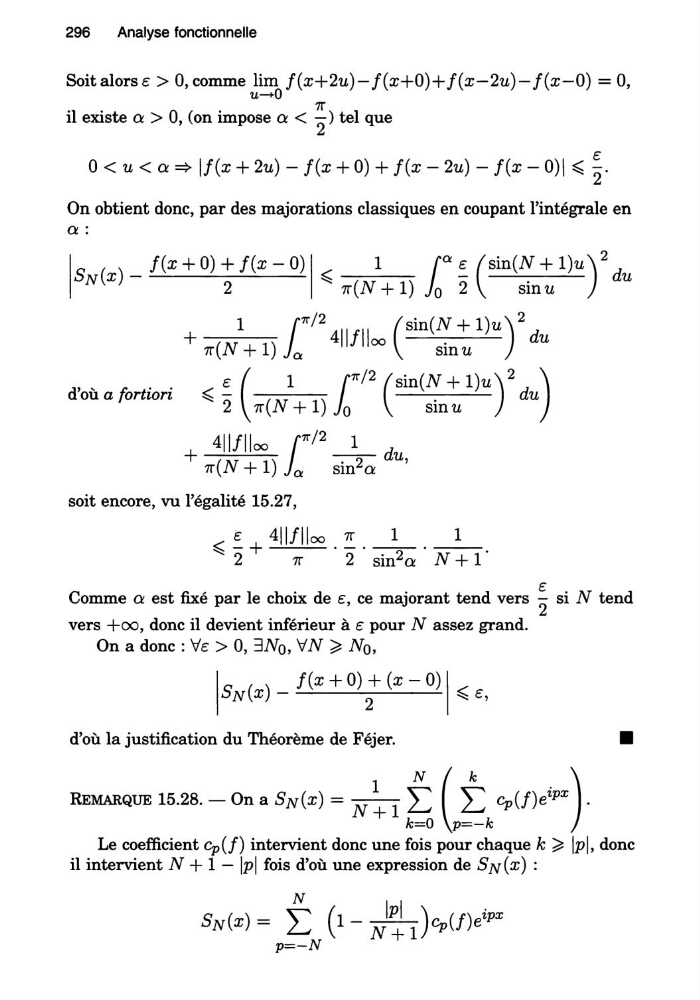
Soit alors c > 0, comme lim f(x+2u)- f(x+O)+ f(x-2u)- f(x-0) = 0,
u-+O
il existe a > 0, (on impose a < i) tel que
é
0 < u < a=} lf(x + 2u) - f(x + O) + f(x - 2u) - f(x - O)I ~ 2·
On obtient donc, par des majorations classiques en coupant l'intégrale en
a:
I
SN(x) _ f(x + 0) + f(x - 0) 1 ~
1
f':t :_(sin(~+ l)u) 2 du
2
7r(N + 1) Jo 2
sm u
+
1
17r/2 411/lloo (sin(~+ l)u)2 du
7r(N + 1) °'
smu
d'où a fortiori
~ :_ ( 1
r/ 2 (sin(N + l)u) 2 du)
"' 2 7r(N + 1) } 0
sin u
411/lloo 17r/ 2 1 d
+
- - u
7r(N + 1) °' sin 2 a '
soit encore, vu l'égalité 15.27,
ê
411/lloo 7r 1
1
~-+
·-·--·--.
2
7r
2 sin 2 a N + 1
é
Comme a est fixé par le choix de c, ce majorant tend vers "2 si N tend
vers +oo, donc il devient inférieur à c pour N assez grand.
On a donc: Ve> 0, 3No, VN ~No,
ls ( ) _ f(x + 0) + (x - 0) 1 ~
N X
2
"' c,
d'où la justification du Théorème de Féjer.
•
REMARQUE 15.28. -On a SN(x) = N ~ l t ( t ep(f)eipx).
k=O p=-k
Le coefficient ep(f) intervient donc une fois pour chaque k ~ IPI, donc
il intervient N + 1 - IPI fois d'où une expression de SN(x) :
N
SN(x) = L ( 1 - ~ )ep(f)eipx
p=-N
N +1
Analyse fonctionnelle
Soit alors c > 0, comme lim f(x+2u)- f(x+O)+ f(x-2u)- f(x-0) = 0,
u-+O
il existe a > 0, (on impose a < i) tel que
é
0 < u < a=} lf(x + 2u) - f(x + O) + f(x - 2u) - f(x - O)I ~ 2·
On obtient donc, par des majorations classiques en coupant l'intégrale en
a:
I
SN(x) _ f(x + 0) + f(x - 0) 1 ~
1
f':t :_(sin(~+ l)u) 2 du
2
7r(N + 1) Jo 2
sm u
+
1
17r/2 411/lloo (sin(~+ l)u)2 du
7r(N + 1) °'
smu
d'où a fortiori
~ :_ ( 1
r/ 2 (sin(N + l)u) 2 du)
"' 2 7r(N + 1) } 0
sin u
411/lloo 17r/ 2 1 d
+
- - u
7r(N + 1) °' sin 2 a '
soit encore, vu l'égalité 15.27,
ê
411/lloo 7r 1
1
~-+
·-·--·--.
2
7r
2 sin 2 a N + 1
é
Comme a est fixé par le choix de c, ce majorant tend vers "2 si N tend
vers +oo, donc il devient inférieur à c pour N assez grand.
On a donc: Ve> 0, 3No, VN ~No,
ls ( ) _ f(x + 0) + (x - 0) 1 ~
N X
2
"' c,
d'où la justification du Théorème de Féjer.
•
REMARQUE 15.28. -On a SN(x) = N ~ l t ( t ep(f)eipx).
k=O p=-k
Le coefficient ep(f) intervient donc une fois pour chaque k ~ IPI, donc
il intervient N + 1 - IPI fois d'où une expression de SN(x) :
N
SN(x) = L ( 1 - ~ )ep(f)eipx
p=-N
N +1