

300
CHAPITRE 9. ESPACES DE TRAJECTOIRES
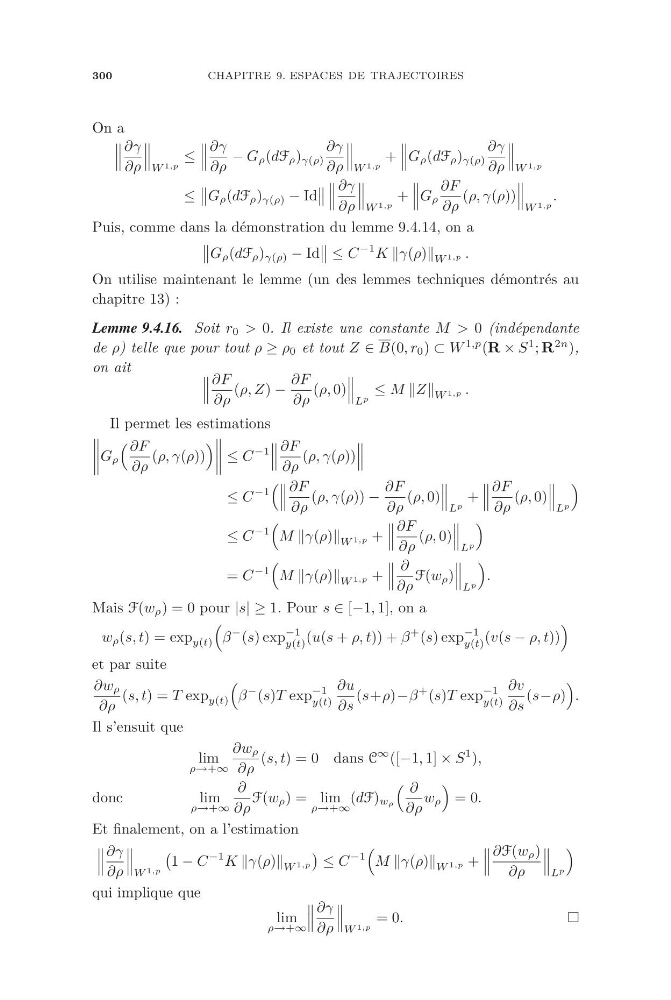
On a
∂γ
∂ρ
W 1,p
≤
∂γ
∂ρ
− G ρ (dF ρ ) γ(ρ)
∂γ
∂ρ
W 1,p
+
G ρ (dF ρ ) γ(ρ)
∂γ
∂ρ
W 1,p
≤
G ρ (dF ρ ) γ(ρ) − Id
∂γ
∂ρ
W 1,p
+
G ρ
∂F
∂ρ
(ρ, γ(ρ))
W 1,p
.
Puis, comme dans la démonstration du lemme 9.4.14, on a
G ρ (dF ρ ) γ(ρ) − Id
≤ C
−1 K γ(ρ) W 1,p .
On utilise maintenant le lemme (un des lemmes techniques démontrés au
chapitre 13) :
Lemme 9.4.16. Soit r 0 > 0. Il existe une constante M > 0 (indépendante
de ρ) telle que pour tout ρ ≥ ρ 0 et tout Z ∈ B(0, r 0 ) ⊂ W
1,p (R × S
1 ; R
2n ),
on ait
∂F
∂ρ
(ρ, Z) −
∂F
∂ρ
(ρ, 0)
L p
≤ M Z W 1,p .
Il permet les estimations
G ρ
∂F
∂ρ
(ρ, γ(ρ))
≤ C
−1
∂F
∂ρ
(ρ, γ(ρ))
≤ C
−1
∂F
∂ρ
(ρ, γ(ρ)) −
∂F
∂ρ
(ρ, 0)
L p
+
∂F
∂ρ
(ρ, 0)
L p
≤ C
−1
M γ(ρ) W 1,p +
∂F
∂ρ
(ρ, 0)
L p
= C
−1
M γ(ρ) W 1,p +
∂
∂ρ
F(w ρ )
L p
.
Mais F(w ρ ) = 0 pour |s| ≥ 1. Pour s ∈ [−1, 1], on a
w ρ (s, t) = exp y(t)
β
− (s) exp
−1
y(t) (u(s + ρ, t)) + β
+ (s) exp
−1
y(t) (v(s − ρ, t))
et par suite
∂w ρ
∂ρ
(s, t) = T exp y(t)
β
− (s)T exp
−1
y(t)
∂u
∂s
(s+ρ)−β
+ (s)T exp
−1
y(t)
∂v
∂s
(s−ρ)
.
Il s’ensuit que
lim
ρ→+∞
∂w ρ
∂ρ
(s, t) = 0 dans C
∞ ([−1, 1] × S
1 ),
lim
ρ→+∞
∂
∂ρ
F(w ρ ) = lim
ρ→+∞
(dF) wρ
∂
∂ρ
w ρ
= 0.
donc
Et finalement, on a l’estimation
∂γ
∂ρ
W 1,p
1 − C
−1 K γ(ρ) W 1,p
≤ C
−1
M γ(ρ) W 1,p +
∂F(w ρ )
∂ρ
L p
qui implique que
lim
ρ→+∞
∂γ
∂ρ
W 1,p
= 0.
CHAPITRE 9. ESPACES DE TRAJECTOIRES
On a
∂γ
∂ρ
W 1,p
≤
∂γ
∂ρ
− G ρ (dF ρ ) γ(ρ)
∂γ
∂ρ
W 1,p
+
G ρ (dF ρ ) γ(ρ)
∂γ
∂ρ
W 1,p
≤
G ρ (dF ρ ) γ(ρ) − Id
∂γ
∂ρ
W 1,p
+
G ρ
∂F
∂ρ
(ρ, γ(ρ))
W 1,p
.
Puis, comme dans la démonstration du lemme 9.4.14, on a
G ρ (dF ρ ) γ(ρ) − Id
≤ C
−1 K γ(ρ) W 1,p .
On utilise maintenant le lemme (un des lemmes techniques démontrés au
chapitre 13) :
Lemme 9.4.16. Soit r 0 > 0. Il existe une constante M > 0 (indépendante
de ρ) telle que pour tout ρ ≥ ρ 0 et tout Z ∈ B(0, r 0 ) ⊂ W
1,p (R × S
1 ; R
2n ),
on ait
∂F
∂ρ
(ρ, Z) −
∂F
∂ρ
(ρ, 0)
L p
≤ M Z W 1,p .
Il permet les estimations
G ρ
∂F
∂ρ
(ρ, γ(ρ))
≤ C
−1
∂F
∂ρ
(ρ, γ(ρ))
≤ C
−1
∂F
∂ρ
(ρ, γ(ρ)) −
∂F
∂ρ
(ρ, 0)
L p
+
∂F
∂ρ
(ρ, 0)
L p
≤ C
−1
M γ(ρ) W 1,p +
∂F
∂ρ
(ρ, 0)
L p
= C
−1
M γ(ρ) W 1,p +
∂
∂ρ
F(w ρ )
L p
.
Mais F(w ρ ) = 0 pour |s| ≥ 1. Pour s ∈ [−1, 1], on a
w ρ (s, t) = exp y(t)
β
− (s) exp
−1
y(t) (u(s + ρ, t)) + β
+ (s) exp
−1
y(t) (v(s − ρ, t))
et par suite
∂w ρ
∂ρ
(s, t) = T exp y(t)
β
− (s)T exp
−1
y(t)
∂u
∂s
(s+ρ)−β
+ (s)T exp
−1
y(t)
∂v
∂s
(s−ρ)
.
Il s’ensuit que
lim
ρ→+∞
∂w ρ
∂ρ
(s, t) = 0 dans C
∞ ([−1, 1] × S
1 ),
lim
ρ→+∞
∂
∂ρ
F(w ρ ) = lim
ρ→+∞
(dF) wρ
∂
∂ρ
w ρ
= 0.
donc
Et finalement, on a l’estimation
∂γ
∂ρ
W 1,p
1 − C
−1 K γ(ρ) W 1,p
≤ C
−1
M γ(ρ) W 1,p +
∂F(w ρ )
∂ρ
L p
qui implique que
lim
ρ→+∞
∂γ
∂ρ
W 1,p
= 0.