

4. SOLUTIONS DES EXERCICES SUR L'INTÉGRALE CURVILIGNE
383
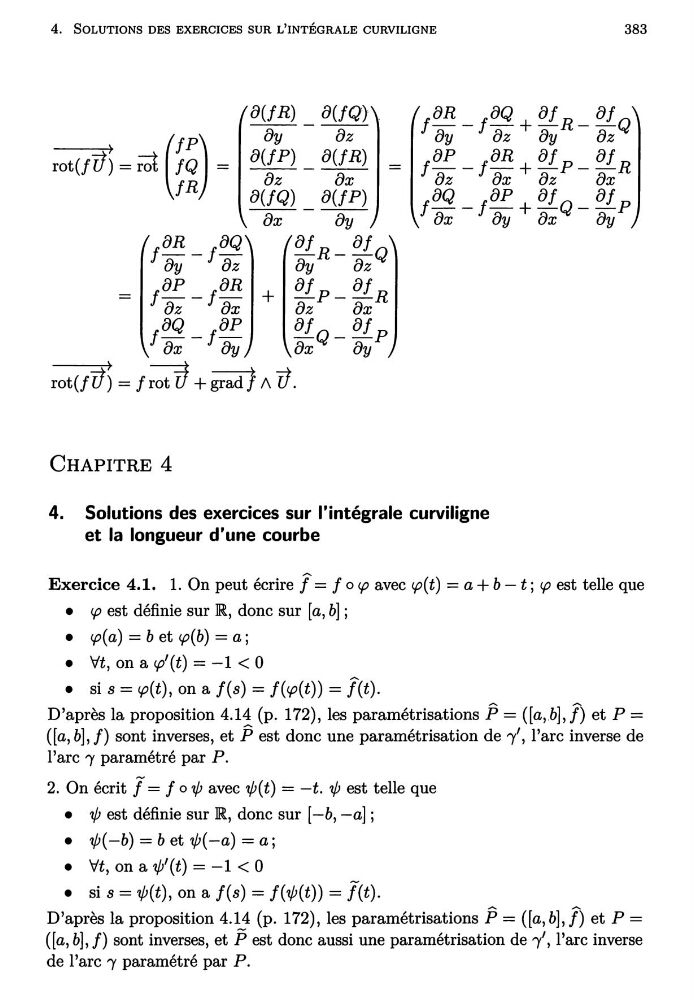
o(f R) o(f Q}
- - - - -
oy
oz
foR _ foQ +of R- of Q
oy
oz oy
oz
rot(!Û) =rot Gi) =
o(f P) o(f R)
- - - · - -
oz
ox
o(f Q) o(f P)
- - - - -
ox
oy
foP _ foR +of P _ of R
oz
ox oz
ox
foQ _ foP +of Q _of P
ox
oy ox
oy
foR _ foQ
of R _ of Q
oy
oz
oy
oz
foP _ foR + of P _ of R
oz
ox
oz
ox
f oQ _ foP
of Q _ of P
ox
oy
ox
oy
rot(JÛ) = f ;;;;[} + grad} /\ Û.
CHAPITRE 4
4. Solutions des exercices sur l'intégrale curviligne
et la longueur d'une courbe
Exercice 4.1. 1. On peut écrire Î = f o • c.p est définie sur ~. donc sur [a, b];
• c.p(a) = b et c.p(b) =a;
• Vt, on a c.p'(t) = -1 < 0
• sis= c.p(t), on a f(s) = f(c.p(t)) = Î(t).
D'après la proposition 4.14 (p. 172), les paramétrisations P = ([a,b], Î) et P =
([a, b], !) sont inverses, et Pest donc une paramétrisation de "( 1 , l'arc inverse de
l'arc ' Y paramétré par P.
2. On écrit f = f o 'I/; avec 'l/;(t) = -t. 'I/; est telle que
• 'I/; est définie sur ~. donc sur [-b, -a] ;
• 'l/;(-b) = b et 'l/;(-a) =a;
• Vt,ona'l/;'(t)=-1<0
• sis= 'l/;(t), on a f(s) = f('l/;(t)) = f{t).
D'après la proposition 4.14 (p. 172), les paramétrisations P = ([a, b], Î) et P =
([a, b], f) sont inverses, et Pest donc aussi une paramétrisation de "( 1 , l'arc inverse
de l'arc ' Y paramétré par P.
383
o(f R) o(f Q}
- - - - -
oy
oz
foR _ foQ +of R- of Q
oy
oz oy
oz
rot(!Û) =rot Gi) =
o(f P) o(f R)
- - - · - -
oz
ox
o(f Q) o(f P)
- - - - -
ox
oy
foP _ foR +of P _ of R
oz
ox oz
ox
foQ _ foP +of Q _of P
ox
oy ox
oy
foR _ foQ
of R _ of Q
oy
oz
oy
oz
foP _ foR + of P _ of R
oz
ox
oz
ox
f oQ _ foP
of Q _ of P
ox
oy
ox
oy
rot(JÛ) = f ;;;;[} + grad} /\ Û.
CHAPITRE 4
4. Solutions des exercices sur l'intégrale curviligne
et la longueur d'une courbe
Exercice 4.1. 1. On peut écrire Î = f o • c.p est définie sur ~. donc sur [a, b];
• c.p(a) = b et c.p(b) =a;
• Vt, on a c.p'(t) = -1 < 0
• sis= c.p(t), on a f(s) = f(c.p(t)) = Î(t).
D'après la proposition 4.14 (p. 172), les paramétrisations P = ([a,b], Î) et P =
([a, b], !) sont inverses, et Pest donc une paramétrisation de "( 1 , l'arc inverse de
l'arc ' Y paramétré par P.
2. On écrit f = f o 'I/; avec 'l/;(t) = -t. 'I/; est telle que
• 'I/; est définie sur ~. donc sur [-b, -a] ;
• 'l/;(-b) = b et 'l/;(-a) =a;
• Vt,ona'l/;'(t)=-1<0
• sis= 'l/;(t), on a f(s) = f('l/;(t)) = f{t).
D'après la proposition 4.14 (p. 172), les paramétrisations P = ([a, b], Î) et P =
([a, b], f) sont inverses, et Pest donc aussi une paramétrisation de "( 1 , l'arc inverse
de l'arc ' Y paramétré par P.