

bound by docking protein on ribosome. And stop of synthesis is released. Then the
protein is traversed lipid bilayer membrane and leader sequence is cut by signal
peptidase and sugar chain is added [16].
5.6.3 Study of Interaction in Membrane Model System
Mattress model is proposed in focusing matching between hydrophobic regions of
protein and lipid membrane. Supporting experiments for mattress model is shown as
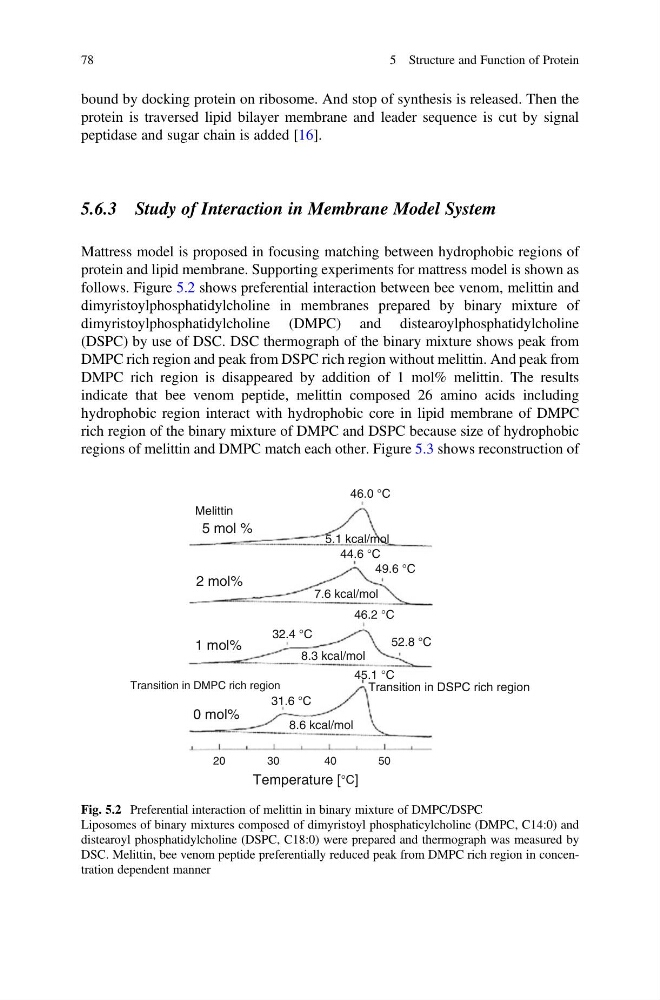
follows. Figure 5.2 shows preferential interaction between bee venom, melittin and
dimyristoylphosphatidylcholine in membranes prepared by binary mixture of
dimyristoylphosphatidylcholine (DMPC) and distearoylphosphatidylcholine
(DSPC) by use of DSC. DSC thermograph of the binary mixture shows peak from
DMPC rich region and peak from DSPC rich region without melittin. And peak from
DMPC rich region is disappeared by addition of 1 mol% melittin. The results
indicate that bee venom peptide, melittin composed 26 amino acids including
hydrophobic region interact with hydrophobic core in lipid membrane of DMPC
rich region of the binary mixture of DMPC and DSPC because size of hydrophobic
regions of melittin and DMPC match each other. Figure 5.3 shows reconstruction of
Melittin
20
30
40
50
Temperature [°C]
0 mol%
1 mol%
2 mol%
5 mol %
5.1 kcal/mol
7.6 kcal/mol
8.3 kcal/mol
8.6 kcal/mol
46.0 °C
44.6 °C
49.6 °C
46.2 °C
52.8 °C
32.4 °C
31.6 °C
45.1 °C
Transition in DMPC rich region
Transition in DSPC rich region
Fig. 5.2 Preferential interaction of melittin in binary mixture of DMPC/DSPC
Liposomes of binary mixtures composed of dimyristoyl phosphaticylcholine (DMPC, C14:0) and
distearoyl phosphatidylcholine (DSPC, C18:0) were prepared and thermograph was measured by
DSC. Melittin, bee venom peptide preferentially reduced peak from DMPC rich region in concentration dependent manner
78
5 Structure and Function of Protein
protein is traversed lipid bilayer membrane and leader sequence is cut by signal
peptidase and sugar chain is added [16].
5.6.3 Study of Interaction in Membrane Model System
Mattress model is proposed in focusing matching between hydrophobic regions of
protein and lipid membrane. Supporting experiments for mattress model is shown as
follows. Figure 5.2 shows preferential interaction between bee venom, melittin and
dimyristoylphosphatidylcholine in membranes prepared by binary mixture of
dimyristoylphosphatidylcholine (DMPC) and distearoylphosphatidylcholine
(DSPC) by use of DSC. DSC thermograph of the binary mixture shows peak from
DMPC rich region and peak from DSPC rich region without melittin. And peak from
DMPC rich region is disappeared by addition of 1 mol% melittin. The results
indicate that bee venom peptide, melittin composed 26 amino acids including
hydrophobic region interact with hydrophobic core in lipid membrane of DMPC
rich region of the binary mixture of DMPC and DSPC because size of hydrophobic
regions of melittin and DMPC match each other. Figure 5.3 shows reconstruction of
Melittin
20
30
40
50
Temperature [°C]
0 mol%
1 mol%
2 mol%
5 mol %
5.1 kcal/mol
7.6 kcal/mol
8.3 kcal/mol
8.6 kcal/mol
46.0 °C
44.6 °C
49.6 °C
46.2 °C
52.8 °C
32.4 °C
31.6 °C
45.1 °C
Transition in DMPC rich region
Transition in DSPC rich region
Fig. 5.2 Preferential interaction of melittin in binary mixture of DMPC/DSPC
Liposomes of binary mixtures composed of dimyristoyl phosphaticylcholine (DMPC, C14:0) and
distearoyl phosphatidylcholine (DSPC, C18:0) were prepared and thermograph was measured by
DSC. Melittin, bee venom peptide preferentially reduced peak from DMPC rich region in concentration dependent manner
78
5 Structure and Function of Protein