

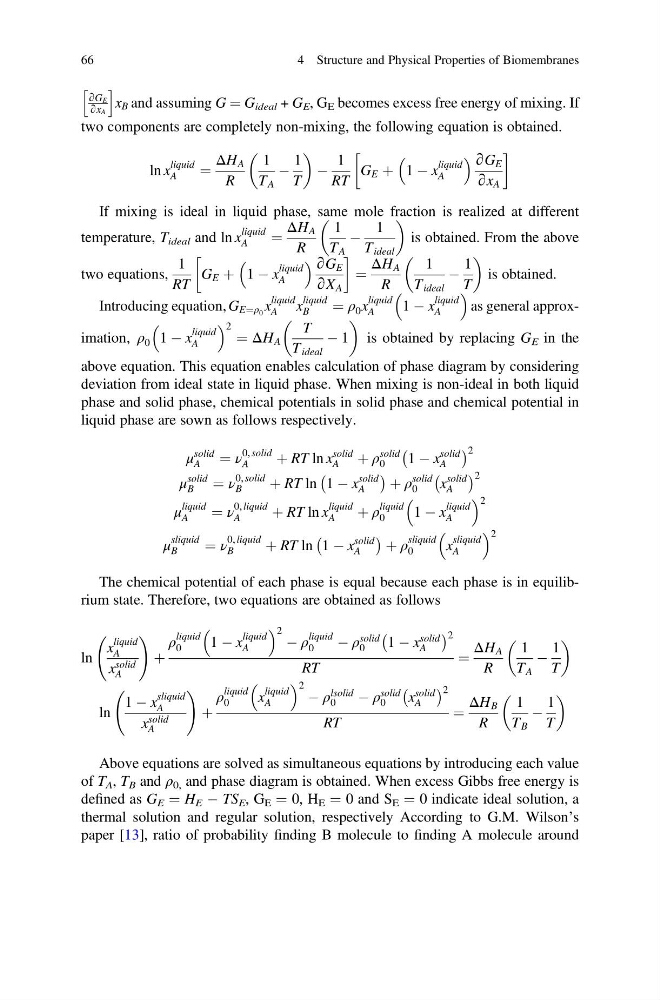
∂G E
∂x A
h i
x B and assuming G ¼ G ideal + G E , G E becomes excess free energy of mixing. If
two components are completely non-mixing, the following equation is obtained.
ln x
liquid
A
¼
ΔH A
R
1
T A
À
1
T
À
1
RT
G E þ 1 À x
liquid
A
∂G E
∂x A
!
If mixing is ideal in liquid phase, same mole fraction is realized at different
temperature, T ideal and ln x
liquid
A
¼
ΔH A
R
1
T A
À
1
T ideal
is obtained. From the above
two equations,
1
RT
G E þ 1 À x
liquid
A
∂G E
∂X A
!
¼
ΔH A
R
1
T ideal
À
1
T
is obtained.
Introducing equation, G E¼ρ 0 x
liquid
A
x
liquid
B
¼ ρ 0 x
liquid
A
1 À x
liquid
A
as general approximation, ρ 0 1 À x
liquid
A
2 ¼ ΔH A
T
T ideal
À 1
is obtained by replacing G E in the
above equation. This equation enables calculation of phase diagram by considering
deviation from ideal state in liquid phase. When mixing is non-ideal in both liquid
phase and solid phase, chemical potentials in solid phase and chemical potential in
liquid phase are sown as follows respectively.
μ
solid
A
¼ ν
0, solid
A
þ RT ln x
solid
A
þ ρ
solid
0
1 À x
solid
A
À
Á 2
μ
solid
B
¼ ν
0, solid
B
þ RT ln 1 À x
solid
A
À
Á þ ρ
solid
0
x
solid
A
À
Á 2
μ
liquid
A
¼ ν
0, liquid
A
þ RT ln x
liquid
A
þ ρ
liquid
0
1 À x
liquid
A
2
μ
sliquid
B
¼ ν
0, liquid
B
þ RT ln 1 À x
solid
A
À
Á þ ρ
sliquid
0
x
sliquid
A
2
The chemical potential of each phase is equal because each phase is in equilibrium state. Therefore, two equations are obtained as follows
ln
x
liquid
A
x
solid
A
!
þ
ρ
liquid
0
1 À x
liquid
A
2 À ρ
liquid
0
À ρ
solid
0
1 À x
solid
A
À
Á 2
RT
¼
ΔH A
R
1
T A
À
1
T
ln
1 À x
sliquid
A
x
solid
A
!
þ
ρ
liquid
0
x
liquid
A
2 À ρ
lsolid
0
À ρ
solid
0
x
solid
A
À
Á 2
RT
¼
ΔH B
R
1
T B
À
1
T
Above equations are solved as simultaneous equations by introducing each value
of T A , T B and ρ 0, and phase diagram is obtained. When excess Gibbs free energy is
defined as G E ¼ H E À TS E , G E ¼ 0, H E ¼ 0 and S E ¼ 0 indicate ideal solution, a
thermal solution and regular solution, respectively According to G.M. Wilson’s
paper [13], ratio of probability finding B molecule to finding A molecule around
66
4 Structure and Physical Properties of Biomembranes
∂x A
h i
x B and assuming G ¼ G ideal + G E , G E becomes excess free energy of mixing. If
two components are completely non-mixing, the following equation is obtained.
ln x
liquid
A
¼
ΔH A
R
1
T A
À
1
T
À
1
RT
G E þ 1 À x
liquid
A
∂G E
∂x A
!
If mixing is ideal in liquid phase, same mole fraction is realized at different
temperature, T ideal and ln x
liquid
A
¼
ΔH A
R
1
T A
À
1
T ideal
is obtained. From the above
two equations,
1
RT
G E þ 1 À x
liquid
A
∂G E
∂X A
!
¼
ΔH A
R
1
T ideal
À
1
T
is obtained.
Introducing equation, G E¼ρ 0 x
liquid
A
x
liquid
B
¼ ρ 0 x
liquid
A
1 À x
liquid
A
as general approximation, ρ 0 1 À x
liquid
A
2 ¼ ΔH A
T
T ideal
À 1
is obtained by replacing G E in the
above equation. This equation enables calculation of phase diagram by considering
deviation from ideal state in liquid phase. When mixing is non-ideal in both liquid
phase and solid phase, chemical potentials in solid phase and chemical potential in
liquid phase are sown as follows respectively.
μ
solid
A
¼ ν
0, solid
A
þ RT ln x
solid
A
þ ρ
solid
0
1 À x
solid
A
À
Á 2
μ
solid
B
¼ ν
0, solid
B
þ RT ln 1 À x
solid
A
À
Á þ ρ
solid
0
x
solid
A
À
Á 2
μ
liquid
A
¼ ν
0, liquid
A
þ RT ln x
liquid
A
þ ρ
liquid
0
1 À x
liquid
A
2
μ
sliquid
B
¼ ν
0, liquid
B
þ RT ln 1 À x
solid
A
À
Á þ ρ
sliquid
0
x
sliquid
A
2
The chemical potential of each phase is equal because each phase is in equilibrium state. Therefore, two equations are obtained as follows
ln
x
liquid
A
x
solid
A
!
þ
ρ
liquid
0
1 À x
liquid
A
2 À ρ
liquid
0
À ρ
solid
0
1 À x
solid
A
À
Á 2
RT
¼
ΔH A
R
1
T A
À
1
T
ln
1 À x
sliquid
A
x
solid
A
!
þ
ρ
liquid
0
x
liquid
A
2 À ρ
lsolid
0
À ρ
solid
0
x
solid
A
À
Á 2
RT
¼
ΔH B
R
1
T B
À
1
T
Above equations are solved as simultaneous equations by introducing each value
of T A , T B and ρ 0, and phase diagram is obtained. When excess Gibbs free energy is
defined as G E ¼ H E À TS E , G E ¼ 0, H E ¼ 0 and S E ¼ 0 indicate ideal solution, a
thermal solution and regular solution, respectively According to G.M. Wilson’s
paper [13], ratio of probability finding B molecule to finding A molecule around
66
4 Structure and Physical Properties of Biomembranes