

A molecule is shown as
x AB
x AA
¼
x B Áexp À
E AB
RT
ð
Þ
x A exp À
E AA
RT
ð
Þ
¼
x B
x A
Á exp
E AB ÀE AA
RT
À
Á ¼
x B ν A
x A ν B
¼ F AB where ν A
and ν B are mole volume of pure A and B, respectively. According to FloryHuggins’s theory of a thermal solution [14], excess free energy is shown as G E
¼ RT
P
x i Á ln
φ i
x i
where φ i and x i are volume fraction of component i and mole
fraction of component i, respectively. Wilson et al. define these mole fractions by use
of volume fractions f A and f B , and finally F AB ¼ 2exp À
ρ 0
4RT
À
Á À 1 at x A ¼ x B ¼ 1/2
because of symmetry of the system. Degree of non-miscibility ρ 0 shows probability
that a molecule finds homo molecule or hetero molecule around its self [13]. Phase
separation is observed in lipid membranes as correlating phenomenon of phase
transition.
Dimyristoyliphosphatidylcholine
(DMPC)
and
dimyristoylphosphatidylethanolamine (DMPE) have same acyl carbon of myristic
acid and their phase transition temperatures are 23
Cand 49
C, respectively. Binary
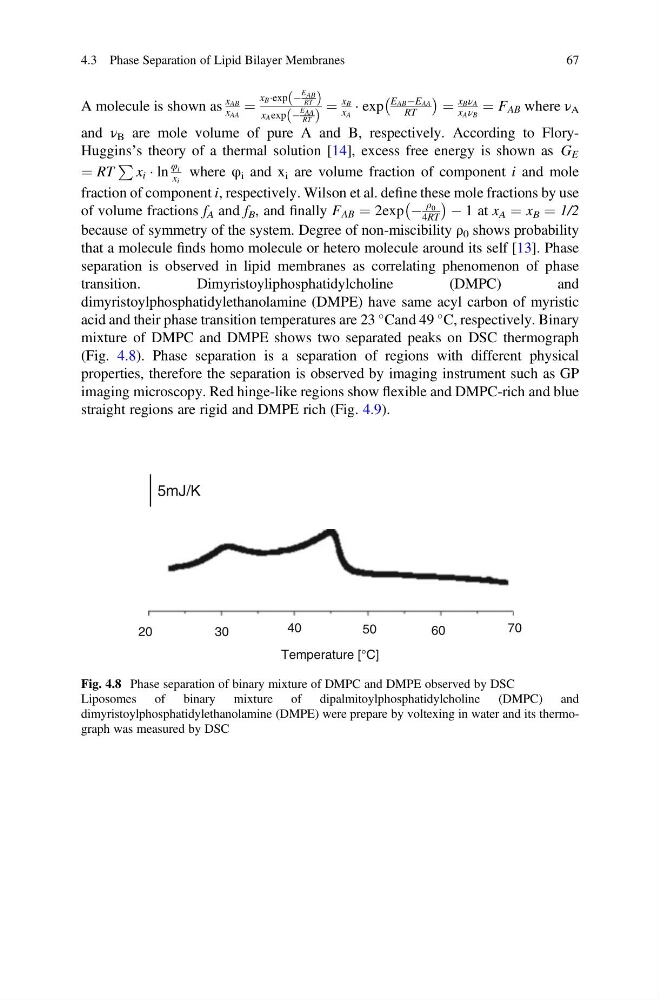
mixture of DMPC and DMPE shows two separated peaks on DSC thermograph
(Fig. 4.8). Phase separation is a separation of regions with different physical
properties, therefore the separation is observed by imaging instrument such as GP
imaging microscopy. Red hinge-like regions show flexible and DMPC-rich and blue
straight regions are rigid and DMPE rich (Fig. 4.9).
20
30
40
50
60
70
Temperature [°C]
5mJ/K
Fig. 4.8 Phase separation of binary mixture of DMPC and DMPE observed by DSC
Liposomes of binary mixture of dipalmitoylphosphatidylcholine (DMPC) and
dimyristoylphosphatidylethanolamine (DMPE) were prepare by voltexing in water and its thermograph was measured by DSC
4.3 Phase Separation of Lipid Bilayer Membranes
67
x AB
x AA
¼
x B Áexp À
E AB
RT
ð
Þ
x A exp À
E AA
RT
ð
Þ
¼
x B
x A
Á exp
E AB ÀE AA
RT
À
Á ¼
x B ν A
x A ν B
¼ F AB where ν A
and ν B are mole volume of pure A and B, respectively. According to FloryHuggins’s theory of a thermal solution [14], excess free energy is shown as G E
¼ RT
P
x i Á ln
φ i
x i
where φ i and x i are volume fraction of component i and mole
fraction of component i, respectively. Wilson et al. define these mole fractions by use
of volume fractions f A and f B , and finally F AB ¼ 2exp À
ρ 0
4RT
À
Á À 1 at x A ¼ x B ¼ 1/2
because of symmetry of the system. Degree of non-miscibility ρ 0 shows probability
that a molecule finds homo molecule or hetero molecule around its self [13]. Phase
separation is observed in lipid membranes as correlating phenomenon of phase
transition.
Dimyristoyliphosphatidylcholine
(DMPC)
and
dimyristoylphosphatidylethanolamine (DMPE) have same acyl carbon of myristic
acid and their phase transition temperatures are 23
Cand 49
C, respectively. Binary
mixture of DMPC and DMPE shows two separated peaks on DSC thermograph
(Fig. 4.8). Phase separation is a separation of regions with different physical
properties, therefore the separation is observed by imaging instrument such as GP
imaging microscopy. Red hinge-like regions show flexible and DMPC-rich and blue
straight regions are rigid and DMPE rich (Fig. 4.9).
20
30
40
50
60
70
Temperature [°C]
5mJ/K
Fig. 4.8 Phase separation of binary mixture of DMPC and DMPE observed by DSC
Liposomes of binary mixture of dipalmitoylphosphatidylcholine (DMPC) and
dimyristoylphosphatidylethanolamine (DMPE) were prepare by voltexing in water and its thermograph was measured by DSC
4.3 Phase Separation of Lipid Bilayer Membranes
67