

“Thermal ratchet” model, it has been assumed that the x axis is parallel to the
direction of the polymer, actin filament is straight; no bending is considered, and
that the membrane was replaced with a disk with a diffusion coefficient, D. The
external force, F, causes the constant drift of the disk: the velocity of which, V drift , is
related to the D value and F by the Einstein’s relation; V drift ¼ F (D/k B T ). The
quantity in the parentheses is equal to the inverse of the frictional coefficient of the
disk. Based on the structure of the reconstituted actin filament, a simplified model of
the protomer addition to the tip was adopted. Thus, because of the stagger between
two protofilaments in an actin filament, the actin filament was assumed to elongate
by half the protomer length, d along the filament axis. Peshkin et al. derived a
diffusion-reaction equation for the ratcheting action of the fluctuating and drifting
obstacle (the disk). They considered an ensemble of the filament tip and obtained a
function for the probability of the distribution of the filament tip, g(x), x being the
distance of the tip from the obstacle. The expression of g(x) was derived by solving a
system of differential equations, and they obtained the ensemble average of the
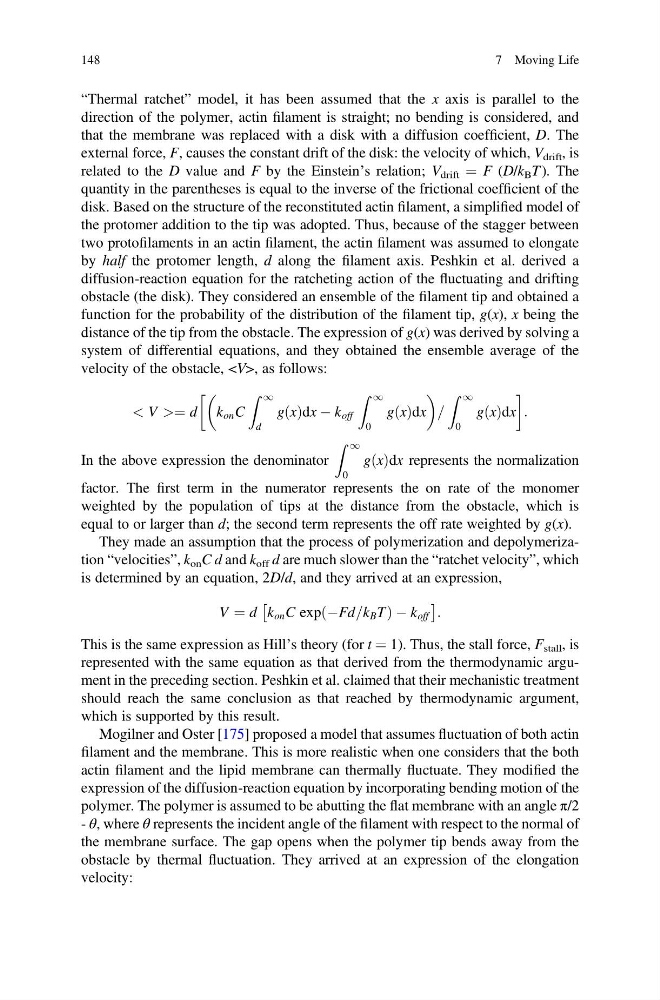
velocity of the obstacle,, as follows:
< V >¼ d k on C
Z 1
d
g x
ð Þdx À k off
Z 1
0
g x
ð Þdx
=
Z 1
0
g x
ð Þdx
!
:
In the above expression the denominator
Z 1
0
g x
ð Þdx represents the normalization
factor. The first term in the numerator represents the on rate of the monomer
weighted by the population of tips at the distance from the obstacle, which is
equal to or larger than d; the second term represents the off rate weighted by g(x).
They made an assumption that the process of polymerization and depolymerization “velocities”, k on C d and k off d are much slower than the “ratchet velocity”, which
is determined by an equation, 2D/d, and they arrived at an expression,
V ¼ d k on C exp ÀFd=k B T
ð
ÞÀk off
Â
à :
This is the same expression as Hill’s theory (for t ¼ 1). Thus, the stall force, F stall , is
represented with the same equation as that derived from the thermodynamic argument in the preceding section. Peshkin et al. claimed that their mechanistic treatment
should reach the same conclusion as that reached by thermodynamic argument,
which is supported by this result.
Mogilner and Oster [175] proposed a model that assumes fluctuation of both actin
filament and the membrane. This is more realistic when one considers that the both
actin filament and the lipid membrane can thermally fluctuate. They modified the
expression of the diffusion-reaction equation by incorporating bending motion of the
polymer. The polymer is assumed to be abutting the flat membrane with an angle π/2
- θ, where θ represents the incident angle of the filament with respect to the normal of
the membrane surface. The gap opens when the polymer tip bends away from the
obstacle by thermal fluctuation. They arrived at an expression of the elongation
velocity:
148
7 Moving Life
direction of the polymer, actin filament is straight; no bending is considered, and
that the membrane was replaced with a disk with a diffusion coefficient, D. The
external force, F, causes the constant drift of the disk: the velocity of which, V drift , is
related to the D value and F by the Einstein’s relation; V drift ¼ F (D/k B T ). The
quantity in the parentheses is equal to the inverse of the frictional coefficient of the
disk. Based on the structure of the reconstituted actin filament, a simplified model of
the protomer addition to the tip was adopted. Thus, because of the stagger between
two protofilaments in an actin filament, the actin filament was assumed to elongate
by half the protomer length, d along the filament axis. Peshkin et al. derived a
diffusion-reaction equation for the ratcheting action of the fluctuating and drifting
obstacle (the disk). They considered an ensemble of the filament tip and obtained a
function for the probability of the distribution of the filament tip, g(x), x being the
distance of the tip from the obstacle. The expression of g(x) was derived by solving a
system of differential equations, and they obtained the ensemble average of the
velocity of the obstacle,
< V >¼ d k on C
Z 1
d
g x
ð Þdx À k off
Z 1
0
g x
ð Þdx
=
Z 1
0
g x
ð Þdx
!
:
In the above expression the denominator
Z 1
0
g x
ð Þdx represents the normalization
factor. The first term in the numerator represents the on rate of the monomer
weighted by the population of tips at the distance from the obstacle, which is
equal to or larger than d; the second term represents the off rate weighted by g(x).
They made an assumption that the process of polymerization and depolymerization “velocities”, k on C d and k off d are much slower than the “ratchet velocity”, which
is determined by an equation, 2D/d, and they arrived at an expression,
V ¼ d k on C exp ÀFd=k B T
ð
ÞÀk off
Â
à :
This is the same expression as Hill’s theory (for t ¼ 1). Thus, the stall force, F stall , is
represented with the same equation as that derived from the thermodynamic argument in the preceding section. Peshkin et al. claimed that their mechanistic treatment
should reach the same conclusion as that reached by thermodynamic argument,
which is supported by this result.
Mogilner and Oster [175] proposed a model that assumes fluctuation of both actin
filament and the membrane. This is more realistic when one considers that the both
actin filament and the lipid membrane can thermally fluctuate. They modified the
expression of the diffusion-reaction equation by incorporating bending motion of the
polymer. The polymer is assumed to be abutting the flat membrane with an angle π/2
- θ, where θ represents the incident angle of the filament with respect to the normal of
the membrane surface. The gap opens when the polymer tip bends away from the
obstacle by thermal fluctuation. They arrived at an expression of the elongation
velocity:
148
7 Moving Life