

dL
dt
¼ 2:7 Â 116 exp 0:66tF
ð
ÞÀ1:1exp 0:66 1 À t
ð
ÞF
f
g
½
:
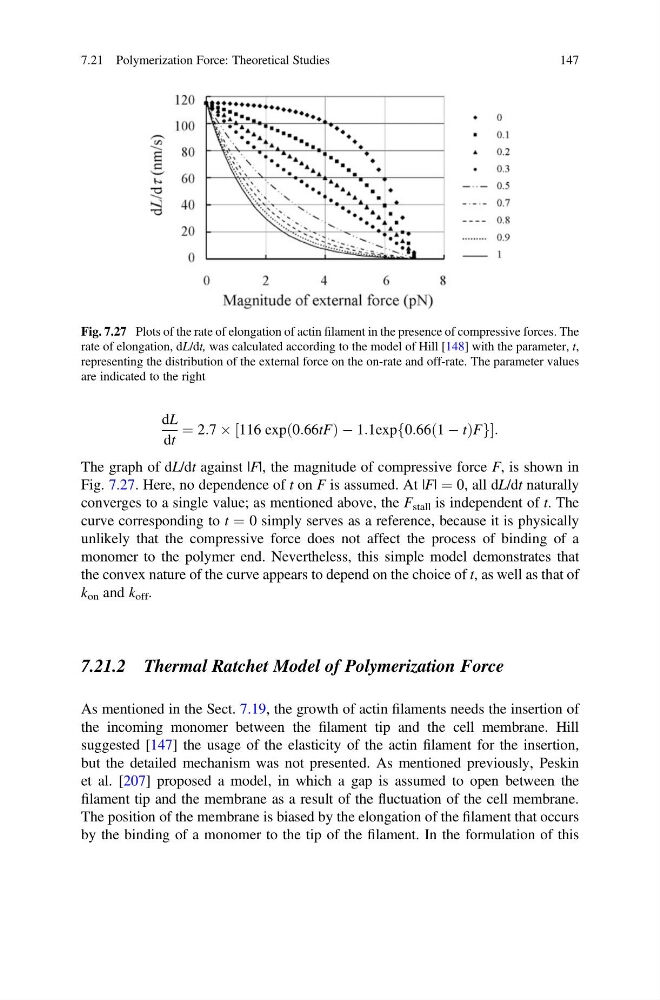
The graph of dL/dt against |F|, the magnitude of compressive force F, is shown in
Fig. 7.27. Here, no dependence of t on F is assumed. At |F| ¼ 0, all dL/dt naturally
converges to a single value; as mentioned above, the F stall is independent of t. The
curve corresponding to t ¼ 0 simply serves as a reference, because it is physically
unlikely that the compressive force does not affect the process of binding of a
monomer to the polymer end. Nevertheless, this simple model demonstrates that
the convex nature of the curve appears to depend on the choice of t, as well as that of
k on and k off .
7.21.2 Thermal Ratchet Model of Polymerization Force
As mentioned in the Sect. 7.19, the growth of actin filaments needs the insertion of
the incoming monomer between the filament tip and the cell membrane. Hill
suggested [147] the usage of the elasticity of the actin filament for the insertion,
but the detailed mechanism was not presented. As mentioned previously, Peskin
et al. [207] proposed a model, in which a gap is assumed to open between the
filament tip and the membrane as a result of the fluctuation of the cell membrane.
The position of the membrane is biased by the elongation of the filament that occurs
by the binding of a monomer to the tip of the filament. In the formulation of this
Fig. 7.27 Plots of the rate of elongation of actin filament in the presence of compressive forces. The
rate of elongation, dL/dt, was calculated according to the model of Hill [148] with the parameter, t,
representing the distribution of the external force on the on-rate and off-rate. The parameter values
are indicated to the right
7.21 Polymerization Force: Theoretical Studies
147
dt
¼ 2:7 Â 116 exp 0:66tF
ð
ÞÀ1:1exp 0:66 1 À t
ð
ÞF
f
g
½
:
The graph of dL/dt against |F|, the magnitude of compressive force F, is shown in
Fig. 7.27. Here, no dependence of t on F is assumed. At |F| ¼ 0, all dL/dt naturally
converges to a single value; as mentioned above, the F stall is independent of t. The
curve corresponding to t ¼ 0 simply serves as a reference, because it is physically
unlikely that the compressive force does not affect the process of binding of a
monomer to the polymer end. Nevertheless, this simple model demonstrates that
the convex nature of the curve appears to depend on the choice of t, as well as that of
k on and k off .
7.21.2 Thermal Ratchet Model of Polymerization Force
As mentioned in the Sect. 7.19, the growth of actin filaments needs the insertion of
the incoming monomer between the filament tip and the cell membrane. Hill
suggested [147] the usage of the elasticity of the actin filament for the insertion,
but the detailed mechanism was not presented. As mentioned previously, Peskin
et al. [207] proposed a model, in which a gap is assumed to open between the
filament tip and the membrane as a result of the fluctuation of the cell membrane.
The position of the membrane is biased by the elongation of the filament that occurs
by the binding of a monomer to the tip of the filament. In the formulation of this
Fig. 7.27 Plots of the rate of elongation of actin filament in the presence of compressive forces. The
rate of elongation, dL/dt, was calculated according to the model of Hill [148] with the parameter, t,
representing the distribution of the external force on the on-rate and off-rate. The parameter values
are indicated to the right
7.21 Polymerization Force: Theoretical Studies
147