

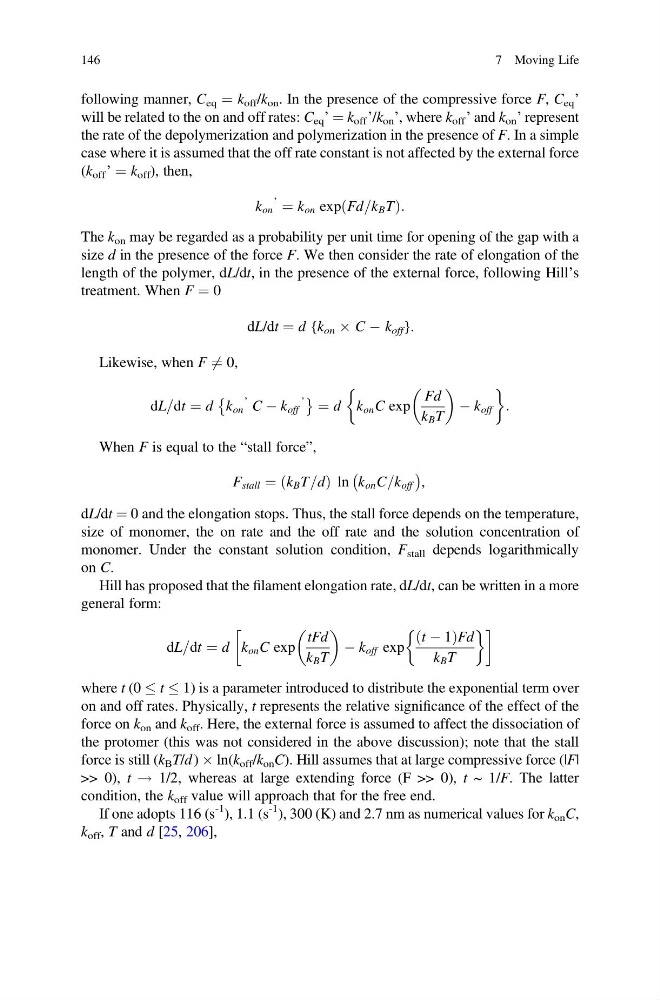
following manner, C eq ¼ k off /k on . In the presence of the compressive force F, C eq ’
will be related to the on and off rates: C eq ’ ¼ k off ’/k on ’, where k off ’ and k on ’ represent
the rate of the depolymerization and polymerization in the presence of F. In a simple
case where it is assumed that the off rate constant is not affected by the external force
(k off ’ ¼ k off ), then,
k on
’
¼ k on exp Fd=k B T
ð
Þ :
The k on may be regarded as a probability per unit time for opening of the gap with a
size d in the presence of the force F. We then consider the rate of elongation of the
length of the polymer, dL/dt, in the presence of the external force, following Hill’s
treatment. When F ¼ 0
dL/dt ¼ d {k on  C À k off }.
Likewise, when F 6 ¼ 0,
dL=dt ¼ d k on
’ C À k off
’
È
É ¼ d k on C exp
Fd
k B T
À k off
&
'
:
When F is equal to the “stall force”,
F stall ¼ k B T=d
ð
Þ ln k on C=k off
À
Á
,
dL/dt ¼ 0 and the elongation stops. Thus, the stall force depends on the temperature,
size of monomer, the on rate and the off rate and the solution concentration of
monomer. Under the constant solution condition, F stall depends logarithmically
on C.
Hill has proposed that the filament elongation rate, dL/dt, can be written in a more
general form:
dL=dt ¼ d k on C exp
tFd
k B T
À k off exp
t À 1
ð
ÞFd
k B T
&
' !
where t (0 t 1) is a parameter introduced to distribute the exponential term over
on and off rates. Physically, t represents the relative significance of the effect of the
force on k on and k off . Here, the external force is assumed to affect the dissociation of
the protomer (this was not considered in the above discussion); note that the stall
force is still (k B T/d ) Â ln(k off /k on C). Hill assumes that at large compressive force (|F|
>> 0), t ! 1/2, whereas at large extending force (F >> 0), t ~ 1/F. The latter
condition, the k off value will approach that for the free end.
If one adopts 116 (s
-1 ), 1.1 (s
-1 ), 300 (K) and 2.7 nm as numerical values for k on C,
k off , T and d [25, 206],
146
7 Moving Life
will be related to the on and off rates: C eq ’ ¼ k off ’/k on ’, where k off ’ and k on ’ represent
the rate of the depolymerization and polymerization in the presence of F. In a simple
case where it is assumed that the off rate constant is not affected by the external force
(k off ’ ¼ k off ), then,
k on
’
¼ k on exp Fd=k B T
ð
Þ :
The k on may be regarded as a probability per unit time for opening of the gap with a
size d in the presence of the force F. We then consider the rate of elongation of the
length of the polymer, dL/dt, in the presence of the external force, following Hill’s
treatment. When F ¼ 0
dL/dt ¼ d {k on  C À k off }.
Likewise, when F 6 ¼ 0,
dL=dt ¼ d k on
’ C À k off
’
È
É ¼ d k on C exp
Fd
k B T
À k off
&
'
:
When F is equal to the “stall force”,
F stall ¼ k B T=d
ð
Þ ln k on C=k off
À
Á
,
dL/dt ¼ 0 and the elongation stops. Thus, the stall force depends on the temperature,
size of monomer, the on rate and the off rate and the solution concentration of
monomer. Under the constant solution condition, F stall depends logarithmically
on C.
Hill has proposed that the filament elongation rate, dL/dt, can be written in a more
general form:
dL=dt ¼ d k on C exp
tFd
k B T
À k off exp
t À 1
ð
ÞFd
k B T
&
' !
where t (0 t 1) is a parameter introduced to distribute the exponential term over
on and off rates. Physically, t represents the relative significance of the effect of the
force on k on and k off . Here, the external force is assumed to affect the dissociation of
the protomer (this was not considered in the above discussion); note that the stall
force is still (k B T/d ) Â ln(k off /k on C). Hill assumes that at large compressive force (|F|
>> 0), t ! 1/2, whereas at large extending force (F >> 0), t ~ 1/F. The latter
condition, the k off value will approach that for the free end.
If one adopts 116 (s
-1 ), 1.1 (s
-1 ), 300 (K) and 2.7 nm as numerical values for k on C,
k off , T and d [25, 206],
146
7 Moving Life